The Panic Broadcast

panic.jpg

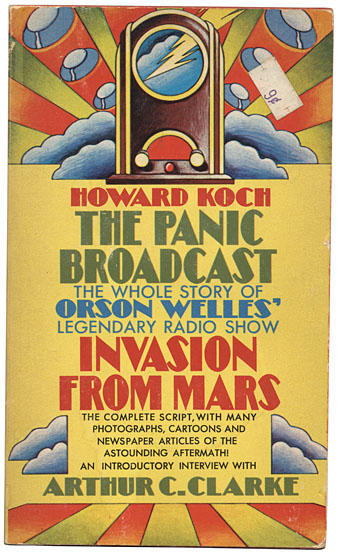
It was 70 years ago today—October 30, 1938—that Orson Welles and the Mercury Theatre traumatised American radio listeners with their brilliant adaptation of The War of the Worlds. I wrote about that recording last year so rather than repeat myself, here’s the final words from Howard Koch’s 1970 book about the play, The Panic Broadcast. (That’s the cover of my cheap paperback edition.) Koch was charged by Welles and producer John Houseman with the task of condensing and updating HG Wells’ novel and he ends his book with an examination of the lessons to be learned from the resulting hysteria. America’s current crop of demagogues on TV and radio—and the audiences prepared to take everything they say at face value—render his words as apposite now as they were forty years ago.

Meanwhile, how can we protect ourselves from politically biased information coming to us through the mass media? It isn’t as simple as dialing another station as in the case of the Martian scare. In my opinion, the only safeguard we have is the cultivation of a skeptical attitude toward all authority, to regard no person or office sacrosanct, to accept nothing that doesn’t accord with our experience and our knowledge acquired from other sources.

Most of my generation were brought up to give unquestioned obedience to authority, whether parental, religious or political. The result has been a compliant and conformist society that has tolerated a war every decade, all sorts of racial and economic inequities and a progressive spoliation of our planet. The management, shall we say, has been less than perfect.

But for the first time there are signs of a change and we have good reason to hope that the world won’t be lost by default. Today all authority is being questioned and challenged, especially by the young. The American people have become more concerned with public affairs on every level. They are taking less on faith; the individual intelligence is beginning to assert itself in self-protection and therein lies the promise of a society with the attributes for survival.

If the nonexistent Martians in the broadcast had anything important to teach us, I believe it is the virtue of doubting and testing everything that comes to us over the airwaves and on the printed pages – including those written by the author of this book.

The Mercury Theatre on the Air | An archive of the radio shows

Previously on { feuilleton }
The night that panicked America
War of the Worlds book covers

Sword on the rocks

swordsman.jpg

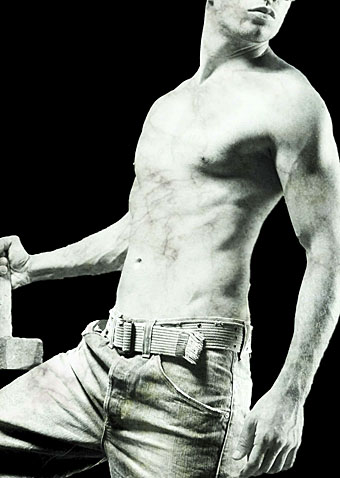
More unclothed men with swords and another vintage example, shamelessly swiped from Planet Fabulon.

And while we’re on the subject of men, the Kangaroo Court Theatre Company has another new adaptation of The Picture of Dorian Gray (Matthew Bourne’s dance version is still touring) opening this week at the Tabard Theatre, London.

A daring musical adaptation transports Oscar Wilde’s masterpiece into our own celebrity-obsessed, gossip-driven times – complete with shallow pop stars, sex-crazed artists and sleazy journalists. Co-produced with Kangaroo Court Theatre Company, this new adaptation of Dorian Gray updates the story incorporating new technology and an original musical score.

The company’s site has a few more details. The way they’re using the picture below to promote the work I think we can guess the audience they’re going for.

dorian.jpg

Elsewhere on { feuilleton }
The men with swords archive

Previously on { feuilleton }
Matthew Bourne’s Dorian Gray
John Osborne’s Dorian Gray
Dorian Gray revisited
The Picture of Dorian Gray I & II

Buchinger’s Boot Marionettes

buchinger1.jpg

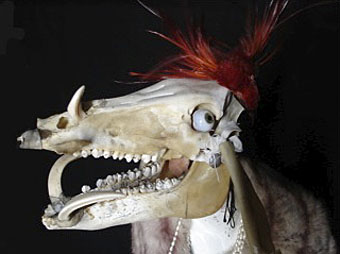
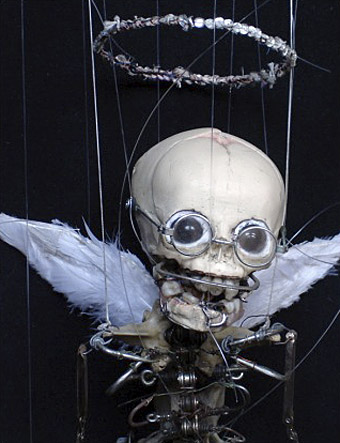
Buchinger’s Boot Marionettes was founded in 2004 by Patrick Sims, Mafalda da Camara and Richard Penny. This pair of grotesques are from a show entitled The Vestibular Folds, described as “a tale about the engraving and destruction of a metaphysical gramophone record”. There is more

buchinger2.jpg

Previously on { feuilleton }
Jan Švankmajer: The Complete Short Films

Dark horses

equus1.jpg

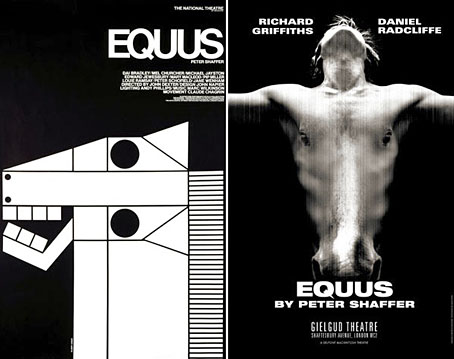
A juxtaposition of old and new theatre posters in the New York Times caught my eye this week, part of a feature about the current Broadway run of Peter Shaffer’s play. The news there, of course, has been Daniel Radcliffe’s on-stage nudity; understandable, perhaps, but celebrity trivia has overshadowed appraisal of Shaffer’s work as a piece of art.

What struck me seeing these was the two very different approaches to the same design problem. Given the subject matter, using an image of a horse is somewhat unavoidable as well as being immediately attractive since horses nearly always look good. The freight of historical and cultural association they carry is also one of the themes of the play. I really like the spare treatment of Gilbert Lesser’s 1976 poster for the National Theatre (left) and much prefer it to the new version used for the London and New York shows. The Lesser poster has the quality of a puzzle, matching the psychological piecing together of the story and Alan Strang’s accusation that Dysart the psychiatrist is always “playing games”. It also has a sinister quality lacking in the contemporary version; Shaffer’s Equus is an unforgiving god and the black eyes could refer to the blinded horses. The Photoshop horse looks altogether too mundane and is it my imagination or is the horse head misshapen slightly in order to fit the torso?

Continue reading “Dark horses”