Chris Watson: Oceanus Pacificus

watson.jpg

This is worth noting even though it’s nearly over, a short presentation of sound recordings by Chris Watson at the alt.gallery, Newcastle. Watson was a founder member of one of my favourite groups of the post-punk era, Cabaret Voltaire. He left CV in 1981 and shortly thereafter formed The Hafler Trio, an experimental audio outfit with whom I conducted some correspondence for a couple of years. I still have a letter somewhere signed by the group authorising me to act (creatively) on their behalf, a licence I’m sorry to say I never took advantage of beyond sneaking the name of their enigmatic mentor, Robert Spridgeon, into the Thackery T Lambshead Pocket Guide to Eccentric and Discredited Diseases. Watson today is an internationally renowned wildlife sound recordist, responsible for a number of stunning CDs on the Touch label, as well as much work for television documentaries. The alt.gallery exhibition runs to August 6, 2008.

Oceanus Pacificus brings the sounds of the largest ocean, encompassing almost a third of our planet, into one of the UK’s smallest galleries. This unique four channel sound installation is created from nighttime underwater recordings of the Pacific Ocean.

Recorded at the depth of three metres, reflecting the exact physical dimensions of the gallery space, the installation presents underwater voices, rhythms and movements rarely heard by the human ear. The ebb and flow of the Humboldt Current creates a seductive and harmonic rhythm as cold water wells up from the depths, drawing up the sounds of life.

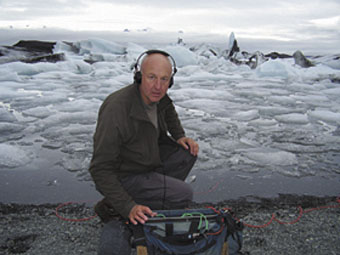
The recordings were made on location around the Galapagos Islands 1000km off the coast of Ecuador, using a pair of Dolphin Ear Pro Hydrophones onto a NAGRA ARES-PII digital audio recorder. The four hydrophones were fixed on a square wooden rig and suspended three metres below the surface at night to capture the voices and rhythms of this hostile environment.

Chris Watson is a sound recordist specialising in natural history with a particular and passionate interest in recording the wildlife sounds of animals, habitats and atmospheres from around the world. He is interested in the quality, depth and diversity of sounds produced by water, from single drops to streams, ice sheets, glaciers, waterfalls and oceans. He has described the sounds of water as “the music of another medium”.

He is one of the most prolific and versatile figures working in sound today. In 1971 he was a founder member of the influential Sheffield-based experimental music group Cabaret Voltaire and in 1981 was a member of The Hafler Trio. His sound recording career began in 1981 when he joined Tyne Tees Television. Since then he has worked with David Attenborough on BBC TV productions such as The Life of Birds and The Blue Planet.  In 1998 he won a BAFTA for Best Factual Recording for The Life of Birds.

He has produced various sound installations, including Whispering in the Leaves commissioned by AV Festival 08 and Forma. From 19 July – 2 November he will be presenting the sound installation Cima Verde as part of Manifesta 7 in Italy.

The 7” record Oceanus Pacificus was released by Touch in 2007 as part of the Touch Sevens series of 7” vinyl only releases. For further information please visit www.touchmusic.org.uk/touchsevens.

www.chriswatson.net

Previously on { feuilleton }
Max Eastley’s musical sculptures
The Avant Garde Project

John Osborne’s Dorian Gray

dg1.jpg

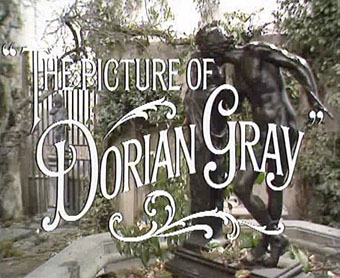
I wrote recently about John Selwyn Gilbert’s television play, Aubrey, an hour-long drama concerning the artist Aubrey Beardsley. The play was only screened once in 1982 and, like most one-off studio works of the period, is unavailable on DVD. John Osborne’s 1976 adaptation of The Picture of Dorian Gray is a welcome exception to this neglect and can be acquired in a box set along with three BBC productions of Wilde’s plays and a more recent Wilde documentary.

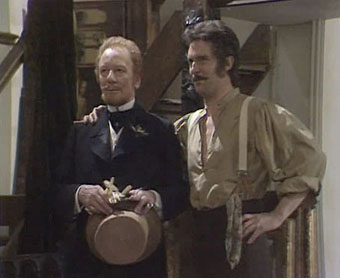
The stage plays are decent enough although the cast in the 1952 film version of The Importance of Being Earnest takes some beating. Dorian Gray is for me the essential work in the collection, even if its 100-minute running time cuts the story to the bone. The principal attraction in an entirely studio-bound work with few actors is the leads, and for this we have two great performances from John Gielgud as Lord Henry and Jeremy Brett as artist Basil Hallward. The tragic Dorian is played by Peter Firth who has difficulty keeping up with these heavyweights, especially in the later scenes when the story concentrates more fully on his predicament. Matters aren’t helped by his Yorkshire accent which frequently rises to the surface in a manner that would surely raise eyebrows in Mayfair drawing rooms.

dg2.jpg

Lord Henry & Basil Hallward admire the portrait.

Continue reading “John Osborne’s Dorian Gray”

Aubrey by John Selwyn Gilbert

aubrey00.jpg

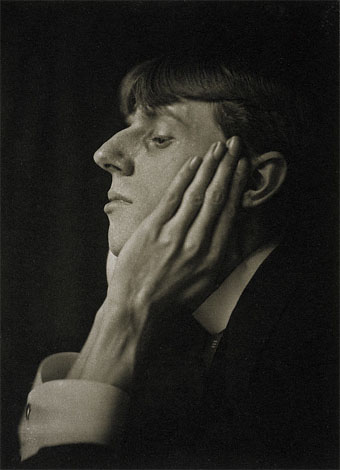
Aubrey Beardsley photographed by Frederick Evans (1894).

I’ve been going through the Coulthart VHS library recently, transferring to DVD recordings which can’t be purchased or found online. Among these is a drama from the BBC’s Playhouse strand, Aubrey by John Selwyn Gilbert, which was broadcast in 1982. This drama follows the life of artist Aubrey Beardsley from the time of Oscar Wilde’s arrest in April 1895—which event resulted in Beardsley losing his position at The Yellow Book—through the foundation of The Savoy magazine, to his tubercular death in March 1898.

aubrey01.jpg

John Dicks as Aubrey.

Playhouse was a BBC 2 equivalent of Play for Today (which usually ran on BBC 1) and Aubrey, like many other dramas of the period, was shot on video in the studio. This was done for convenience as well as being cheaper than shooting on film, since scenes could be filmed using several cameras simultaneously. The drawback is that the image looks very harsh, and historical works such as this often seem unreal and artificial as a result. If you can forgive this deficiency, Aubrey was an excellent production with some great performances, especially Ronald Lacey as Leonard Smithers and Rula Lenska as Aubrey’s sister, Mabel. The details of Beardsley’s life are very accurate, down to his beloved Mantegna prints on the walls, and many of the scenes are arranged to correspond with his drawings, the production design being largely monochrome.

Continue reading “Aubrey by John Selwyn Gilbert”

Robert Rauschenberg, 1925–2008

rauschenberg.jpg

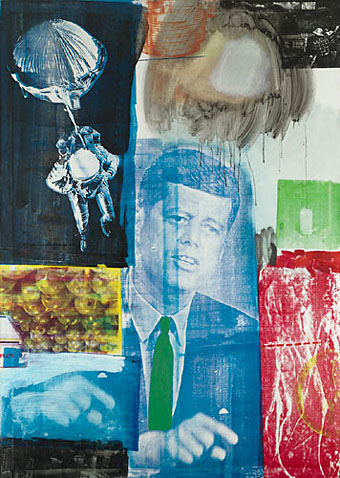
Retroactive I (1964).

My youthful enthusiasm for art acquainted me with the name of Robert Rauschenberg (who died two days ago) earlier than most. Surrealism and Pop Art held an appeal that was immediate, if rather superficially appreciated at the time, and it was seeing works from both those movements which were the most memorable aspect of my first visit to the Tate Gallery when I was 13. Later on when I was reading JG Ballard’s stories and essays in back numbers of New Worlds, Rauschenberg was one of a handful of artists who seemed to depict in visual terms what Ballard was describing in words. In this respect Robert Hughes’s discussion of the “landscape of media” (Ballard’s common phrase would be “media landscape”) below is coincidental but significant. Retroactive I was painted a couple of years before Ballard began the stories that would later become The Atrocity Exhibition and it could easily serve as an illustration for that book.

There are and will be plenty of words written elsewhere about Rauschenberg’s work and influence. I’ll note here his inclusion in the list of gay artists at GLBTQ for his creative and personal partnership with another great Pop artist, Jasper Johns.

One of the artists (television) most affected in the Sixties was Rauschenberg. In 1962, he began to apply printed images to canvas with silkscreen—the found image, not the found object, was incorporated into the work. “I was bombarded with TV sets and magazines,” he recalls, “by the refuse, by the excess of the world … I thought that if I could paint or make an honest work, it should incorporate all of these elements, which were and are a reality. Collage is a way of getting an additional piece of information that’s impersonal. I’ve always tried to work impersonally.” With access to anything printed, Rauschenberg could draw on an unlimited bank of images for his new paintings, and he set them together with a casual narrative style. In heightening the documentary flavour of his work, he strove to give canvas the accumulative flicker of a colour TV set. The bawling pressure of images—rocket, eagle, Kennedy, crowd, street sign, dancer, oranges, box, mosquito—creates an inventory of modern life, the lyrical outpourings of a mind jammed to satiation with the rapid, the quotidian, the real. In its peacock-hued, electron-sweetbox tints, this was an art that Marinetti and the Berlin Dadaists would have recognized at once: an agglomeration of memorable signs, capable of facing the breadth of the street. Their subject was glut.

Rauschenberg’s view of this landscape of media was both affectionate and ironic. He liked excavating whole histories within an image—histories of the media themselves. A perfect example is the red patch at the bottom right corner of Retroactive I. It is a silkscreen enlargement of a photo by Gjon Mili, which he found in Life magazine. Mili’s photograph was a carefully set-up parody, with the aid of a stroboscopic flash, of Duchamp’s Nude Descending a Staircase, 1912. Duchamp’s painting was in turn based on Marey‘s photos of a moving body. So the image goes back through seventy years of technological time, through allusion after allusion; and a further irony is that, in its Rauschenbergian form, it ends up looking precisely like the figures of Adam and Eve expelled from Eden in Masaccio’s fresco for the Carmine in Florence. This in turn converts the image of John Kennedy, who was dead by then and rapidly approaching apotheosis as the centre of a mawkish cult, into a sort of vengeful god with a pointing finger, so fulfilling the prophecy Edmond de Goncourt confided to his journal in 1861:

“The day will come when all the modern nations will adore a sort of American god, about whom much will have been written in the popular press; and images of this god will be set up in the churches, not as the imagination of each individual painter may fancy him, but fixed, once and for all, by photography. On that day civilization will have reached its peak, and there will be steam-propelled gondolas in Venice.”

Robert Hughes, The Shock of the New (1980).

Previously on { feuilleton }
Transfer drawings by Robert Rauschenberg
Jasper Johns
Michael Petry’s flag
JG Ballard book covers