Bohren & Der Club Of Gore

bohren.jpg

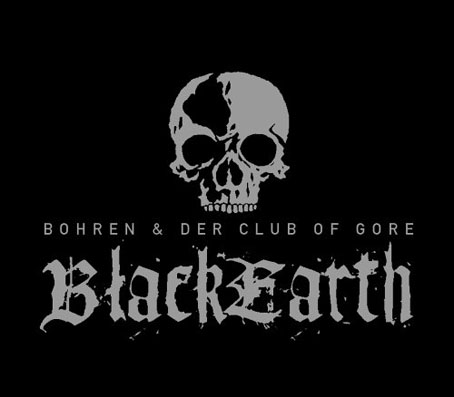
Black Earth by Bohren & Der Club Of Gore.

How to sustain the atmosphere of something you’ve enjoyed without flogging the work itself to death by repeated viewing? In the case of Twin Peaks, the subject of yesterday’s post, you can indulge yourself with spin-off merchandise like this Garmonbozia T-shirt. Or you could try playing the Twin Peaks Murder Mystery Board Game. I own the latter and while it provides some amusement the reduction of the first season’s enigmas to a set of board game rules doesn’t really work that well. Better by far are the two soundtrack CDs by Angelo Badalamenti, Twin Peaks and Fire Walk With Me, and the first Julee Cruise album, Floating Into The Night. And if that’s still not enough, there’s always Bohren & Der Club Of Gore.

Bohren… are a German “doom jazz” outfit whose origins in the hardcore scene and their enthusiasm for Black Sabbath explains both their name and the appearance of CD covers like the one for Black Earth (2002). But the music within contradicts all expectations. I was first alerted to them a few years ago when I saw them described as being “like the Twin Peaks soundtrack”. An initial “yeah, sure…” scepticism crumbled upon hearing their third album, Sunset Mission (2000), which really does sound like a continuation of Angelo Badalamenti’s slow, dark jazz scores. The fourth album, Black Earth, is better in many ways since it sounds less derivative, further reducing the rhythms to a slow crawl in the manner of doom metal band Earth. In place of the riffs of the doom-meisters you get a sullen saxophone wailing in the dark. Black Earth was followed by the even more minimal Geisterfaust (2005) which happens to have a blue flower on its cover. Coincidence or not? Their most recent album, Dolores (2008), lets some light return with an organ and vibraphone augmenting the slow evolution of each piece. Bohren & Der Club Of Gore are a great band who deserve wider recognition. If you’re a Lynch enthusiast then Sunset Mission and Black Earth are the ones to go for, I’ve been playing them continually all week.

MySpace page
Prowler | Midnight Black Earth

Previously on { feuilleton }
Through the darkness of future pasts
Earth in Manchester

Through the darkness of future pasts

peaks1.jpg

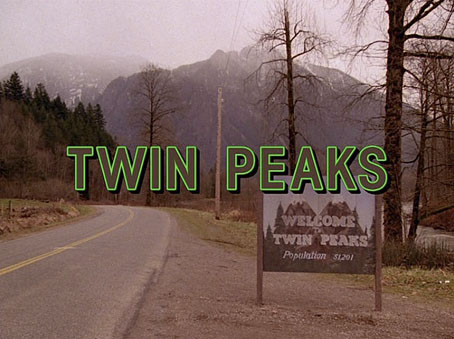
Having spent the past two weeks re-watching the whole run of Twin Peaks, and following that with David Lynch’s 1992 prequel, Fire Walk With Me, I feel I owe the producers of these works a note of apology. Being a long-time Lynchophile I eagerly watched every episode of Twin Peaks when it was first screened by the BBC in 1991, and while I thoroughly enjoyed the first fifteen episodes I grew increasingly dismayed with the series as the principal writer and director wandered off halfway through and the whole thing lost focus. There was a return to form with the very last episode, and Fire Walk With Me is great despite some flaws, a film I much prefer to the later Lost Highway, but that disappointment meant I’d never tried watching the whole series again until now, courtesy of a very reasonably-priced Gold Box Edition (thanks, Fopp).

peaks2.jpg

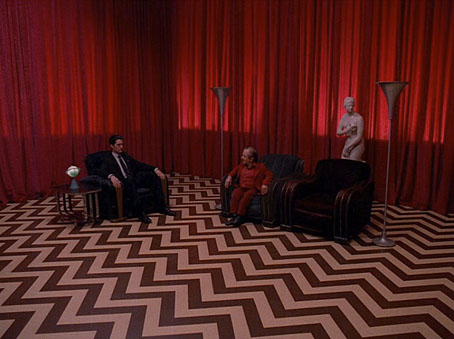
Kyle MacLachlan and Michael J. Anderson.

There were a number of surprises: first of all the main story hangs together better than I remembered, starting with the investigation into Laura Palmer’s death, grading to the cat-and-mouse game with rogue FBI agent Windom Earle, then looping back via the Black Lodge business in the final episode and Fire Walk With Me to Laura Palmer again. The sub-plots in season two are still a mix of the annoying (all the Dick Tremayne stuff) or the pointless (the unconvincing attempt to put James Hurley into a Black Widow ménage)—and the episode directed by Diane Keaton is positively amateurish—but if you stick with Agent Cooper all is well. Aside from the content lapses the quality of the whole thing was a delight, having watched the series originally with mono sound on a TV with a fuzzy picture. There are many great performances which benefit from the DVD mastering, among which I’d choose Kyle MacLachlan, Sherilyn Fenn, and especially Ray Wise as Leland Palmer whose role is by turns comic, terrifying, and ultimately tragic when he comes to terms with the horror of his predicament.

The best episodes are all Lynch-directed, of course, and I hadn’t realised before that the climax of the first story arc, the murder of Maddy Ferguson, is episode 15, right in the middle of the run. And I had the opportunity this time to do something I’m sure many Lynch-heads have done already, namely watch Fire Walk With Me after the final episode as though it’s episode 31. Seeing the film this way deepens the whole experience despite obvious disjunctions such as the slightly older cast and Donna Hayward being played by a different actor altogether. (In a David Lynch film this perhaps doesn’t matter too much.) What’s most thrilling is the realisation that Lynch has done something here which seems almost unique by joining the end of his otherwise unfinished story to its beginning; Laura Palmer’s life and death becomes a Möbius strip in which questions of ends or beginnings are negated. And why not when the Red Room is an apparently timeless space?

peaks3.jpg

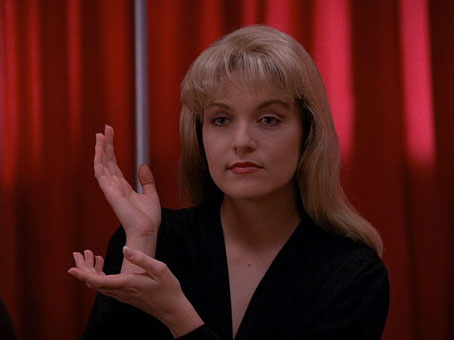
Sheryl Lee.

I could enthuse at length about the musical moments which are always a high spot in Lynchland—Julee Cruise’s appearances, Audrey’s dance, Little Jimmy Scott (!) in The Black Lodge—but if you’ve seen these you’ll know to what I refer. If you haven’t, well…your life is a hollow sham. Now that we’re in the month of the Gift Apocalypse I’d thoroughly recommend the Twin Peaks box as a purchase for anyone who likes the weird stuff. A feast of garmonbozia awaits.

Previously on { feuilleton }
David Lynch window displays
Patrick McGoohan and The Prisoner
David Lynch in Paris
Inland Empire

Gilliam’s shaver and Bovril by electrocution

pears.jpg

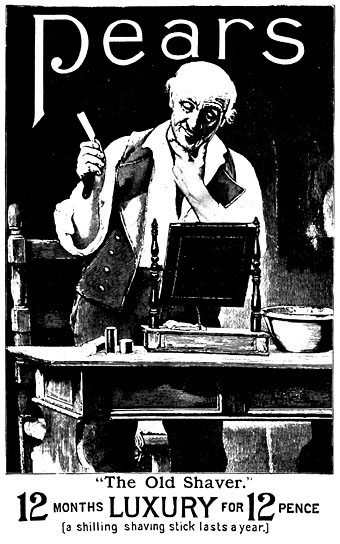
Pears Soap ad, Illustrated London News, March 16, 1895.

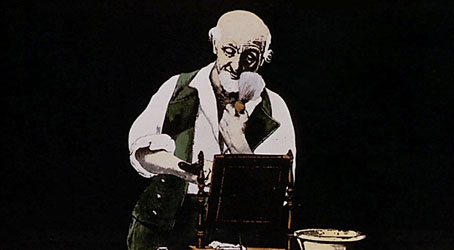
I’ve been working feverishly this week to complete page designs for The Thackery T. Lambshead Cabinet of Curiosities which will be published next year by HarperCollins. This is a sequel of sorts to 2003’s Thackery T. Lambshead Pocket Guide to Eccentric and Discredited Diseases to which I was also a contributor and designer. Ann and Jeff VanderMeer are editing the new collection, and Jeff has posted a couple of teaser introductions to the contents here and here. Gabriel in yesterday’s comments mentioned Terry Gilliam’s animations for the Monty Python TV series, something I was reminded of today while leafing through a 1968 collection of old advertising graphics looking for suitable pictures. Victorian Advertisements was compiled by Leonard de Vries and Ilonka van Amstel, and its Pears Soap ad (above) is obviously the source of Gilliam’s animation (below) showing a man lathering his face then beheading himself with a straight razor, a gag which features in both the TV series and the first Monty Python feature film And Now For Something Completely Different.

gilliam.jpg

And Now For Something Completely Different (1971).

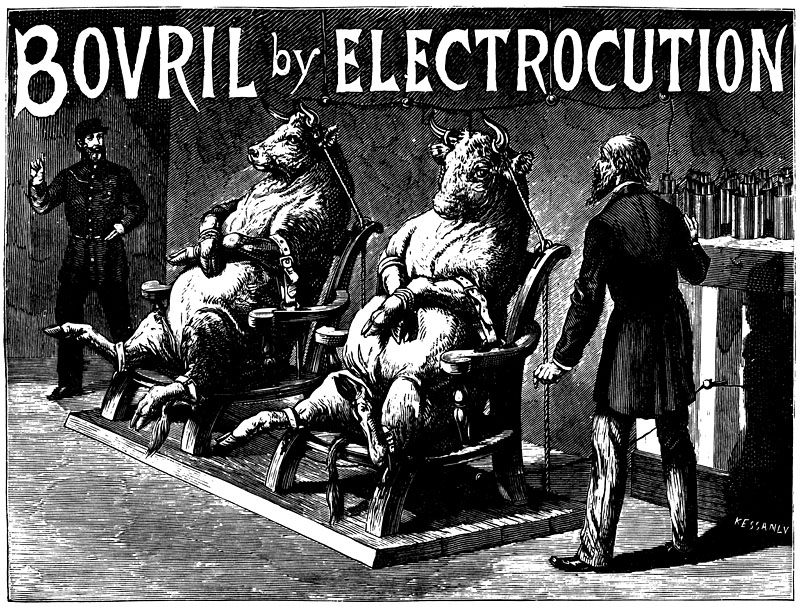
It’s easy to see what would have attracted Gilliam to the De Vries book when it’s filled with bizarre or grotesque ads like the Bovril one below; someone evidently decided that the meaty drink ought to be promoted via the novelty of electricity.

bovril.jpg

Bovril ad from The Graphic, Christmas number, 1891.

De Vries features many ads for electrical products, not all of them genuine or even likely:

Pseudo-science began to play the part it still plays in therapeutic advertising. Electric light was, by the end of the century, being installed in theatres and restaurants and in some private houses. To what other uses could the magnetic fluid be put? Electricity was the new magic and all kinds of quarters began to exploit its possibilities—and impossibilities. The Medical Battery Company Limited, of Oxford Street, assured the public that its Electropathic Belt had “restored thousands of sufferers to health and vigour”, and had “proved an inestimable blessing to the weak and languid”. It was particularly recommended for “weak men suffering from the effect of youthful errors”. Did the weak men in question wear the contraption in bed? Women also could benefit by it, and one is a little surprised to find this and other remedies for “female irregularities” so frankly discussed. An Electric Corset was the “Very Thing” for ladies. One can only wonder how the batteries if there were any operated. And what could possibly be meant by an “electric” towel, and how could failing sight be cured by an “eye battery”?

There’s also an Electric Hair Brush which gives “hope for the bald” without explaining how it differs from an ordinary brush. Several of the pieces in the new Lambshead volume will be exploring similarly eccentric territory. Watch this space for further details.

Previously on { feuilleton }
Portuguese Diseases
Pasticheur’s Addiction
Short films by Walerian Borowczyk

Weekend links 36

high_society.jpg

Mervyn Peake’s Caterpillar from Alice’s Adventures in Wonderland finds itself used to promote High Society, an exhibition at the Wellcome Collection devoted to the long history of human drug-taking. There’s more about the exhibition here and also an accompanying book by Mike Jay from Thames & Hudson. Related: The Most Dangerous Drug:

A group of British drug experts gathered by the Independent Scientific Committee on Drugs (ISCD) rated alcohol higher than most or all of the other drugs for health damage, mortality, impairment of mental functioning, accidental injury, economic cost, loss of relationships, and negative impact on community.

• Unless the magazine Man, Myth & Magic was advertised on TV in 1970 (and I suspect it would have been) Austin Osman Spare’s work has never been seen on British television, certainly not in any detail or with a credit to the artist. This week the BBC finally paid him some attention with a brief spot on The Culture Show as a result of the Fallen Visionary exhibition which is still running (until November 14) in London. Alan Moore, Fulgur‘s Robert Ansell and others attempt to summarise Spare’s career in seven minutes.

fujita.jpg

Neil Fujita designs: Mingus Ah Um (1959) and The Godfather (1969).

• RIP graphic designer Neil Fujita. Related:

“By taking the “G” and extending it to the “D,” I created a house for “God.” The way the word was designed was part of the logo and so was the type design. So when Paramount Pictures does a film version or Random House, which bought out the book from Putnam, does another Godfather book, I still get a design credit. In fact, before the first Godfather film opened in New York I saw a huge billboard going up in Times Square with my design on it. I actually got them to stop work on it until we were able to come to an agreement.” Waxing Chromatic: An Interview with S. Neil Fujita

French SF illustration. Related: Where did science fiction come from? A primer on the pulps, a feature by Jess Nevins with some of the craziest covers you’ll see this month.

• Gay-bashers in 1970s San Francisco had to beware the wrath of the Lavender Panthers.

• More Marian Bantjes as she discusses her work in an audio interview.

Music from Saharan cellphones.

Origami Beauty Shots.

Krautrock.com

Better Git It In Your Soul (1959) by Charles Mingus.

Weekend links 34

austin.jpg

Halloween in Austin, Texas this year will look and sound like this.

• “Blade Runner will prove invincible“: Philip K Dick’s letter of praise to the film’s producers. Related: one of the Blade Runner designers, Syd Mead, has recently styled New York’s Bar Basque and Foodparc.

• “I decided to go into fields where mathematicians would never go because the problems were badly stated…I have played a strange role that none of my students dare to take.” RIP Benoît Mandelbrot.

Science and poetry: “a richly vexed topic badly in need of rethinking”. Related: Why the Singularity isn’t going to happen.

• In case you missed this week’s earlier announcement, a reminder that I was interviewed at Coilhouse. My vanity: it knows no bounds.

• Franklin Booth’s illustrations for The Flying Islands of the Night (1913) by James Whitcomb Riley.

On the Verge (1950) by Maurice Sandoz, illustrated by Salvador Dalí. Also this and this.

bowie.jpg

Bowie Sphinx, 1969. Photo by Brian Ward.

The Laughing Gnostic: David Bowie and the Occult.

• “Moonlighting as a Conjurer of Chemicals“: Isaac Newton’s alchemical interests.

• “A sense of otherness that goes right back“: Alan Garner at Alderley Edge.

Jimmy’s End—Alan Moore’s new feature film and spin-off TV series.

A Guide to the New Ruins of Great Britain by Owen Hatherley.

• The It Gets Better Project now has a dedicated website.

Quicksand (1971) by David Bowie.