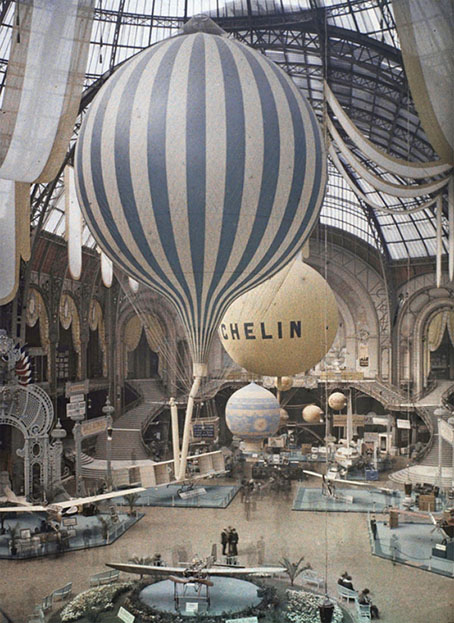
Balloons in the Grand Palais

balloons1.jpg

Autochrome by Léon Gimpel.

The Grand Palais exhibition hall in Paris is one of the few sites remaining from the Exposition Universelle of 1900 (see yesterday’s post), and is still in use today as a venue for art exhibits, fashion shows and the like. The huge and graceful canopy ceiling makes it a far better venue for art events than the Turbine Hall in Tate Modern, London, which suffers from being narrow, lightless and bisected by a concrete walkway.

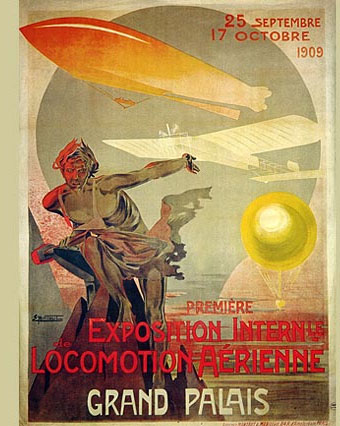
palaisposter.jpg

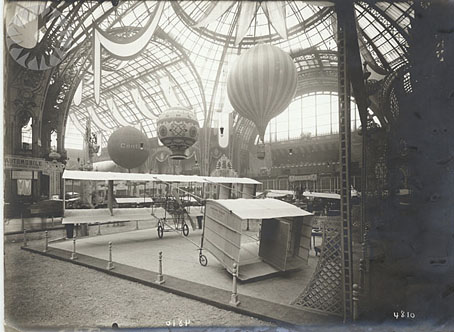
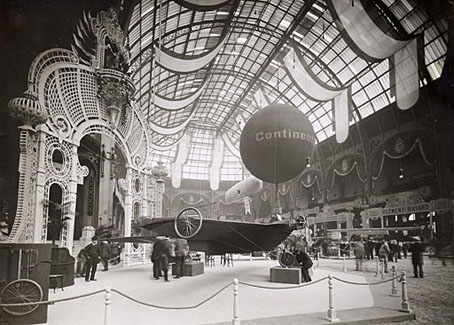
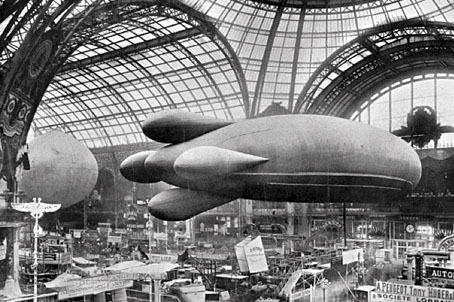
Nine years after the Exposition the first Paris Air Show was held at the Grand Palais giving us these photos of the place filled with a variety of balloons and a blimp. I’m wondering now whether you could fit an entire Zeppelin inside the nave (probably not), although even if it fit there’d be no way to get it inside without demolishing a wall.

The current Grand Palais site has a section devoted to the history of the building which includes this surprising photo from 1937 showing the Beaux Arts structure covered in a Deco-style disguise.

balloons2.jpg

balloons3.jpg

balloons4.jpg

balloons5.jpg

Previously on { feuilleton }
Paris III: Le Grande Répertoire–Machines de Spectacle

Exposition Universelle photochroms

exposition05.jpg

Grand entrance.

Every time I think I’ve said enough on this subject something else turns up. I’ve linked before to the Brooklyn Museum’s tinted photographs of the Paris Exposition Universelle of 1900 but these photochom prints at the Library of Congress are so sharp, detailed and subtly hued they make all other views seem crude in comparison. If you’ve seen earlier views of the exposition buildings then everything here is very familiar, albeit more lifelike than anything you’ll find elsewhere. In addition to the greater veracity, the Library of Congress also makes many of its pictures available as high-quality files. These prints and the few minutes of film footage is the closest you’ll get to this event without a time machine.

exposition01.jpg

Champs de Mars.

exposition02.jpg

Le Chateau d’eau and plaza.

exposition03.jpg

The Palais Lumineux.

Continue reading “Exposition Universelle photochroms”

Golem, 2012

golem.jpg

“There are always more golems,” I wrote back in August, and here’s another. The artificial entity this time is a military computer that’s the subject of Golem XIV (1973), a science fiction story by Stanisław Lem that was later expanded into a novel:

The book is written from the perspective of a military AI computer who obtains consciousness and starts to increase his own intelligence, moving towards personal technological singularity. It pauses its own development for a while in order to be able to communicate with humans before ascending too far and losing any ability for intellectual contact with them. During this period, Golem XIV gives several lectures and indeed serves as a mouthpiece for Lem’s own research claims. The lectures focus on mankind’s place in the process of evolution and the possible biological and intellectual future of humanity. (more)

Golem (2012) is a seven-minute film by Patrick Mccue & Tobias Wiesner which uses elaborate and detailed CGI to illustrate Lem’s story. The music is an original piece by Cliff Martinez that in its final moments echoes his score for Steven Soderbergh’s Solaris (2002). Watch it here. (Via Coudal.)

Previously on { feuilleton }
More Golems
Das Haus zur letzten Latern
Hugo Steiner-Prag’s Golem
Barta’s Golem

Hanging in Lovecrafton

lovecrafton01.jpg

Lovecrafton.

I’ve had online art exhibitions in the past but this month some of my work can be seen inside a virtual space. Lovecrafton is a Lovecraft-themed town in Second Life created by illustrator John Aardema. As is evident from the screenshots, the atmosphere is suitably autumnal with the requisite Colonial architecture. I was slightly surprised by these views, almost everything I’d seen of Second Life in the past looked overlit and underdeveloped, giving the impression of a crude computer game.

lovecrafton02.jpg

Carter Family Homestead.

I’ve not visited Lovecrafton but if you have a Second Life account you can access it via this link. Lovecraft-derived artwork by several artists will be displayed in the art gallery there throughout October, all of it annotated and linked to the websites of each artist.

lovecrafton03.jpg

The art gallery.

lovecrafton04.jpg

Continue reading “Hanging in Lovecrafton”

Weekend links 122

jackson.jpg

Transmitter Crowbar Discharge Unit, Bates Linear Accelerator. Photo by Daniel Jackson from his Dark Machines series.

The language we use for writing about art is oddly pornographic: We know it when we see it. No one would deny its distinctiveness. Yet efforts to define it inevitably produce squeamishness, as if describing the object too precisely might reveal one’s particular, perhaps peculiar, investments in it. Let us now break that unspoken rule and describe the linguistic features of IAE in some detail.

IAE has a distinctive lexicon: aporia, radically, space, proposition, biopolitical, tension, transversal, autonomy. An artist’s work inevitably interrogates, questions, encodes, transforms, subverts, imbricates, displaces—though often it doesn’t do these things so much as it serves to, functions to, or seems to (or might seem to) do these things. IAE rebukes English for its lack of nouns: Visual becomes visuality, global becomes globality, potential becomes potentiality, experience becomes…experiencability. […] Whatever the content, the aim is to sound to the art world like someone worth listening to, by adopting an approximation of its elite language.

International Art English by Alix Rule & David Levine

For years I’ve been calling it Artspeak: the frequently disingenuous, misleading or merely confused jargon that passes for descriptive writing in the art world. Alix Rule and David Levine apply the more neutral label of International Art English. In a lengthy essay at Triplecanopy they reveal the origins of IAE’s terminology and show why the stuff has spread like semantic kudzu.

• “What a bizarre focal point Anish Kapoor’s spiral callipers are: a Laocoönian observation platform strangled in red steel at a cost of many millions, while electricity pylons, with their austere elegance, once hymned by the poets of the 1930s, have been removed, at enormous cost, from the same site to be buried in the radioactive tilth of landfill dumps and industrial detritus.” Iain Sinclair reports on the Olympics.

Alfred Kubin in…Nottingham! The Other Side, an exhibition of “haunting drawings of death, trauma and fantastical creatures inhabiting imaginary worlds”, running to the end of September.

Francis Ford Coppola and Stewart Copeland discuss the making of Rumble Fish (1982). Over at The Rumpus there’s Coppola talking about his career and his latest film, TWIXT.

Eraserhead: The Making of a Cult Classic. In the 1980s Kenneth George Godwin interviewed everyone responsible for making David Lynch’s film. Fascinating reading.

Skin Job, the debut poetry collection by Evan J. Peterson, is twenty-one poems about monsters, horror, and science fiction. Evan made a trailer.

• Wood, brass and “the latest advances in nanotechnology”: Teka, an OLED lamp by Aldo Cibic and Tommaso Corà.

Tonite Let’s All Make Love in London (1967): Peter Whitehead’s film of the capital at its swinging height.

“Beam Us Up, Mr. Scott!”: Why Misquotations Catch On by Maria Konnikova.

Hari Kunzru‘s ten favourite books about underground London.

The Periodic Table of Heavy Metals.

Alan Garner: A life in books.

Fuck yeah, manuscripts!

• (HR) Giger Counter.

• This week was all about Vangelis in the 1970s: Creation du Monde (1973) | Spiral (1977) | Himalaya / Summit (1979).