
Biologists Helping Bookstores
“My mission: To correctly shelve pseudo-scientific junk to the appropriate parts of bookstores.”
Category: {religion}
Religion
Design as virus 1: Victorian borders
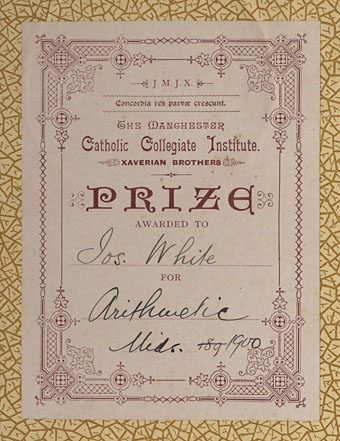
There’s nothing new about drawing attention to the viral nature of design, whether in the repeated use of motifs and styles or the way in which typefaces breed and proliferate; Jonathan Barnbrook alludes to this process directly by calling his font house Virus.
The plate above comes from a Victorian book I bought several years ago, The Pictorial Cabinet of Marvels, a reasonably lavish volume for children concerning places and things of interest around the world. Since I like playing with excessive Victorian flourishes now and then I’m always on the look out for new examples and the border here immediately caught my eye. I have a decent selection of clip art books from Dover and Pepin containing this kind of thing but nothing quite like this particular design. When I was putting the Damnation and A Day album together for Cradle of Filth I took one of the corner pieces as a starting point for a border design I used on the front and back of the booklet and the tray.
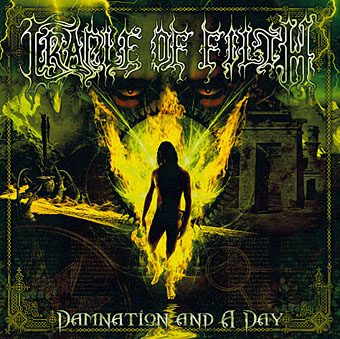
The poor old Xaverian Brothers of Manchester’s Catholic Collegiate Institute would no doubt be mortified to see part of their prize bookplate being used to decorate such a blasphemous artefact. The album was released by Sony Music in 2003 so this little border motif has travelled the world by now. I seem to recall sending the record company the border design separated from the artwork so they could make up some posters.
And so we come to what I’m assuming is its latest manifestation, a poster design for Manifest Destiny, a Los Angeles music event organised by Tee Pee Records.

I say “assuming” since I’ve no idea whether this example is from my design or not. But it seems a safe bet seeing as the original is from such an obscure source. Not that I mind if it is, of course. I can’t very well complain when I swiped the thing in the first place, now can I?
Update: Tee Pee designer Sarah MacKinnon writes to say her Victorian motif is from one of Dover’s clip art books. Now I know that I wouldn’t mind finding the book for my own collection. This makes the occurrence of the original more unusual, at least from my point of view, since it’s the only time I’ve spotted one of these reprinted elements in its period setting.
Previously on { feuilleton }
• Masonic fonts and the designer’s dark materials
The art of Agostino Arrivabene
%20Lo%20psiconauta.jpg)
Lo psiconauta (2006).
%20capriccio%20co%20ruderi%20di%20citta%20ideale.jpg)
Capriccio con ruderi di città ideale (2003).
%20Vanitas%20su%20zola%20di%20viole.jpg)
Vanitas su zolla di viole (2006).
I’ve tagged this as “gay” since the first painting is featured in the controversial Arte E Omosessualita’. Da von Gloeden a Pierre et Gilles at the Palazzo della Ragione, Milan. That exhibition has caused as stir with Catholics who demanded that Paolo Schmidlin’s Miss Kitty, which shows the current Pope in drag, be removed.
Whatever Agostino Arrivabene‘s sexuality he’s no slouch with a paintbrush, and all the sections on his site are worth looking at. The “Paesaggi” section features some architectural caprices, there’s a section of vanitas works and a fair amount of artistic quotation; I spotted references to Piranesi, Boulée and George Minne, among others.
Elsewhere on { feuilleton }
• The fantastic art archive
Previously on { feuilleton }
• Vanitas paintings
• Giant Skeleton and the Chocolate Jesus
Guillaume Bijl’s buried church
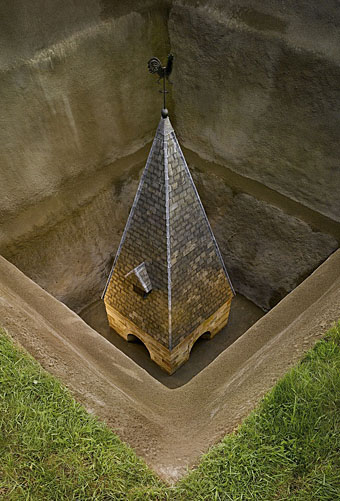
Archaeological Site (A Sorry-Installation) by Guillaume Bijl.
A work for the Skulptur Projekte Münster 07. More views on Flickr.
The art of Lucio Bubacco

Devils and Angels.
There’s been plenty of speculation over the past twenty-four hours concerning the nature of the post-mortem torments that might await Jerry Falwell now that his soul has departed its corpulent container. Various suggestions I’ve seen run the gamut from the fanciful—being buggered for eternity by purple Teletubbies—to the semi-serious—finding himself in the Third Circle of Dante’s Inferno along with the rest of the gluttons who, so Dante tells us, lie in continual hail and rain whilst eating their own excrement. For a man who spent most of his life talking shit, the latter would seem to be a fitting end.
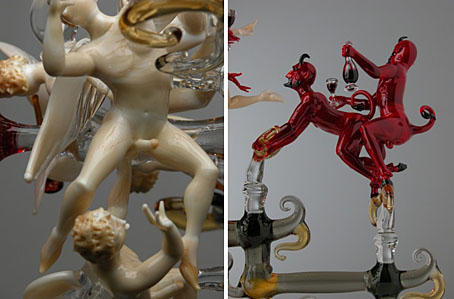
Devils and Angels (details).
Which disrespectful preamble brings us to another Italian, Lucio Bubacco, and his glass artworks. Bubacco is a Venetian and Venice has long been a centre of excellence in glass-blowing and sculpture. Yet Bubacco excels even by the standards of his birthplace, and his work is a deal more witty, imaginative and finely-crafted than the dull porn glassworks Jeff Koons had produced (by Italians also) for his Made in Heaven series in 1991. Of the work on Bubacco’s site my favourites are those in the “Transgressive” section which includes the marvellous Devils and Angels tableaux shown above, where a complement of masculine angels and demons are arranged about the central pillar in a Kama Sutra of celestial copulation. Not all his work is this outrageous, some is merely sweetly subversive like The Kiss showing an amorous encounter between a satyr and a naked man. That’s still enough to upset Falwell’s Puritan pod people but then they’re beyond our salvation, aren’t they?
• Official site | Lucio Bubacco on MySpace
Elsewhere on { feuilleton }
• The gay artists archive
Previously on { feuilleton }
• The art of ejaculation
• Czanara’s Hermaphrodite Angel
• Angels 4: Fallen angels
• Angels 1: The Angel of History and sensual metaphysics
• The glass menagerie