The art of Thomas Cole, 1801–1848

cole1.jpg

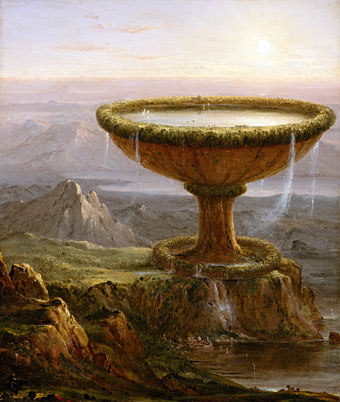
The Titan’s Goblet (1833).

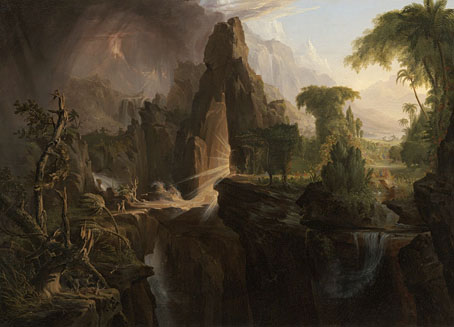
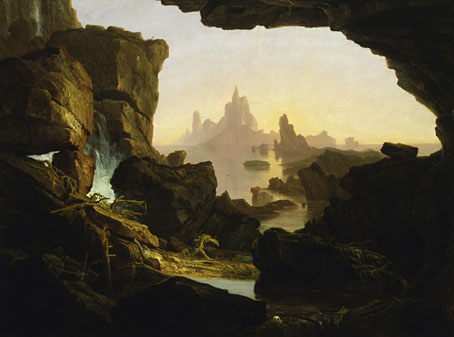
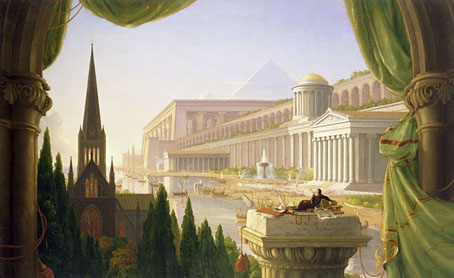
Thomas Cole’s Titan’s Goblet isn’t featured at the Google Art Project, unfortunately, but the following paintings are, and all benefit from being able to explore their details. Cole’s colossal vessel predates Surrealism by a century, and is one of many paintings which always has me mentally labelling him as the American John Martin (1789–1854). Having thought of him for years as an American artist–not least because he founded the Hudson River School–it’s a surprise to learn he was born in Bolton, a town not far from Manchester, with his parents emigrating to the US when he was 17. John Martin also grew up in the north of England so there’s another similarity, although the more important comparison concerns their use of painting to convey the spectacularly vast and unreal scenes common to the imaginative side of Romantic art. The Titan’s Goblet is unusual in not having any particular symbolic or moral significance, unlike the pictures below, it’s Magritte-like in its careful depiction of the impossible. The Subsiding of the Waters of the Deluge, on the other hand, could be exhibited beside Francis Danby’s The Deluge (1840) for a “before and after” effect. Like Martin, Cole enjoyed painting architecture of an exaggerated scale. The Architect’s Dream features an Egyptian temple of stupendous size, while the pyramid looming in the background is closer to William Hope Hodgson’s seven-mile-high Last Redoubt than any structure on the Nile plain.

Of equal interest are Cole’s two well-known series: The Course of Empire (1833–36) and The Voyage of Life (1842), both of which I’d love to see at Art Project size.

cole2.jpg

Expulsion from the Garden of Eden (1828).

cole3.jpg

The Subsiding of the Waters of the Deluge (1829).

cole4.jpg

The Architect’s Dream (1840).

Elsewhere on { feuilleton }
The fantastic art archive

Previously on { feuilleton }
John Martin’s musical afterlife
Albert Bierstadt in Yosemite
Danby’s Deluge
John Martin: Heaven & Hell
Darkness visible
Two American paintings
The apocalyptic art of Francis Danby

Borobudur panoramas

borobudur1.jpg

Photo by Ursula & David Molenda.

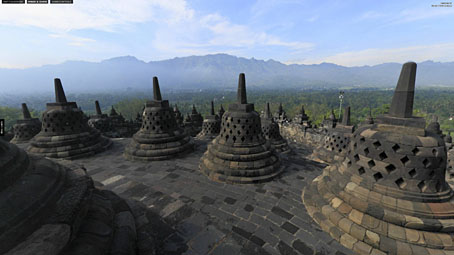
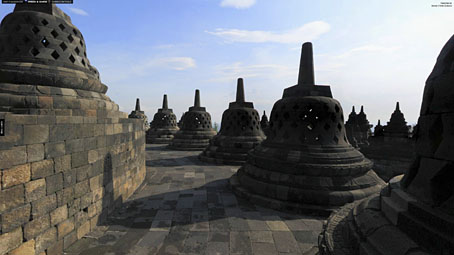
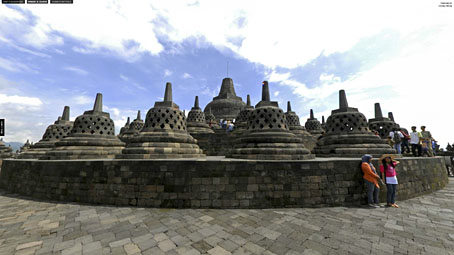
Panoramas of Borobudur, the Buddhist monument in Magelang, Central Java, which lay undisturbed and overgrown for centuries until restoration began following the British occupation of the island in the 19th century. The bell-like structures are stupas, many of which contain statues of the Buddha in different symbolic postures. The entire monument is a complex three-dimensional map of the Buddhist cosmology: pilgrims ascend from the lowest level reading the bas-reliefs and visiting each Buddha in turn. Wikipedia has a detailed account of both the history of the monument and its meaning as a piece of religious architecture.

borobudur2.jpg

Photo by Ursula & David Molenda.

borobudur3.jpg

Photo by Lanang Lintang.

borobudur4.jpg

Photo by Lanang Lintang.

Elsewhere on { feuilleton }
The panoramas archive

The art of Guido Reni, 1575–1642

reni01.jpg

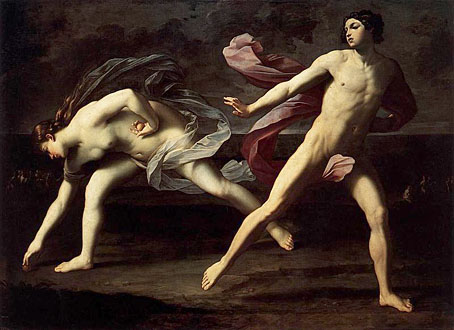
Atalanta and Hippomenes (c. 1612).

More golden apples appear in this painting by Guido Reni, not the most famous ones in art history—those would be all the Apples of Discord seen in the various Judgements of Paris—these are the fruit of the sacred tree in the Garden of the Hesperides which Hippomenes drops to prevent Atalanta from beating him in a race. The object of interest here isn’t the apples but the near-naked male, a favourite subject for Baroque artist Guido Reni whose work strikes viewers today as significantly homoerotic. This interpretation is by no means a recent one: Oscar Wilde was famously smitten with Reni’s depiction of Saint Sebastian (below) when he saw the painting in Genoa; in the 20th century the same painting (or one of Reni’s other Sebastians) excited the 12-year-old protagonist in Yukio Mishima’s novel Confessions of a Mask. Here’s what GLBTQ has to say about Reni:

Given the fierce homophobia prevailing in Europe during the Baroque era, historians seeking to reconstruct the lifestyles and works of queer artists often have to depend upon undocumented anecdotes and innuendoes.

Utilizing this type of evidence (including rumors about his supposed disdain of women, his possible romantic involvement with his long-time assistant, his interest in cross-dressing, and his “delicate” mannerisms), recent scholars interpret Guido Reni (1575–1642) as a gay artist.

The disdain of women is referred to in an earlier account, as are other pertinent details:

He was accustomed to paint with his mantle about him, gathered gracefully over his left arm. His pupils, of whom he had a great number—at one period no less than eighty, drawn from nearly every nation of Europe—vied with each other to serve him, esteeming themselves fortunate to have opportunities to clean his brushes or to prepare his palette. He had no dearth of models in the multitude of youths and disciples which surrounded him; but all that Guido cared of them was to refresh his memory by viewing their limbs and torsos, and after that he could adjust them and correct their imperfections.

In the same way any head sufficed him for a model. Being once besought by Count Aldovrandi to confide in him who the lady was of whom he availed himself in drawing his beautiful Madonnas and Magdalens, he made his color-grinder, a fellow of scoundrelly visage, sit down, and commanding him to look upward, drew from him such a marvelous head of a saint that it seemed as if it had been done by magic. Better than any other artist he understood how to portray upturned faces, and boasted that he knew a hundred ways of making heads with their eyes lifted to heaven. He often declared that his favorite, models were the ‘Venus of Medici’ and the wonderful heads in the Niobe group.

He was always in great fear of sorcery and poisoning, and for that reason could not endure women in his house, abhorring to have any dealings with them, and, when such were unavoidable, hurrying them through as rapidly as possible. Old women were his especial detestation, and he always fled from them, and lamented grievously if one of them should appear when he was about beginning or closing some commission.

From Guido Reni (1903)

That’s one way of either justifying your misogyny or explaining to the neighbours why your house is full of young men with no women.
reni10.jpg

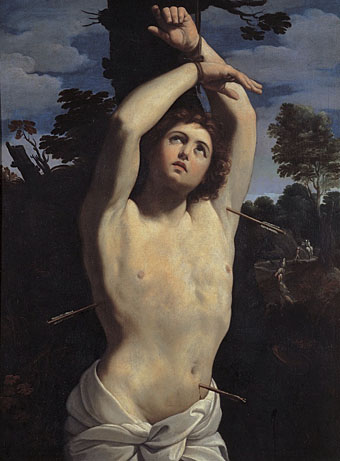
Saint Sebastian (1615).

Speculation about the sexuality of artists from past centuries seldom leads anywhere but it can be a fun parlour game, provided you take accounts like the one above with a pinch of salt. In Reni’s case you’d have to point to the many paintings where a religious subject is used as the merest pretext for some shirtless male pulchritude. This was a common ploy in other areas of art: landscape painting evolved as a genre in its own right when post-Renaissance artists began to shrink the religious figures who were the ostensible subject of their commissions into the corner of a field or the shadows of a valley; the imagination could be given free rein by the expedient of painting an apocalypse or a Temptation of St Anthony.

Reni lets loose his temperament by returning to a range of religious subjects that happen to feature attractive youths. Even his picture of Sacred Love defeating Profane Love (below) shows a divine figure who seems to represent more of the libido than the subject should require. Elsewhere he follows Caravaggio with a youthful John the Baptist preaching in the wilderness in an almost total state of nature. Reni’s angels are some of the most androgynous figures you’ll find in Baroque painting; the model for his very girlish Archangel Gabriel also appears as Jesus in another painting, raising a somewhat scandalous implication as to the real paternity of Christ.
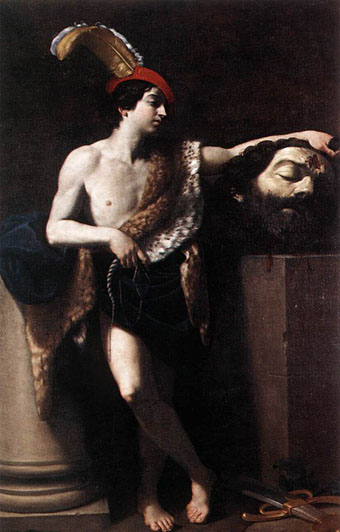
reni07.jpg

David with the Head of Goliath (1605).

The following selection of paintings is a prejudiced choice, of course. Some of these can be seen at a much larger size at the Google Art Project. Frivolous speculation aside, at his best Reni could be very good indeed as in this superb portrait of Saint Matthew with another androgynous angel. It’s no surprise to read that his work was in great demand throughout his life.

Continue reading “The art of Guido Reni, 1575–1642”

Weekend links 105

klikovac.jpg

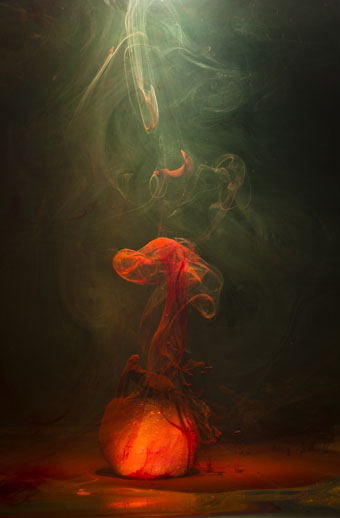
A suspended fluid photograph from Demersal, a series by Luka Klikovac.

• “Soon, Mr. Lachman was writing occult music. His song “(I’m Always Touched by Your) Presence, Dear,” which appeared on Blondie’s 1977 album Plastic Letters, was an example.” Gary Lachman: from Blondie to Swedenborg.

Neil Krug’s cover art for the new Scissor Sisters album, Magic Hour, channels the cloudless skies and photographic surrealism of Storm Thorgerson.

Implicate Explicate, a multiple 16mm film installation by Rose Kallal. Sound by Rose Kallal & Mark Pilkington using modular synthesizers.

Despite conservative queerdom’s best efforts to hide its “otherness” behind a velvet wall of “same as you” Tom and Hank and Jill and Janes, Mattilda and her like will not be ignored. As parades of neo-nuclear same sex families mug for the cameras on courthouse steps, queer body boys parade and flex impossibly taut muscles across our nation’s gym runways and circuit parties, and far, far too many proudly proclaim in knee-jerk defensiveness how “straight-acting” they are across the net, Sycamore blows raspberries at the forced mirage and holds up faded pictures of yesteryear boys and girls whose one claim to fame once was their difference.

Mattilda Bernstein Sycamore is interviewed at Lambda Literary

Paul Oestreicher, an Anglican priest, sets the cat squarely among the pigeons with the question (and answer) “Was Jesus gay? Probably.”

Andromeon, video by Alexander Tucker and Serena Korda for a new song by Alexander Tucker.

• Museums of Melancholy: Iain Sinclair on London’s memorials. An LRB essay from 2005.

FACT mix 325 is by Battles: from Boredoms to Cluster and The Alchemist.

The glass hills of Mars, “a region the size of Europe”.

Labyrinths and clues, an essay by Alan Wall.

The Alchemy of Emptiness.

Drop (1972) by Soft Machine | Drop (2002) by Hope Sandoval & The Warm Inventions | Airdrop (2006) by Kashiwa Daisuke.

The art of Léon Bonnat, 1833–1922

bonnat1.jpg

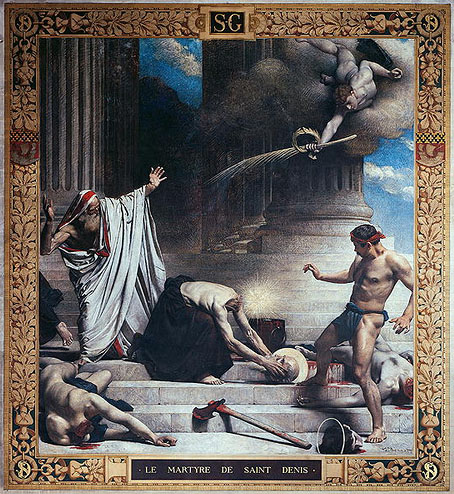
The Martyrdom of St Denis (1885).

Léon Bonnat’s depiction of St Denis reaching for his detached head might be included with St Lucy (always shown with her dish of eyeballs) and St Peter of Verona (seldom without an axe stuck in his skull) in a facetious list of Saints Do The Funniest Things. Bonnat’s gory painting can be found on a wall in the Panthéon in Paris, and is the kind of image I often keep in mind for those moments when someone wants to argue that violent imagery is a very recent thing. Academic painting at the end of the 19th century reached a pitch of photo-realism which demanded that acts of murder be shown with all the relevant blood splashes, hence St Denis and the characteristic excess of Georges Rochegrosse’s Andromaque, painted two years earlier. The 50 Watts Flickr pages have a large monochrome reproduction of Bonnat’s picture.

bonnat2.jpg

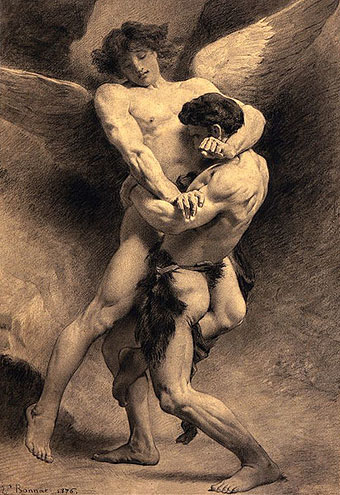
Jacob Wrestling with the Angel (1876).

It was this drawing of Jacob wrestling the angel that set me looking for more of Bonnart’s work. With the exception of a Tarzanesque painting of Samson fighting a lion there isn’t much else like this, a disappointment to those of us who can’t help but notice the Simeon Solomon-like homoerotic quality of the clinch.

Previously on { feuilleton }
Nirvana and The Conquerors