Athanasius Kircher’s Pan

kircher1.jpg

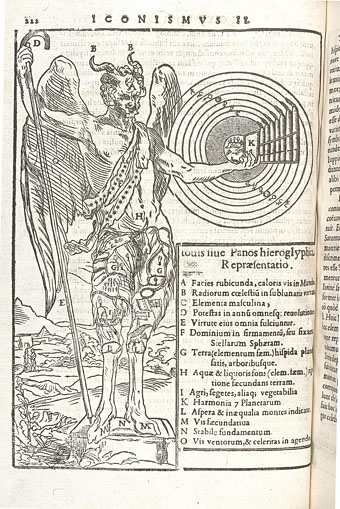
More from the Kircher archives at the University of Heidelberg. As before, it’s good to see illustrations familiar from countless reprintings in books in their place of origin. The volume in question is Obeliscus Pamphilius: hoc est, Interpretatio noua & Hucusque Intentata Obelisci Hieroglyphici (1650), one of Kircher’s attempts at deciphering the hieroglyphics on Egyptian obelisks. I’m still not sure how the Great God Pan fits into these speculations even as a diagrammatic figure, unless in this case it’s Pan as a representative of Nature as a whole.

Whatever the explanation, the Pan picture often turns up in occult anthologies although you’re as likely to see the copy from Manly P. Hall’s The Secret Teachings of All Ages (1928) as the original. Hall’s rendering is useful for the translation of the Latin although he also says it may represent the god Jupiter (?) and he censors the not-very-obtrusive penis, a rather fatuous bit of prudery for a book that’s supposedly concerned with universal truths.

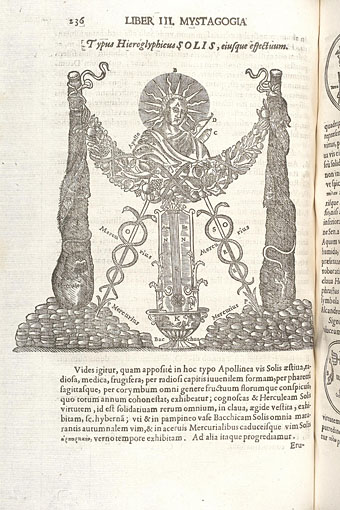
A few more plates follow, one of which features a serpent I swiped several years ago for a Cradle of Filth T-shirt design.
kircher2.jpg

Continue reading “Athanasius Kircher’s Pan”

Weekend links 224

zona.jpg

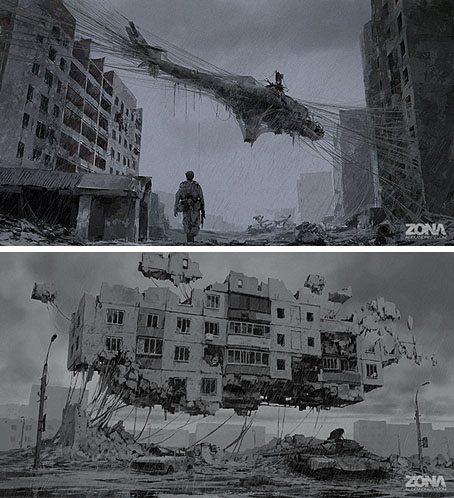
Zona: concept art by Alex Andreyev for a planned TV series based on Roadside Picnic by Arkady & Boris Strugatsky.

The Black Sessions are a long-running series of concerts by international artists recorded for radio station France Inter. UK group Broadcast were recorded by the station in May, 2000. While copies of the shows can be often be hard to find, files of the Broadcast concert may be downloaded here. A fantastic performance, especially the white-hot psychedelic freakout at the end.

• Further investigations from the radio age: Invention for Radio No. 1: The Dreams (43 mins, 1964): “an attempt to re-create in five movements some sensations of dreaming—running away, falling, landscape, underwater and colour”. Voices recorded by Barry Bermange with Radiophonic manipulation by Delia Derbyshire.

• “…in his first description of Cthulhu he gives you a list of four things that Cthulhu isn’t quite like.” Nick Talbot talks to Alan Moore about HP Lovecraft. Related: one of my depictions of Azathoth appears in this list of “gods who have forsaken you”.

• Tracking the locations of JG Ballard’s Super-Cannes: an investigation by Rick Poynor. Related: houseboats, architecture and eco-disaster; Justin Sullivan photographs California’s extreme drought.

• “As her writing career existed outside the realm of respectable ‘high-lit’ fiction, she cast herself as an outsider icon.” Chris Kraus on I’m Very Into You, a collection of Kathy Acker’s emails.

• Cover design inspiring fiction: Susan Coll on how a photo of a Bauhaus chair on the cover of her new novel, The Stager, made her alter her text at the last minute.

• “People were either taken by it or felt it was the Antichrist.” MetaFilter on Clair Noto’s unmade science-fiction film, The Tourist.

The Norwood Variations is a new album by Drew Mulholland (Mount Vernon Arts Lab et al).

• Thought Maybe has a collection of the television essays made by Adam Curtis.

• From 1974: How To Make Magic, a children’s handbook of the occult.

• Mix of the week: Secret Thirteen Mix 126 by Mira Calix.

One Minute Blasts Rising To Three And Then Diminishing (2000) by Mount Vernon Arts Lab | Dashwood’s Reverie (2001) by Mount Vernon Arts Lab | Warner’s Reverie (2002) by Mount Vernon Astral Temple

Chinnamasta

chinnamasta1.jpg

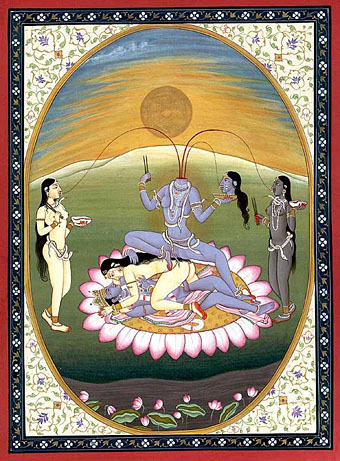
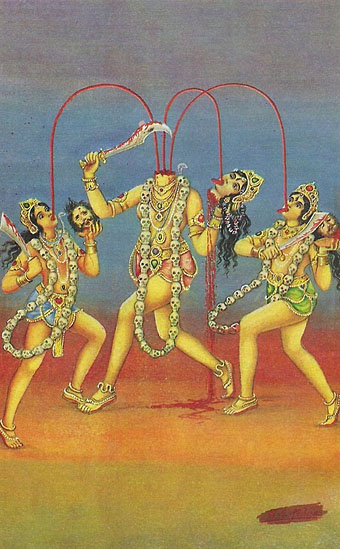
The saintly cephalophores may be reconciled to their martyrdoms but none of them decapitated themselves, unlike Chinnamasta, the self-decapitating Tantric goddess. The most common representations show her sitting or standing on a copulating couple while blood from her neck spouts into the mouth of her severed head and the mouths of her attendants, Dakini and Varnini. In other depictions she should probably be classed among the cephalophores when she goes for a walk or a ride on a lion. The fourth picture here is of Chinnamunda, a related, wrathful form of Vajrayogini from Tibetan Buddhism.

chinnamasta2.jpg

chinnamasta3.jpg

chinnamasta4.jpg

Previously on { feuilleton }
Cephalophores
Decapitations

Cephalophores

denis1.jpg

Martyrdom of Saint Denis, Saint Eleutherius and Saint Rusticus by Pierre II Mignard.

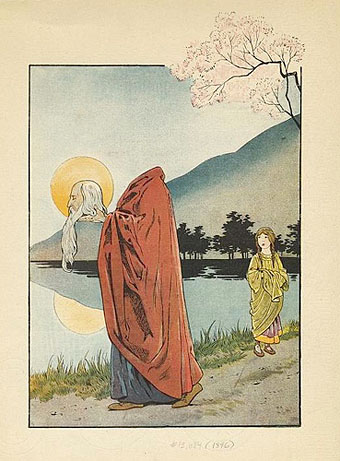
Consider this an addendum to an earlier post about decapitations in art history. What I didn’t know then was that decapitated saints have their own “cephalophore” category if they’ve been recorded as going for a post-decapitation stroll; a case of “take up thy head and walk”. Saint Denis of Paris receives more attention than most on account of his being a patron saint of France. This also explains why his martyrdom is depicted in gory detail on the wall of the Pantheon in Paris.

denis2.jpg

St. Denis bearing his head and halo (1896).

Nine-year-old Saint Justus of Beauvais differs from the strolling cephalophores—who manage to walk some distance before finally expiring—in having picked up his head severed head and carried on speaking. Rubens is one of the few artists to depict this event, although his habitual all-shall-have-muscles technique makes the boy look a lot older. Wikimedia Commons has a few more examples of Saint Denis, with and without head.

justus.jpg

The Miracle of Saint Justus (c. 1635) by Peter Paul Rubens.

Previously on { feuilleton }
Decapitations

Weekend links 219

balbusso.jpg

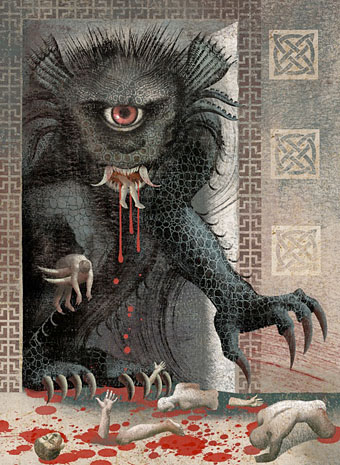
Grendel Monster (2013) by Anna & Elena Balbusso.

Rick Poynor looks at the Guide de la France mystérieuse (1964), a fantastic (in every sense) doorstop of a volume whose collage alphabet by Roman Cieślewicz can be seen on the cover of Carnival In Babylon (1972) by Amon Düül II.

• Boolean mathematics, Charles Howard Hinton, The Voynich Manuscript, and the effects of surveillance on the political process: Adam Curtis firing on all cylinders as usual.

• At Strange Flowers: The Picture of John Gray, remembering the minor fin de siècle figure who gave Oscar Wilde a surname for his most famous creation.

In “32 Cardinal Virtues of Dennis Cooper,” Wayne Koestenbaum remarks: “Cooper’s quest for the unseeable is virtually religious. I mean: sedulous, abstract, perpetual, unrewarded, unreasonable.” There’s much more to be said of Gone, its power, its pain, its odd intrigues, but perhaps it will suffice to say that it is revealing: unlike Burroughs’ scrapbooks hidden away by some private collector, never to see the light of day, Gone (and its sister texts at the Fales Library) illuminate in perpetuity Cooper’s obscure quest for the unseeable.

Diarmuid Hester looks at Dennis Cooper’s scrapbooks

The Sallow Tree, a single by Lutine. More music: An hour of Julia Holter‘s St John’s Sessions performance.

• At Dangerous Minds: Christian televangelists listen to Stairway To Heaven forwards.

• Cathy Camper reviews Fearful Hunter, a graphic novel by Jon Macy.

• Mix of the week: FACT mix 452 by Claude Speeed.

Roman Cieślewicz at Pinterest.

The Adobe Illustrator Story

The House of Julian

Unofficial Britain

• Amon Düül II singles: Rattlesnakeplumcake (1970) | Between The Eyes (1970) | Light (1971) | Lemmingmania (1971)