Number 10: Mirror Animations, a film by Harry Smith

smith2.jpg

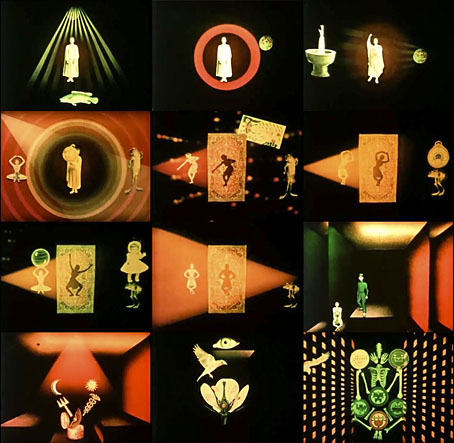
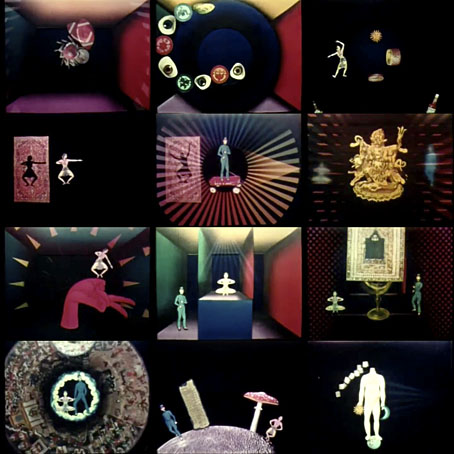
Another Harry Smith film that’s very similar to the one featured here a couple of weeks ago, Number 11, which is also entitled Mirror Animations. Smith wrote a description for this one: “An exposition of Buddhism and the Kaballah in the form of a collage. The final scene shows Agaric mushrooms growing on the moon while the Hero and Heroine row by on a cerebrum.” The copy at YouTube has an improvised score which isn’t very flattering. The film runs for around 4 minutes so I’d suggest finding something of that length from elsewhere. Elastic Dance by African Head Charge works well.

Previously on { feuilleton }
Number 11: Mirror Animations, a film by Harry Smith
Meeting Harry Smith by Drew Christie
Heaven and Earth Magic by Harry Smith
Harry Smith revisited
The art of Harry Smith, 1923–1991

Number 11: Mirror Animations, a film by Harry Smith

smith.jpg

A very short collage animation from 1956 that Smith later expanded into a version running 12 minutes. The artwork crams a great deal of occult and religious symbolism into its 3-minute running time—alchemy, the Kabbalah, Buddhism, Eliphas Levi’s Baphomet, and so on—while Misterioso by Thelonious Monk is playing. Watching this makes me realise that there are still many Harry Smith films I’ve not yet seen despite having read about them for years. Further investigation is required.

Previously on { feuilleton }
Meeting Harry Smith by Drew Christie
Heaven and Earth Magic by Harry Smith
Harry Smith revisited
The art of Harry Smith, 1923–1991

Enki by Melechesh

enki.jpg

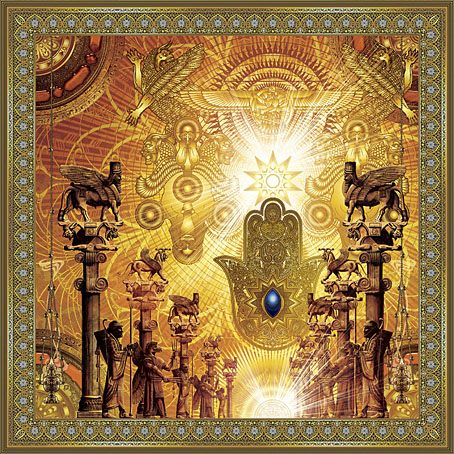
Another album cover, and this time the artwork is my own, being my third cover for metal band Melechesh. The album won’t be released until February but the record label, Nuclear Blast, revealed the cover earlier this week so I thought I may as well post it myself. See a larger copy here. Note that other copies in circulation at the moment show a temporary title design (not my doing) which will probably be changed by release time.

This is my third cover for the band whose songs are preoccupied with Sumerian mythology, as should be evident from the symbolism. The artwork was also one of two elaborate (unconnected) designs I’d been working on over the autumn. The other one may be revealed next week so watch this space.

Elsewhere on { feuilleton }
The album covers archive

Previously on { feuilleton }
The Epigenesis by Melechesh

Weekend links 235

shadows.jpg

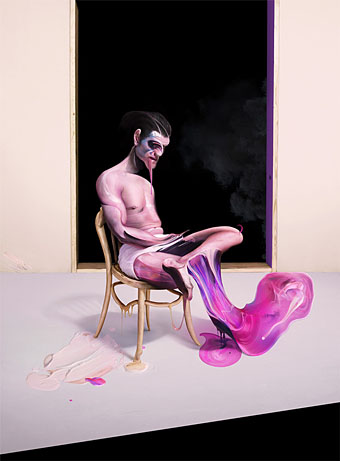
Shadows (1974) by Pawel Nolbert & Lukasz Murgrabia, one of three images recreating Francis Bacon’s Triptych–August 1972.

Breaking the Code (1996), a BBC film by Herbert Wise based on Hugh Whitemore’s stage play about Alan Turing. Wise’s film has been linked here before but it’s relevant again thanks to the release of The Imitation Game. Derek Jacobi played Turing on stage and screen, and Whitemore’s script managed to deal with Turing’s life and work without insulting the man or the intelligence of its audience.

• “…if you listen to A Beacon From Mars by Kaleidoscope or if you listen to some Turkish taxim then something starts happening.” Robert Plant talking to Julian Marszalek about the music that excites him.

• “CGI has become wearingly dull and clichéd. Can its deep weirdness be recovered and filmgoers’ minds stretched again?” asks Jonathan Romney.

The cult of the Thirty-Seven Nats is unique to Burma. […] The junta’s attempts to subdue nat worship had an unintended effect: the role of the nat wife was embraced by an already marginalized group. Homosexuality is illegal in Burma and has been since its British colonizers instituted a late-nineteenth-century ban on “intercourse against the order of nature”. Government restrictions opened a professional vacuum, says scholar Tamara C. Ho. Becoming a nat kadaw offered the achauk—a Burmese term for gay and transgender men—both “a vocation and queer visibility”.

After the Green Death by Will Boast

• “Cat memes and other frivolities aren’t the work of an Internet culture. They’re the work of an American one, ” says Caitlin Dewey.

• Hear the cavernous reverb of Berlin’s Kraftwerk captured by Emptyset’s James Ginzburg and Yair Elazar Glotman.

• Take part in the first #psychedelicpride photoshoot in central London on Saturday, December 13th.

• Mix of the week: FACT Mix 470 by Jonny Trunk who also appears in the list of vinyl hoarders below.

• Queer Noise: Abigail Ward on the history of LGB music and club culture in Manchester.

More photos of the steampunk exhibition at 751 D-Park, Beijing, China.

A chronological list of synth scores & soundtracks.

• Animated photography by Julien Douvier.

• A Third Ear Band archive at SoundCloud.

The secret lives of vinyl hoarders.

Taxim (1968) by Kaleidoscope | Water (1970) by Third Ear Band | Love Is The Devil (1998) by Ryuichi Sakamoto

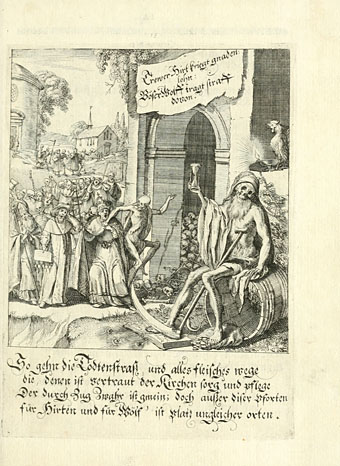
Meyer’s Todtengessängen

meyer01.jpg

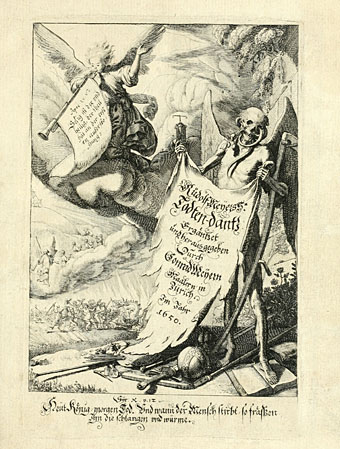
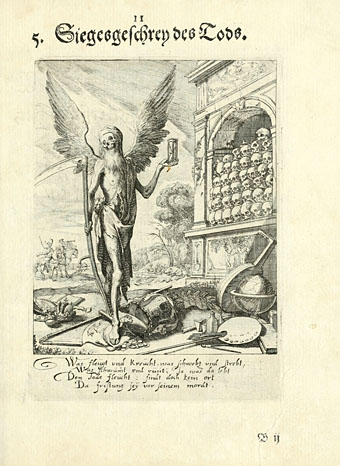
The traditional post for Día de los Muertos is a selection of illustrations by Conrad Meyer (1618–1689) for a Dance of Death from 1650. Unlike some earlier examples this book has a specific religious moral, opening with the expulsion from the Garden of Eden and ending with the triumph of Christ over Death. Given that, it’s surprising the degree of struggle in some of the illustrations, whether in the determination of the skeletal intruders to drag away the mortals they meet, or the reluctance and horror displayed by those mortals. Towards the end there are some details worthy of William Hogarth with revellers puking on unfortunate dogs. Browse the rest of the book here or download it here.

meyer02.jpg

meyer03.jpg

Continue reading “Meyer’s Todtengessängen”