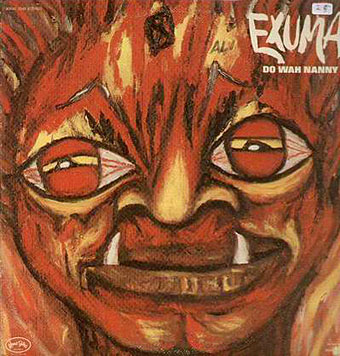
Exuma: Obeah men and the voodoo groove

exuma.jpg

Do Wah Nanny by Exuma (Kama Sutra LP, 1971).

I came down on a lightning bolt
Nine months in my Mama’s belly.
When I was born, the midwife scream and shout,
I had fire crystals coming out of my mouth.
I’m Exuma, I’m the Obeah Man!

So you’ve listened to Dr John‘s Gris-Gris over and over and become addicted to its swampy, voodoo-inflected psychedelia. Where to go next? Dr John’s subsequent career isn’t much help even though he dallied with voodoo themes on his next couple of albums; nothing there quite achieves the distinctive flavour (dare we say “gumbo”?) of his first album. Praise Dambala, then, for Exuma, whose career was launched on the back of Dr John’s success but who often manages to sound more “authentic” (whatever that means) than the New Orleans maestro. These are recording studio confections so authenticity doesn’t really enter into it even though both artists strive to sound like feathered and beaded voodoo-priests lifting the curtain on their spooky rituals.

Screamin’ Jay Hawkins was one of the first to go this route in the 1950s, albeit in a more comical fashion, with I Put A Spell On You (1956) and the very swampy Alligator Wine (1958). The latter wasn’t written by some chicken-sacrificing Baron Samedi but by Leiber and Stoller, a pair of Jewish boys in New York City. Mac Rebennack also started out doing rock’n’roll novelty records, among them Bad Neighborhood by Ronnie & the Delinquents and Morgus The Magnificent by Morgus & the 3 Ghouls. His new persona of Dr John (full designation: Dr John Creaux, the Night Tripper) was taken wholesale from Robert Tallant’s Voodoo in New Orleans (1946), a book which features a chapter detailing the exploits of the original voodoo chieftain of that name, and whose text includes a number of the songs and chants (including the classic I Walk on Guilded Splinters) adapted by Rebennack for Gris-Gris. His debut album sounds like it was recorded in some deconsecrated church in a New Orleans swamp but was actually created between very mundane pop sessions at Phil Spector’s Los Angeles studio with other session musician friends. Which brings us to Exuma. But who was Exuma? Perfect Sound Forever asked the same question:

Who was Exuma?

• He was a spirit who came from a planet, now extinct, brought to us on a lightning bolt, who had communed with Charon, the ferryman of the River Styx and Vodun priests. When he informed the world of his travels and even warned of Armageddon, he left the Earth, perhaps tiring of the corporeal and moving to the ethereal.

• He was born McFarlane Anthony McKay on Cat Island in the Bahamas in the early 1940’s. He then relocated to New York, to study architecture at the age of 17. He ran out of money for his studies and in 1962, participated in folk music hootenannies. Gaining confidence, he started a group called Tony McKay and the Islanders. He also was in a show called A Little of This ’n’ That in 1965, along with Richie Havens.

• He was a marketing nightmare. Who knew how to peg him? Finding his records has never been an easy task. Often, through dint of color, he was placed in the Soul or R&B bin, even though his music, while soulful, does not belong in either. When his first album was released in 1970, there were sections for music of other countries, however, since he lived in New York and recorded for Mercury, it may have looked out of place there. His music was not Ska or Reggae. He was a contemporary of Bob Dylan’s and Peter Paul and Mary, even playing the Café Wha? and the Bitter End in Greenwich Village, but his music wasn’t quite from the same branch of Folk singing as Dylan, Woody Guthrie or Ramblin’ Jack Elliott. His albums couldn’t be placed in Rock; besides, who would get it if it was put there?

All of the above answers are, in varying degrees, “correct.”

Continues here. Typically with fugitive culture of this kind there isn’t much information around but there’s another appreciation of Exuma’s talents here. As with much black music there’s a political dimension also, despite the magickal doodlings. On Fire in the Hole from the second album, Exuma sings “You can’t build a nation off of bloodshed and expect the blood not to stain the land.” The reference originally would have been to the Vietnam War but that line and others can’t help but have a resonance today.

McFarlane Anthony McKay left the planet Earth in 1997 but happily his early albums are all available on CD. If you’re feeling unfulfilled by current servings of musical minestrone get yourself down to the swamp for a dose of gumbo, authentic or not.

Exuma (LP Mercury 1970, CD TRC 1993)
Exuma II (LP Mercury 1970, CD TRC 1993)
Do Wah Nanny (LP Kama Sutra 1971, CD Castle 1993)
Snake (LP Kama Sutra 1972, CD Castle 1993)
Reincarnation (LP Kama Sutra 1972, CD Castle 1993)
Life (LP Buddah 1973, CD Castle 1993)
Penny Sausage (Inagua 1980)
Going to Cat Island (??)
Universal Exuma (??)
Rude Boy (ROIR 1986) (originally released as Street Life)

Previously on { feuilleton }
Metabolist: Goatmanauts, Drömm-heads and the Zuehl Axis
A playlist for Halloween
Ghost Box
Voodoo Macbeth
Davy Jones

Simplicissimus

simplicissimus.jpg

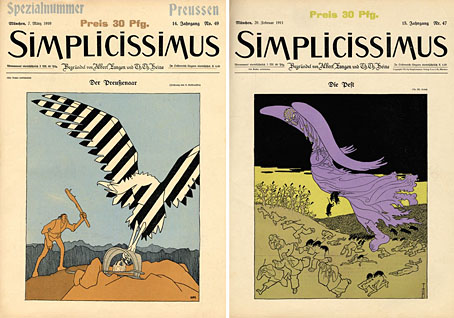
Every issue of the weekly German satire magazine—from 1896 to 1944—is available for download as a free PDF here. Amazing.

Combining brash and politically daring content, a bright, immediate, surprisingly modern graphic style, Simplicissimus featured the work of German cartoonist Thomas Theodor Heine on every cover, and published the work of writers such as Thomas Mann and Rainer Maria Rilke. Its most reliable targets for caricature were stiff Prussian military figures, and rigid German social and class distinctions as seen from the more relaxed, liberal atmosphere of Munich.

Yes, the content is in German but Simplicissimus, like Punch, featured cartoons (some in strip form) and illustrations as well. Each issue also includes a couple of pages of adverts that are fun to look at. Lots of samples from its visual contributors, including the great Heinrich Kley, here. Via Design Observer.

Previously on { feuilleton }
Revenant volumes: Bob Haberfield, New Worlds and others
100 Years of Magazine Covers
It’s a pulp, pulp, pulp world
Vintage magazine art II
The art of Heinrich Kley, 1863–1945
Neville Brody and Fetish Records
View: The Modern Magazine
Vintage magazine art
Oz magazine, 1967–73

The Trap by Adam Curtis

Adam Curtis, producer of brilliant documentary series such as Pandora’s Box, The Century of the Self and The Power of Nightmares, has a new series starting on BBC 2 next week. The Guardian profiled him and his work today. The Power of Nightmares is available to download here.

Cry freedom
In the cold war paranoia made sense, but a bold new documentary argues that the west has become trapped in a false idea of what it means to be human. By Oliver Burkeman

Oliver Burkeman
The Guardian, Saturday March 3, 2007

IN THE MID-1950s, with the cold war growing chillier, paranoia seeped through the corridors of the Rand Corporation, the fabled military thinktank in California. After all, to the hotshot young analysts paid to devise America’s strategy in the nuclear standoff with Moscow, paranoia seemed to make perfect sense. If you assumed that you couldn’t trust your enemy—and you assumed that your enemy felt the same about you—then whatever noises you made about disarmament, you’d always stockpile weapons, because you’d assume your enemy was doing the same. Nobody would dare attack, and an edgy stability would result. Act with trust and co-operation, on the other hand, and you risked a situation where both sides would claim to be willing to disarm, but then only you actually did so, spelling instability, then doom.

This was what the thinktank’s logicians called the “prisoner’s dilemma”, and the more ambitious among them—inspired by John Nash, the mathematical genius and Rand Corporation scholar portrayed by Russell Crowe in the film A Beautiful Mind—had high hopes for their newborn theory. Could it be, they wondered, that stability in everyday human relations was achieved by the same kind of self-centred suspicion and distrust? To test their ideas, they recruited the nearest everyday humans they could find: the Rand Corporation’s secretaries. In experiments, they posed various dilemmas for pairs of secretaries, in which they could co-operate or betray each other. (A typical question involved the purchase of a Buick; one imagines women in knee-length dresses, gamely tolerating questions from clipboard-wielding men in horn-rimmed glasses and short-sleeved shirts.) The theory predicted they’d choose betrayal, because they couldn’t trust the other one not to. Every single time, however, they chose to co-operate.

Perhaps if the analysts had paid more attention to their secretaries, the history of the past half-century would have proved very different. Instead, according to a new documentary series beginning on BBC2 next weekend, the paranoid theories hatched during the cold war would come to inspire a peculiar, cold-hearted idea of personal freedom—one that helps explain everything from the rise of Prozac and Viagra to Labour’s obsession with healthcare targets, from the military crusades of George Bush and the rise of the Iraqi insurgency to the rampant diagnosis of attention deficit disorder in children.

Continue reading “The Trap by Adam Curtis”

Dead monuments

mosfilm.jpg

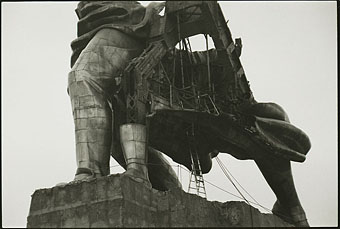
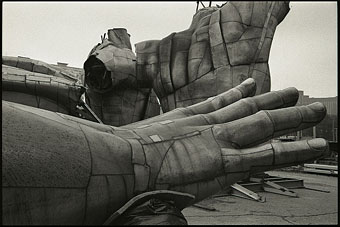
Anyone who’s seen a Soviet film from 1947 onwards will recognise the logo of the Mosfilm studio which featured a model of Vera Mukhina’s Worker and Kolkhoz Woman monument. This 24-metre tall steel-plate statue proved surplus to requirements after the collapse of the old order, like so many monuments of that period. English Russia has a series of moody photographs of the structure lying in pieces whilst being dismantled.

monument1.jpg

monument2.jpg

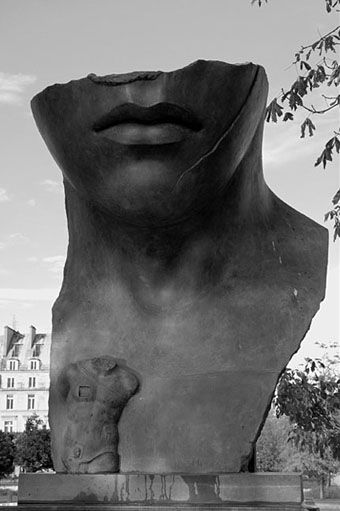
Poor Vera, who died in 1953, must have thought her work would last a very long time; these pictures are a poignant reminder of the ephemeral nature, not only of art, but of whole ideologies. They’re also reminiscent of the deliberately degraded sculptures made by Igor Mitoraj (below) which trade for their effect on exactly this disjunction between delusions of permanence and the ravages of history.

mitoraj.jpg

And on these Flickr pages you can see one of Mitoraj’s influences from a ravaged past, the fragments of the Colossal Statue of Constantine in the Palazzo dei Conservatori, Rome.

Previously on { feuilleton }
The Stalker meme
The art of Igor Mitoraj
Enormous structures II: Tatlin’s Tower
Solaris