Terminus by John Schlesinger

terminus.jpg

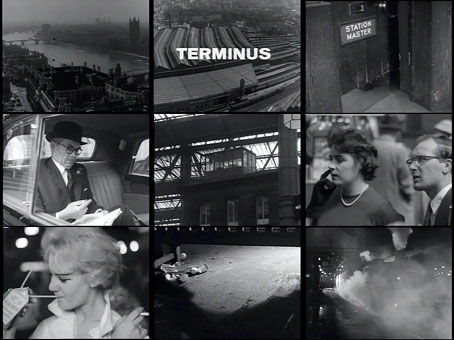
Before John Schlesinger made his debut feature, A Kind of Loving (1962), he directed a number of short documentary films. Terminus (1961), a day in the life of the Waterloo railway station in London, is the most notable of these, an award-winning snapshot of a period when Britain’s railways were still nationalised and steam trains were about to vanish from regular service. The film has that crisp, black-and-white photography so typical of the early 1960s, a look which renders close-ups with uncanny fidelity and makes the outmoded fashions—the bowler-hatted men and gloved women—seem all the more curious. A year later Orson Welles was deploying a similar style when photographing the dishevelled splendour of the Gare d’Orsay in Paris for his film of The Trial.

For a different take on London’s railway stations there’s Terminus by analogue electronic outfit Node, a track inspired by concerts they played live at Paddington station in 1995.

Previously on { feuilleton }
Screening Kafka

Zeppelinology

zeppelin1.jpg

Robe dans le style Zeppelin, Berlin, vers 1930.

So after you’ve donned your very best Zeppelin dress (and grabbed a pair of binoculars)…

zeppelin2.jpg

…you can head on over to the Zep Diner for lunch.

zeppelin3.jpg

Try some of the Zeppelin Bread: it’s light as air!

zeppelin4.jpg

Afterwards (if it’s not too early) you can relax with a martini prepared in a Hindenburg shaker

zeppelin5.jpg

…whilst listening to Billy Murray singing a song about his (male) sweetheart, Come Take A Trip In My Airship, and browsing colour photographs of the Hindenberg interior.

(Thanks to Thom for starting the ball rolling with his new Paris/Berlin tumblr!)

Previously on { feuilleton }
Vickers Airship Catalogue
The Air Ship
Dirigibles
The Airship Destroyer
Zeppelin vs. Pterodactyls

William Mortensen’s Salomés

mortensen1.jpg

Joyzelle Joyner as Salomé.

Two undated photographs by William Mortensen (1897–1965) which use the Salomé theme as a possible disguise for motives that have little to do with Biblical storytelling; looking at this collection of Mortensen’s work he evidently had a thing for arty erotica. Joyzelle Joyner was an American actress who appeared in minor roles in a number of silent films. Her lascivious scene in Cecil B. DeMille’s The Sign of the Cross (1932) was deemed scandalous enough to later be cut from the film by censors. Watch it here. (Tip via Beautiful Century.)

mortensen2.jpg

Elsewhere on { feuilleton }
The Salomé archive

Silent Engine

schutze1.jpg

Artist/composer Paul Schütze unveiled some new photo prints this weekend, a series he calls Silent Engine. At first glance I thought the view on the left above was indeed an engine interior, with that radial construction being some kind of extractor fan. But these are actually nocturnal views of one of my favourite places in London, Sir John Soane’s Museum in Lincoln’s Inn Fields. The photos use only the available light which makes Soane’s collection of ancient sculpture and architectural fragments seem like the components of some antiquarian generator. Anyone familiar with Schütze’s 1997 album Second Site will know that this isn’t the first time he’s applied the word “engine” to architecture.

schutze2.jpg

Previously on { feuilleton }
Paul Schütze online

Weekend links 115

vandamme.jpg

Untitled painting by Suzanne Van Damme (1901–1986).

Eric Berkowitz, author of Sex and Punishment: 4000 Years of Judging Desire, chooses five books for The Browser.

Venus febriculosa is running another competition: Design a new cover for Brian Eno’s Music For Films.

• Paul Mayersberg and Tony Richmond on making The Man Who Fell to Earth.

When a good idea occurs, it has been prepared by a long time of reflection. But you have to be patient. We all have what I call the invisible worker inside ourselves; we don’t have to feed him or pay him, and he works even when we are sleeping. We must be aware of his presence, and from time to time stop thinking about what we are trying to do, stop being obsessed about answers, and just give him the room, the possibility, to do his work. He is tenacious, you see. He never loses hope.

Screenwriter Jean-Claude Carrière discusses his remarkable career. Related: The Discreet Charm of the Bourgeoisie revisited.

Tragic Time Capsules: Capturing the Decay of Forgotten Olympic Venues.

Louis Menand on “The Puns and Detritus in James Joyce’s Ulysses“.

• Saul Bass’s original ending for Phase IV unearthed in Los Angeles.

Katherine Lanpher uses witchcraft to find a New York apartment.

Italo Calvino’s adolescence – that in-between time.

• The early film posters of Waldemar Swierzy.

Psychedelic nano-art in oils and ferrofluids.

David Toop has a blog.

Callum James Paper.

Bodies of Water (1995) by David Toop