The recurrent pose 18

gloeden.jpg

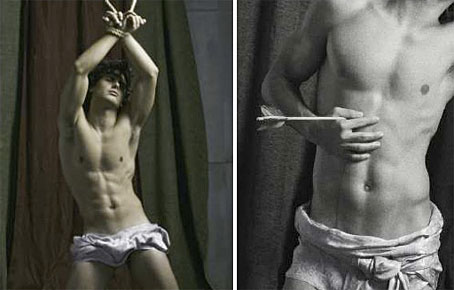
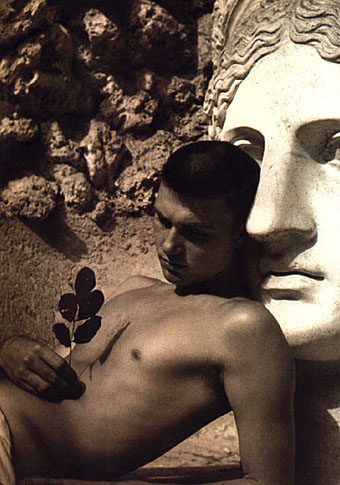
A photograph attributed to William von Gloeden which borrows the Flandrin pose as the photographer did with greater precision in his picture entitled Cain, included in the first post in this series. If there’s scepticism about the origin it’s only that many photographs attributed to von Gloeden are by his cousin Wilhelm von Plueschow. Wikimedia Commons now has a gallery of von Gloeden’s quasi-Classical studies of the boys (and occasionally, girls) of Taormina, Sicily, and there’s another gallery devoted to von Plueschow which includes his own less faithful Flandrin imitation.

Elsewhere on { feuilleton }
The recurrent pose archive

The Feminine Sphinx

colette.jpg

Colette.

Work this week designing a CD of readings from Colette had me searching books for pictures of the author. Of the few I found this is the most interesting, one of several Colette portraits made by photographer Leopold Reutlinger and one of at least two from 1907 which Colette used to promote her Moulin Rouge pantomime, Rêve d’Égypte. (You can see another one here.) The Egyptian theme explains the sphinx pose and her costume but there’s no indication as to whether the pose was borrowed from Franz Stuck’s famous painting (below) or whether the resemblance is coincidental.

stuck.jpg

The Sphinx by Franz Stuck (1889).

Stuck produced two nearly identical paintings on this theme; the other version is here in a rather muddy copy. I like the frame design for this one which explains in pictures the secret of the famous riddle which the Sphinx asks of Oedipus, “Which creature goes on four feet in the morning, two feet at noon, and three in the evening?” Stuck painted another sphinx picture three years earlier, The Kiss of the Sphinx, which portrays a less feminine and distinctly more rapacious hybrid.

rubenstein.jpg

Ida Rubenstein.

Colette was famously bisexual and so too was dancer Ida Rubenstein. In the same book as the Colette picture, there’s this photo of Ida recumbent in a sphinx-like pose in a very exotic boudoir. Photographs such as these are the material connection between the extravagances of the fin de siècle and the Decadent strain of early cinema in works such as Cabiria (written by Ida Rubenstein’s friend Gabriele D’Annunzio), Intolerance and (of course) Alla Nazimova’s Salomé.

Previously on { feuilleton }
The art of Heidi Taillefer
Dorian Gray revisited
Beardsley’s Salomé
Lussuria, Invidia, Superbia
Alla Nazimova’s Salomé
The art of Giulio Aristide Sartorio, 1860–1932

Czanara: The Art & Photographs of Raymond Carrance

czanara1.jpg

Untitled photo print.

A fantastic exhibition of photographs, drawings and engravings by Raymond Carrance, aka Czanara, opens today at Wessel + O’Connor Fine Art, New York, running until June 21, 2008. For those of us who can’t get to see it there’s a selection of the works on show at their site which immediately increases the web visibility of this artist by several orders of magnitude.

Carrance was a photographer and book illustrator who, working mostly in the 1950’s and 60’s, created a private body of homoerotic dreamscape’s under the pseudonym ‘Czanara’. The exhibit shines new light on Carrance’s art, which is certainly courageous and innovative, especially for its time.

One of the last great unknown erotic artists of the 20th century, his work is somewhat reminiscent of the magic realism style of the painters Paul Cadmus and Jared French, yet done in a photographic medium. Using overlays of abstract graphics over dreamy images of languid young men at play, his work is a meditative pondering of the artist’s psyche. The work is reverential, distinctly European, yet never exploitative.

Carrance, who lived from 1921–1998, was also responsible for illustrating with elaborate etchings and lithographs the works of Jules Renard and Cyrano de Bergerac, as well as an edition of Henry de Montherlant’s 1951 gay classic La Ville dont Le Prince est un Enfant (The Land Whose King is a Child). There will be examples of this riveting work, as well as his compelling drawings, on view as well. Having died with no heirs, his work was sold at auction by the French state, but luckily fell into the hands of a bookseller who we have to thank for it finally seeing the light of day.

czanara2.jpg

Untitled engraving (c. 1950s).

Among the items worthy of note is the above engraving which is another version of the hermaphrodite angel picture I posted in March last year. The other engravings are equally fascinating, looking at times like gay equivalents of Hans Bellmer.

czanara3.jpg

May 4, 1953.

There’s also the drawing above which raises a curious artistic conundrum by being very reminiscent of the work of comic artist Burne Hogarth. A couple of weeks after posting the Czanara angel picture I pointed out the similarity between the film poster for Premonition and one of Hogarth’s panels from Jungle Tales of Tarzan, both of which use the trick of making faces out of tree branches. (I also noted that Dalí was doing similar things before almost everyone else.) Czanara’s 1953 drawing not only contains very Hogarthesque figures but does the same thing with the branches to make a skull face. The curious thing here is that Czanara’s picture predates Hogarth’s Tarzan book by more than twenty years. It’s very unlikely that Hogarth would have seen Czanara’s work; given that Hogarth was made world famous by his Tarzan strips of the 1940s it’s more likely that Czanara knew Hogarth’s work although none of his Sunday strips contained these kind of pictorial tricks and I’ve not seen any example of Hogarth doing this in the 1950s. I also haven’t yet seen the recent book about Czanara so can’t say what light has been shed on his artistic influences. If anyone can solve this mystery (which may simply be coincidence, of course), please leave a note in the comments.

Elsewhere on { feuilleton }
The gay artists archive
The etching and engraving archive

Previously on { feuilleton }
The skull beneath the skin
A premonition of Premonition
Czanara’s Hermaphrodite Angel
The art of Paul Cadmus, 1904–1999

Alexey Titarenko

titarenko.jpg

Untitled (Crowd 1) (1993).

Like Atta Kim, Alexey Titarenko makes use of time-lapse and/or multiple exposure in his photographs. Of the two I prefer Titarenko’s work, not least because of his moody and spectral evocations of the streets of Havana and St Petersburg. His blurring of human figures takes on a sinister cast with the Time Standing Still and City of Shadows series which turn mundane Russian crowds into a parade of ghosts from a Gogol nightmare.

Via Ze Frank.

Previously on { feuilleton }
Abelardo Morell’s camera obscura
Eugene de Salignac
Atta Kim: On-Air