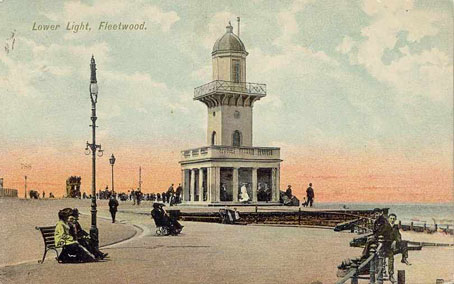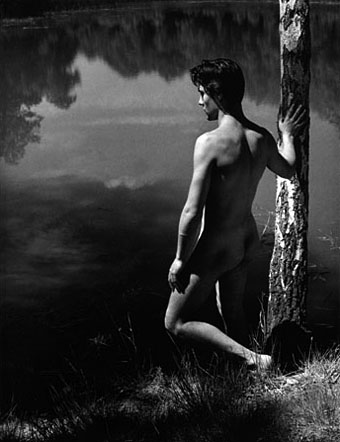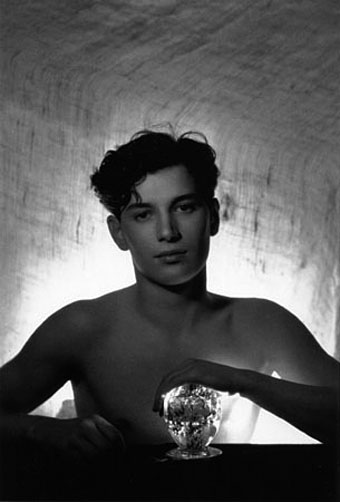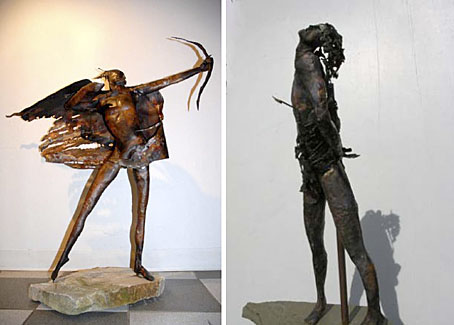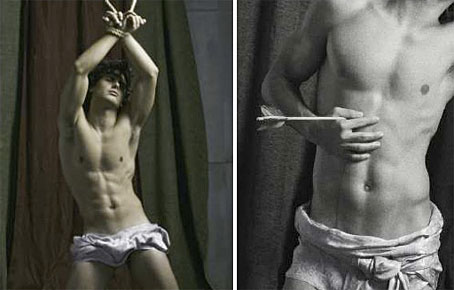
Marko is a Slovenian in London who takes his own delectable photos. This series and others can be seen here. Via Kaiserin magazine.
Category: {photography}
Photography
Herbert List revisited
Youth and Roman bust (1949).
A breathtaking photograph by Herbert List I hadn’t seen before. The model was the Swiss painter Rolf Duerig. Miss Magnolia Thunderpussy’s exemplary Flickr pages have a set of List’s elegant and occasionally erotic photos.
Previously on { feuilleton }
• Vintage/Vantage
• Herbert List’s Beautiful Young Men
• Herbert List
Sam Amidon and Valgeir Sigurdsson in Manchester

Sam and ensemble.
“Bedroom Community, possibly the best label in the world right now” was my earnest declaration back in March after seeing Sam Amidon play for the first time. A few months earlier I’d put Valgeir Sigurðsson‘s Ekvílibríum album on my best of 2007 list for Arthur magazine. Tonight’s event at Trinity Church confirmed that judgement with another great performance of songs from All Is Well by Sam, followed by a set from his Icelandic composer/producer colleague. Support for the evening was from Manchester’s own Denis Jones and a display of his one-man house of cards conjuring with samples and guitar.
Sam Amidon’s set this time lacked some of the stunning impact of the earlier gig but that’s only because the thrill of seeing him for the first time can’t be repeated. If anything the performances were better this time round, not least because there were more string players there to do justice to Nico Muhly‘s marvellous arrangements; Little Satchel especially benefited. Valgeir Sigurðsson (who produced All Is Well) helped out in the background then Sam returned the favour for Valgeir’s set, including singing one of the songs from Ekvílibríum. This easy swapping of roles is one of the things which makes Bedroom Community such a fascinating label; Valgeir produces, everyone plays on everyone else’s albums. All the people involved (Nico Muhly and Ben Frost make up the creative quartet) are highly distinctive and bring a considerable authority to their work. Most of Valgeir’s set this evening was instrumental (there are four songs on the album) and I missed Dawn McCarthy’s vocal on Winter Sleep but the vocal-less rendition gave an opportunity to hear the breadth of the arrangement. The BC site credits the other Icelandic musicians as Una Sveinbjarnardóttir on violin/mandolin, Sigríður Sunna Reynisdóttir on accordion/electric piano and Rebekka Bryndís Björnsdóttir on bassoon/cello.
“Bedroom community” is a euphemism for a suburb or dormitory town, as well as (in the case of the label) a play on the idea of the bedroom musician. Ignore the usual negative connotations of suburbs and think of this community as being one away from the decaying centre and the increasingly desperate frenzy of the mainstream. Back in the late Seventies Robert Fripp was presciently declaring the age of the music dinosaurs over, saying “In the new world the characteristic unit will be small, highly mobile, independent and intelligent.” Bedroom Community, its artists and its ethos, is precisely what he was talking about. We need more like them.
Previously on { feuilleton }
• God only knows
• Sam Amidon in Manchester
The recurrent pose 18
A photograph attributed to William von Gloeden which borrows the Flandrin pose as the photographer did with greater precision in his picture entitled Cain, included in the first post in this series. If there’s scepticism about the origin it’s only that many photographs attributed to von Gloeden are by his cousin Wilhelm von Plueschow. Wikimedia Commons now has a gallery of von Gloeden’s quasi-Classical studies of the boys (and occasionally, girls) of Taormina, Sicily, and there’s another gallery devoted to von Plueschow which includes his own less faithful Flandrin imitation.
Elsewhere on { feuilleton }
• The recurrent pose archive
The Feminine Sphinx

Colette.
Work this week designing a CD of readings from Colette had me searching books for pictures of the author. Of the few I found this is the most interesting, one of several Colette portraits made by photographer Leopold Reutlinger and one of at least two from 1907 which Colette used to promote her Moulin Rouge pantomime, Rêve d’Égypte. (You can see another one here.) The Egyptian theme explains the sphinx pose and her costume but there’s no indication as to whether the pose was borrowed from Franz Stuck’s famous painting (below) or whether the resemblance is coincidental.
The Sphinx by Franz Stuck (1889).
Stuck produced two nearly identical paintings on this theme; the other version is here in a rather muddy copy. I like the frame design for this one which explains in pictures the secret of the famous riddle which the Sphinx asks of Oedipus, “Which creature goes on four feet in the morning, two feet at noon, and three in the evening?” Stuck painted another sphinx picture three years earlier, The Kiss of the Sphinx, which portrays a less feminine and distinctly more rapacious hybrid.

Ida Rubenstein.
Colette was famously bisexual and so too was dancer Ida Rubenstein. In the same book as the Colette picture, there’s this photo of Ida recumbent in a sphinx-like pose in a very exotic boudoir. Photographs such as these are the material connection between the extravagances of the fin de siècle and the Decadent strain of early cinema in works such as Cabiria (written by Ida Rubenstein’s friend Gabriele D’Annunzio), Intolerance and (of course) Alla Nazimova’s Salomé.
Previously on { feuilleton }
• The art of Heidi Taillefer
• Dorian Gray revisited
• Beardsley’s Salomé
• Lussuria, Invidia, Superbia
• Alla Nazimova’s Salomé
• The art of Giulio Aristide Sartorio, 1860–1932