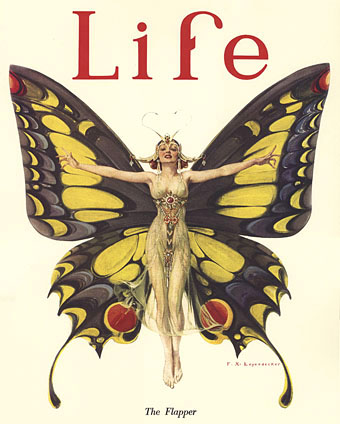
The Flapper by Frank X Leyendecker, Life magazine (1922).
When I posted this splendid cover last July I said that I ought to make a post of Butterfly Women, so here is one. Don’t expect this to be at all comprehensive, women with butterfly wings are as legion as mermaids, these are merely a couple of favourites.

Loïe Fuller by Koloman Moser (1901).
The ultimate butterfly woman must be Loïe Fuller (1862–1928) whose Serpentine Dance inspired a host of fin de siècle paintings and sculptures and was also filmed by the Lumière brothers in 1896. The Internet Archive has a tinted copy of the latter while Europa Film Treasures has an Italian short from 1907, Farfale (Butterflies) with a troupe of dancers (also hand-tinted) imitating the Fuller style.

Life magazine cover by Wladyslaw Benda (1923).
These two pictures were discovered via the wonderful Golden Age Comic Book Stories who always has the best scans of vintage art. The Life covers are from the humour periodical which expired in 1936, not the later photojournalism magazine. For more Life covers, look here.

Dragonfly by Alberto Vargas (1922).
Okay, so it’s called Dragonfly but those look more like butterfly wings to me. A delicate piece of Vargas cheesecake which echoes the flapper theme of the Leyendecker picture. This Flickr user has a whole set of butterfly girl cigarette cards but we don’t get to see them properly without paying. If anyone has seen them elsewhere, please leave a comment.
Elsewhere on { feuilleton }
• The illustrators archive
Previously on { feuilleton }
• Mermaids
• Wladyslaw Benda
• Vintage magazine art II
• Vintage magazine art