Weekend links 811

reiniger.jpg

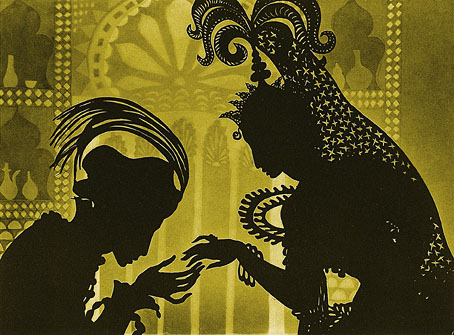
A still from The Adventures of Prince Achmed (1926), a feature-length animated film by Lotte Reiniger.

Hélice 39 is a speculative-fiction journal (in Spanish) whose current issue includes an article by Marcelo Sanchez: “What did Borges think of Lovecraft?”

• Among the new titles at Standard Ebooks, the home of free, high-quality, public-domain texts: The Maltese Falcon by Dashiell Hammett.

• Old music: Hydrophony For Dagon by Max Eastley & Michael Prime; The Adventures Of Prince Achmed by Morricone Youth.

Public Domain Review lists some of the writers whose works will enter the public domain this year.

• “Modern Japanese Printmakers celebrates vibrant mid-20th-century innovation“.

• At Nautilus: “Here’s what’s happening in the brain when you’re improvising.”

• At the BFI: Pamela Hutchinson selects 10 great films of 1926.

• New music: The Future Is Now by Pietro Zollo.

• At Dennis Cooper’s: Phil Solomon Day.

• 2026 is the Year of the Fire Horse.

Runaway Horses (“poetry written with a splash of blood”) (1985) by Philip Glass | Unicorns Were Horses (1996) by New Kingdom | Red Horse (2002) by Jack Rose

Illustrating Hyperborea

hyperborea00.jpg

The Book of Hyperborea (1996). Cover art by Robert H. Knox.

“My Hyperborean tales, it seems to me, with their primordial, prehuman and sometimes premundane background and figures, are the closest to the Cthulhu Mythos, but most of them are written in a vein of grotesque humor that differentiates them vastly.” — Clark Ashton Smith

Since re-reading Clark Ashton Smith’s The Tale of Satampra Zeiros I’ve been revisiting more of Smith’s stories set in the lost world of Hyperborea. And having put together a post some years ago that gathered all the original illustrations for Smith’s Zothique cycle, I thought I’d try and do the same for another of his story series. As I noted in the earlier post, we’re fortunate today that it’s so easy to see illustrations that in the past would have been impossible to find unless you owned (or had access to) a huge collection of pulp magazines. Pulp illustrations aren’t always very good—in the case of the early issues of Weird Tales, they’re frequently amateurish—but those that illustrate new fiction for the first time are historically important if nothing else.

pennington1.jpg

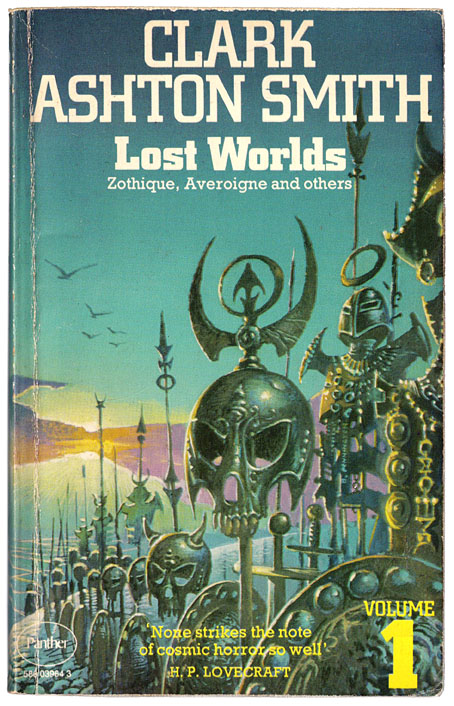
Lost Worlds: Volume 1 (1974). Cover art by Bruce Pennington. Lost Worlds was a single-volume collection published by Arkham House (USA) and Neville Spearman (UK). The Panther paperback covers by Bruce Pennington could easily be used on other books but these were the first Smith volumes I owned.  

The first Hyperborea stories were among Smith’s earliest prose fantasies, owing something to Lord Dunsany on the one hand (HP Lovecraft detected a Dunsanian quality), and the writers of antiquity on the other, the name “Hyperborea” (“Behind the North Wind”) being borrowed from the Greeks. The northern location is about the only feature of the continent that the Greek writers would recognise, Smith’s world being a temperate pre-Ice Age realm of mountains and verdant jungles. Dinosaurs and megafauna share the lands with human inhabitants for whom sorcery is a common practice. As with Zothique, the cycle was an influential one. Lin Carter in the introduction to his Ballantine collection, Hyperborea (1971), suggests that the name of the continent might have prompted Robert E. Howard to set his Conan stories in “the Hyborean Age”. This could be the case: Howard and Smith were writing for the same publications, and the first Conan story was published in Weird Tales shortly after The Tale of Satampra Zeiros; but Howard was also reading the Greeks as well. A more substantial influence may be found in Fritz Leiber’s Nehwon, a world in which aspects of Hyperborea and Zothique are combined. Sword and sorcery begins “behind the North Wind”, in other words, although there’s very little sword-play in Smith’s fiction, that was Leiber and Howard’s department.

pennington2.jpg

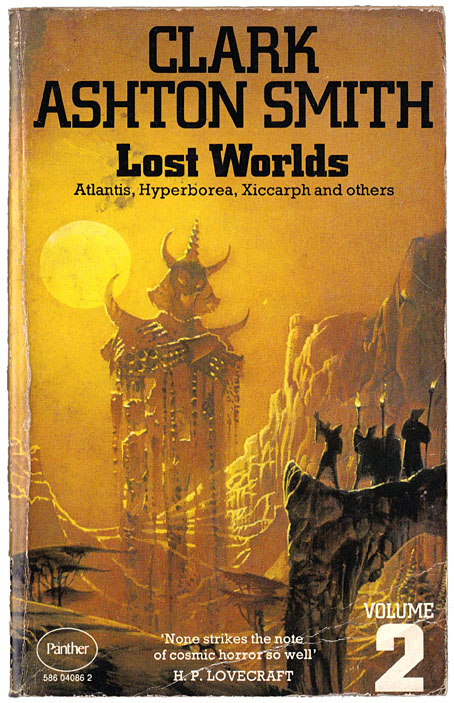
Lost Worlds: Volume 2 (1974). Cover art by Bruce Pennington.

The original Hyperborea illustrations are fewer than those for Zothique. As with the later cycle, several of the stories are unillustrated, while others were given lacklustre artwork. In the earlier post I followed the story order chosen by Lin Carter which attempted to contrive an internal chronology for the cycle. Carter did the same with his Hyperborea collection so I’ve followed his example once again. Later collections, like Will Murray’s Book of Hyperborea, tend to order the stories by publication date.

hyperborea01.jpg

The Seven Geases, Weird Tales, October 1934.

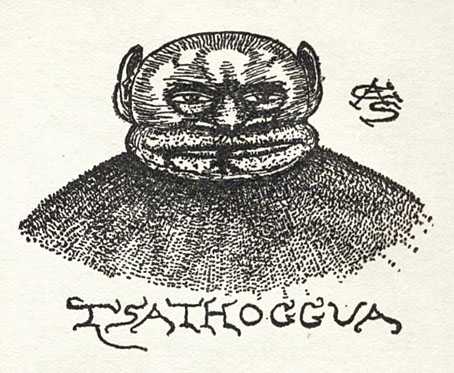
An illustration of Tsathoggua by Smith himself. The toad-god turns up in person in this story.

hyperborea02.jpg

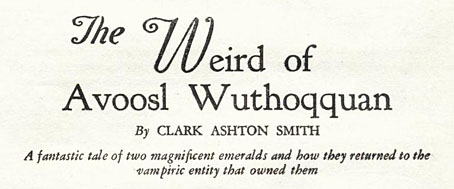
The Weird of Avoosl Wuthoqquan, Weird Tales, June 1932.

Continue reading “Illustrating Hyperborea”

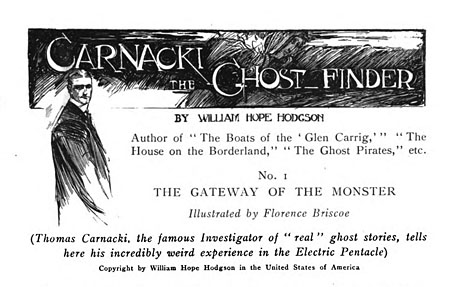
Carnacki’s first manifestation

carnacki1.jpg

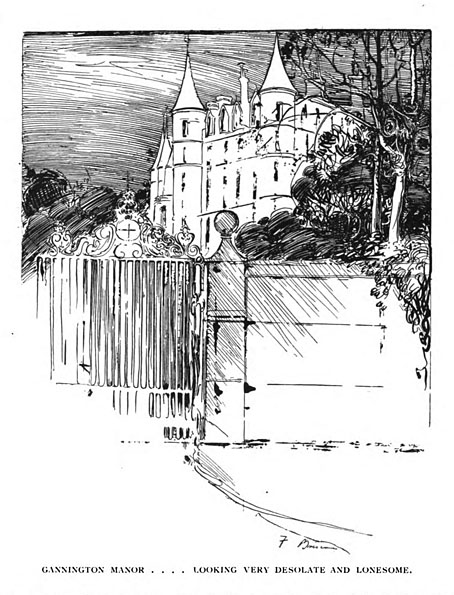
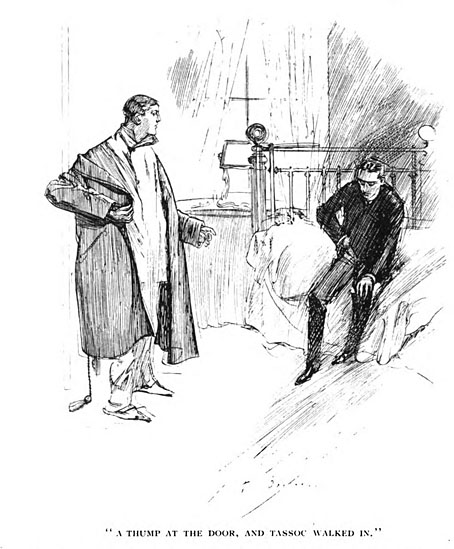
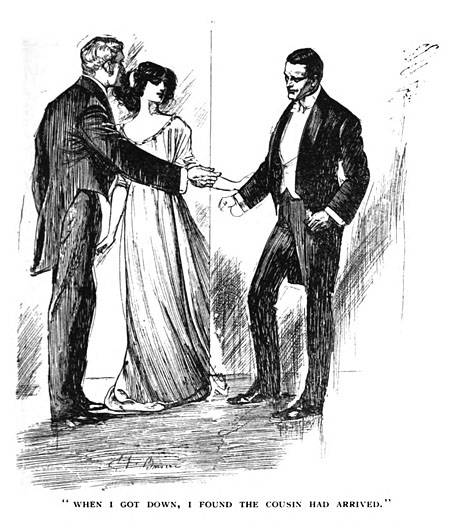
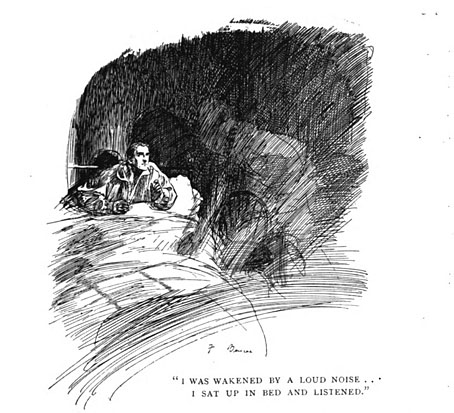
Visual manifestation, that is. The first Carnacki story to see print was The Thing Invisible, published in 1909 as a part of The Ghost Pirates, A Chaunty, and Another Story. The book wasn’t illustrated, nor was the Carnacki collection published by Eveleigh Nash in 1913. The five stories that ran in The Idler, however, were all decorated with sketchy illustrations by Florence Briscoe, all of which may be seen in this collection of extracted pages from the issues for 1910. (For the complete magazines, look here.)

carnacki2.jpg

The House Among the Laurels.

Miss Briscoe (and she does appear to have been a Miss at this point) has the distinction of being one of the first illustrators (possibly the first) of any of Hodgson’s fiction. She was also a friend of the author and may well have used him as a model for many of her illustrations. James Bojaciuk suggests as much in this piece of biographical research that I’d managed to miss when it was posted at Greydogtales. I think we can take Hodgson as a definite model for the portrait of Carnacki that illustrates the magazine header, the similarity between the drawing and one of the author’s photos is beyond doubt even if some of the other Carnacki drawings show less of a resemblance. Carnacki also seems to be quite tall, or at least of average male height, something that the diminutive Hodgson was not.

carnacki4.jpg

The Whistling Room.

Portraiture aside, Florence Briscoe’s illustrations tend to be of a type that I refer to as “people standing about in rooms”, a common form in the world of magazine illustration. Sidney Paget’s famous drawings of Sherlock Holmes are almost all of this type, stories of cerebral industry and ratiocination being rewarding for the reader, less so for the jobbing illustrator. (The Hound of the Baskervilles is a notable exception, with its dramatic locations and spectral atmosphere.) The most obvious difference between Carnacki and Holmes is that Carnacki encounters genuine manifestations of eldritch horror which he manages to keep at bay with his incantations and electrical devices. Miss Briscoe shows us none of this, unfortunately. But her figures are well-drawn, and as general illustration her work is of a higher standard than the often amateurish renderings you find in the early pulp magazines of the 1920s. The growing sphere of Hodgsonian illustration begins with these few stories.

carnacki3.jpg

The Horse of the Invisible.

carnacki5.jpg

The Searcher of the End House.

Elsewhere on { feuilleton }
The illustrators archive

Previously on { feuilleton }
The Whistling Room, 1952
The art of Jean-Michel Nicollet
Suspicion: The Voice in the Night
Hodgsonian vibrations
The Horse of the Invisible
Tentacles #2: The Lost Continent
Tentacles #1: The Boats of the ‘Glen Carrig’
Hodgson versus Houdini
Weekend links: Hodgson edition
Druillet meets Hodgson

Modern Pen Drawings, 1901

drawings08.jpg

Rustum and the Simoorg (1897) by Patten Wilson.

A new arrival at the Internet Archive. Modern Pen Drawings: European and American is a special number of The Studio magazine, one of several such numbers which they published in book form. The magazine’s editor, Charles Holme, edited the volume which maintains the high quality typical of all these publications, with excellent reproductions and informative notes about the artists and their works. Holme’s choices in collections such as this are always varied, mixing imaginative illustrations with comic drawings and nature studies. For a reader, the books are still useful today for showing you drawings that you might not see anywhere else, even when the artist is a familiar name. When the works themselves are familiar the reproductions are invariably better than you’ll find elsewhere. Such is the case with Patten Wilson’s “Rustum and the Simoorg”, an illustration of a Persian folk tale whose fine lines and details are often spoiled by poor printing. Elsewhere there are two pages of Théophile Steinlen’s inevitable cats, a drawing by Fernand Khnopff that I don’t think I’ve seen before, and Edmund J. Sullivan’s rose-bedecked skeleton which Alton Kelley later “repurposed” (or swiped) for the cover of the Grateful Dead’s second live album.

drawings01.jpg

drawings02.jpg

drawings03.jpg

drawings04.jpg

Continue reading “Modern Pen Drawings, 1901”

Weekend links 798

atlantis.jpg

Atlantis (1971) by Bartolomeu Cid dos Santos.

• “Given the workaday settings of many of his movies (a hotel, a summer camp, a science fair), their mortal stakes may come as a surprise, or at least as a paradox—yet paradox is at the heart of his entire body of work.” Richard Brody explores the New Yorker roots of Wes Anderson’s The French Dispatch.

• “The power of the Kelmscott Chaucer is in how all the elements harmonise to create something visually spectacular.” Michael John Goodman on William Morris and his reinvention of book design.

• At Smithsonian Mag: “What actually sparks Will-o’-the-Wisps? A new study traces the science behind the mysterious, wandering lights“.

• At Dennis Cooper’s: A chronology of 26 things with Clive Barker’s name on them and what he thinks about that.

• At Wormwoodiana: The novels of Derek Raymond and the type of crime fiction he called “The Black Novel”.

• At Colossal: Untamed flora subsumes abandoned greenhouses in Romain Veillon’s Secret Gardens.

• At The Wire: Read an extract from James Tenney: Writings and Interviews on Experimental Music.

• The Strange World of…Mulatu Astatke.

• RIP Patricia Routledge.

The Garden (1981) by John Foxx | The Secret Garden: Main Title (1993) by Zbigniew Preisner | Secret Garden (2011) by Sussan Deyhim