Illustrating Poe #3: Harry Clarke

hc_poe1.jpg

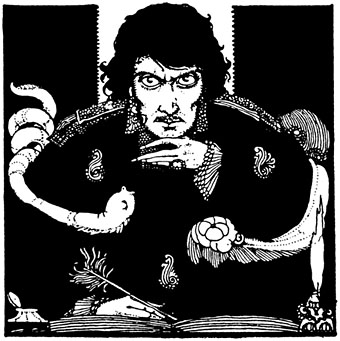
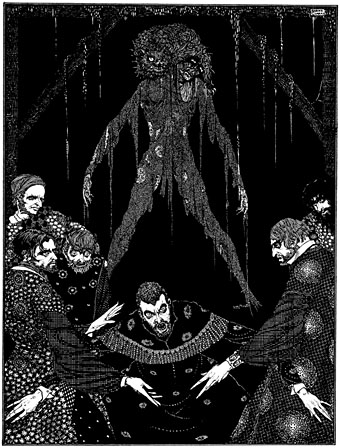
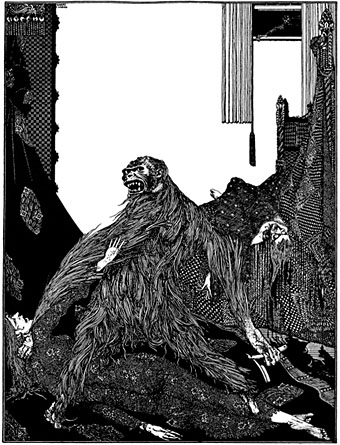
And so to the master. Harry Clarke’s illustrated edition of Tales of Mystery and Imagination was published by Harrap in 1919, with a new edition following in 1923 that featured an additional series of colour plates. I can’t imagine anyone ever producing a better illustrated version of Poe than Clarke managed, the morbid quality which some complain about in his work is perfectly suited to that most morbid of writers. So too are Clarke’s haunted and neurasthenic figures, and the many decorative details which provide an analogue to the author’s distinctive prose style. The first four drawings which follow repeat the earlier order of the Beardsley illustrations; an unfair comparison, perhaps, since the subject matter didn’t suit Aubrey’s temperament, but a comparison shows how differently the same stories might be illustrated, and how much Clarke brings the macabre elements to the fore.

There’s no need to post a large selection this time when quality scans have already appeared at A Journey Round My Skull and Golden Age Comic Book Stories. These drawings really do need to be seen showing all their fine detail.

hc_poe2.jpg

The Black Cat: “I had walled the monster up within the tomb!”

hc_poe3.jpg

The Murders in the Rue Morgue: “Gnashing its teeth, and flashing fire from its eyes, it flew upon the body of the girl.”

Continue reading “Illustrating Poe #3: Harry Clarke”

Illustrating Poe #1: Aubrey Beardsley

beardsley_poe1.jpg

The Black Cat.

Halloween approaches, as if you needed reminding. In honour of that event it’s Poe Week here at {feuilleton}, and we’ll be skating through some favourite depictions of stories and poems by the Boston genius.

Aubrey Beardsley’s four Poe illustrations were commissioned by Herbert S. Stone and Company, Chicago, in 1894 as embellishment for a multi-volume collection of the author’s works. The Black Cat is justifiably the most reproduced of these. The other drawings are fine in themselves but not very successful illustrations of Poe’s tales. Aubrey wasn’t really suited to this kind of horror atmosphere; looking at his ear-ringed orangutan and the spotless furnishings surrounding it you’d never guess the scene of murderous simian frenzy which lies at the heart of the story.

beardsley_poe2.jpg

The Murders in the Rue Morgue.

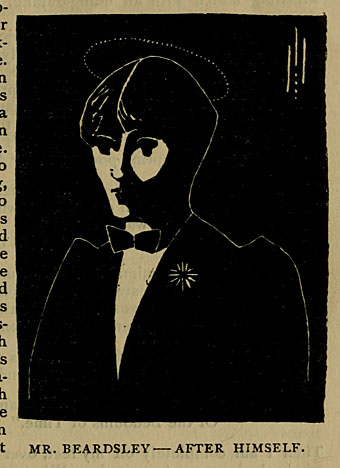
Herbert Stone’s company had begun publishing The Chap-Book in the same year, a witty American equivalent of British periodicals like The Yellow Book, and Beardsley’s work was featured in the early issues. Looking through some of these at the Internet Archive I was surprised to see the following illustration in a short appraisal of Beardsley’s art. If this is by the artist, as the credit implies, it’s a drawing I haven’t seen in any books of his work. If anyone can confirm this is a genuine Aubrey then please leave a comment. The other Poe illustrations follow.

beardsley_portrait.jpg

From The Chap-Book, May 15th, 1894.
Continue reading “Illustrating Poe #1: Aubrey Beardsley”

Horror! 333 Films to Scare You to Death

horror.jpg

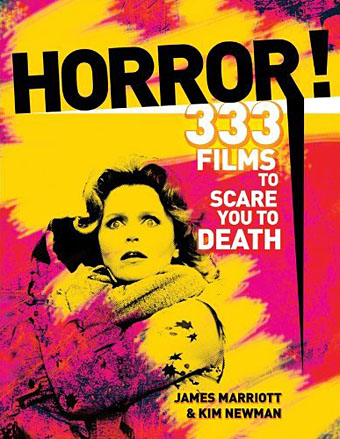
Arriving in the post this week was this 350-page guide to horror cinema, a Carlton Books reprint of the 2006 Andre Deutsch volume to which I contributed some 30-plus reviews and essays on Dracula, Lovecraft and occult cinema. This new printing is slightly expanded although the production is a lot less lavish than the earlier book which was a hardback with colour photos throughout. I suppose this one goes by the TV chair whereas the previous edition deserved a place on the bookshelf. I didn’t have a lot of time earlier this year to help with the updating but I did manage to write reviews of The Mist and Cloverfield, two recent horror outings I enjoyed a great deal. Despite the proliferation of online reviews there’s still a place for handy guides such as this, and I’d say that even if I wasn’t a contributor. Kim Newman is a contributing editor at Sight & Sound magazine, and both he and James Marriott have produced their own excellent guides to horror cinema. When sites like IMDB are weighed down with an opinionated rabble, an intelligent and informed counterweight is essential.

Previously on { feuilleton }
Berni Wrightson in The Mist
Stamps of horror
Horror comics
Hail, horrors! hail, infernal world!

Two Brides

ansin.jpg

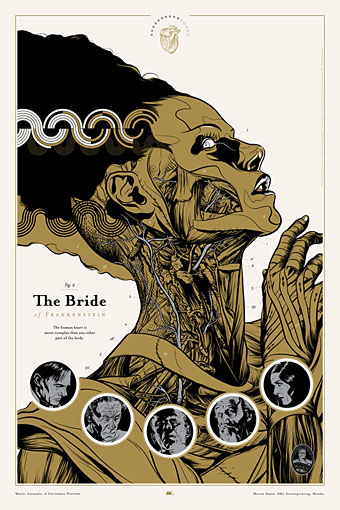
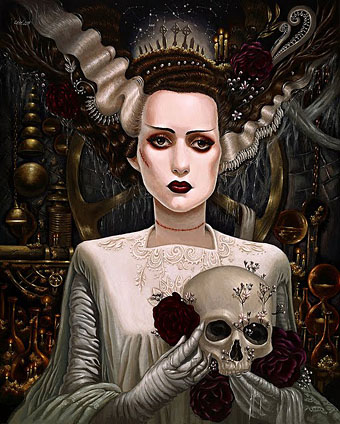
Ah, sweet serendipity… What are the odds, dear reader, of two blogospheric friends posting equally splendid pictures of everyone’s favourite hand-stitched and reanimated woman within days of each other? (It helps that Evan P and Monsieur Thombeau share a number of interests but let’s not spoil the moment.) The Gray’s-like dissection above is the work of illustrator Martin Ansin, while the painting below is by Michelle Mia Araujo, or Mia, as she prefers. Both artists have produced a quantity of other work which demands your attention. As for James Whale’s Bride of Frankenstein, it is, of course, one of the great cultural artefacts of the previous century; if you’ve never seen it there’s a Boris Karloff and Elsa Lanchester-shaped hole in your life which needs to be filled without delay.

mia.jpg

Previously on { feuilleton }
The Mask of Fu Manchu
Berni Wrightson’s Frankenstein

Druillet’s vampires

vampire3.jpg

Le Viol du Vampire (1968) or Rape of the Vampire (stay classy, Jean!); re-titled Queen of the Vampires for the Anglophone world.

We’re so inundated these days with vampires and—worse—fucking zombies, that I’ll be perfectly happy if I never see another bloodsucker or shambling corpse again. But let’s overlook the degrading of horror staples for a moment to consider Philippe Druillet‘s excursions into the art of the cinema poster.

vampire1.jpg

La Vampire Nue (1969).

These pieces are for Jean Rollin‘s first three films, additions to the groovy-lesbian-vampire-with-false-eyelashes-and-bare-boobs sub-genre made at a time—the late 60s—when all the European film studios, Hammer included, were pushing the erotic content of their films more than had previously been dared. Rollin’s erotic comic strip from 1967, Saga de Xam, featured art contributions from Druillet, among others, which no doubt explains the choice of artist. As with David Palladini’s fantastic design for Werner Herzog’s Nosferatu the Vampyre (1979), these are further examples of how unique and distinctive film posters once were in a way they rarely are today. (Druillet, incidentally, produced his own adaptation of Nosferatu in 1989.)

vampire2.jpg

Le Frisson des Vampires (1970).

Pages from the fabulously rare Saga de Xam feature in the Art Nouveau catalogue that was the subject of yesterday’s post. So too does Druillet’s poster for Le Frisson des Vampires although any of these pieces would have made suitable inclusions. Even more than in his comic strips Druillet’s work here shows the overt influence of Alphonse Mucha.

Most of Rollin’s films seem to be available on DVD should you be desperate for some fangs and boobs. I’d much rather see Saga de Xam be reissued; it’s been out of print since 1967 and the copies available go for upwards of £200. This site has samples of the pages and there’s a post about the book (in French) here. For more about Jean Rollin, see Fascination: the Jean Rollin Experience.

Elsewhere on { feuilleton }
The illustrators archive

Previously on { feuilleton }
The Art Nouveau dance goes on forever
Salammbô illustrated
Druillet meets Hodgson
The music of Igor Wakhévitch
Nosferatu