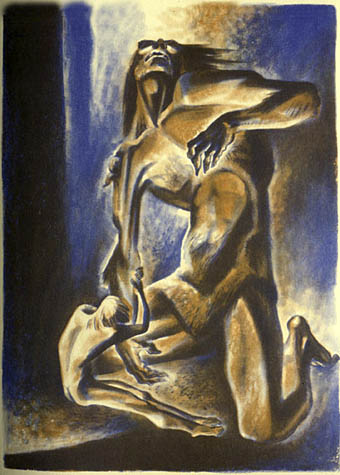
Beowulf wrestles with Grendel, Lynd Ward (1939).
There’s nothing new in pointing out Hollywood’s crimes against literature, the film business has been screwing up book adaptation since the earliest days of silent cinema. But sometimes the wound is so grievous you can’t help but speak out, in this case against Roger Avary’s Beowulf which is released next month. This is another CGI-heavy confection along the lines Polar Express, with the actors being given digital bodies via motion-capture, and it’s something I’d probably have ignored until I saw this picture of Grendel, the story’s principal monster. Beowulf is one of the earliest surviving Anglo-Saxon poems and Grendel, the bloodthirsty creature which Beowulf battles, is one of the ur-fiends of English literature, along with his equally monstrous, lake-dwelling mother and the dragon which fatally wounds the hero. The trio give us a peek back into the dark imagination from a time before recorded history and Grendel especially has always had something raw and primal about its character. So when you see a beast with such a history portrayed as little more than a diseased muppet you wonder what’s going on. Are the creators inept? Ignorant? Were studio restrictions at work? How does an industry with the talent to give splendid life to the trolls and Balrog of Lord of the Rings, or Davy Jones and crew in Pirates of the Caribbean, screw up so badly?
Continue reading “Cain’s son: the incarnations of Grendel”