New things for July

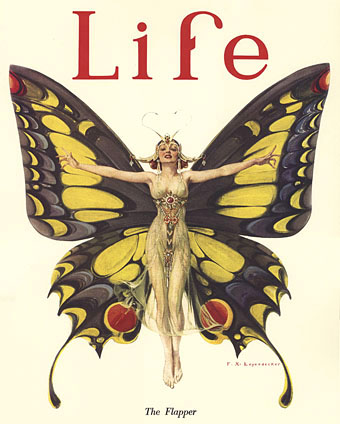
leyendecker_flapper.jpg

The Flapper by Frank X Leyendecker, Life magazine (1922).

• 2008 is turning out to be a great year for Lovecraft aficionados. As well as the stupendous Lovecraft Retrospective: Artists Inspired by HP Lovecraft, we’re also awaiting Frank Woodford’s feature length documentary, Lovecraft: Fear of the Unknown. I’m lucky to have my work included in Frank’s film which is easily the best documentary to date concerning the life and work of HPL. Among the interviewees are Neil Gaiman, John Carpenter, Guillermo Del Toro, Caitlin R Kiernan, Peter Straub, Ramsey Campbell and Lovecraft scholar ST Joshi. The film will receive its first (?) public screening later this month at the San Diego Comic Con:

Thursday, July 24
8:00–9:45pm
Room 26AB

• Over the weekend Arthur Magazine cleared the $20,000 it needed to keep running before the three-day deadline elapsed. A stunning piece of fund-raising which shows how much people value Jay and company’s efforts.

• The gorgeous cover above is the work of Frank X Leyendecker (1876–1924), brother of the more well-known (and gay) Joseph C Leyendecker. Makes me think I should make a post of Butterfly Women if only as an excuse to track down more pictures of Loie Fuller.

• Last but not least: happy birthday Lorraine!
Over the rainbow

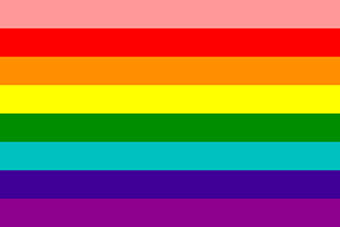
gay_flag1.jpg

Today is the 30th anniversary of the first appearance of the rainbow flag at a gay pride event. Gilbert Baker designed the flag which was used for the 1978 Gay Freedom Parade in—where else?—San Francisco and he talked to The Independent last week about its legacy.

waitcursor.gif

Baker’s original design can be seen below, with the stripes signifying (from top to bottom) sexuality, life, healing, sunlight, nature, magic, serenity and spirit. Subsequent changes dropped sexuality and magic to give us the more familiar arrangement seen in the photo above but it seems Baker would prefer everyone to revert to his original design. I tend to be ambivalent about rainbows, not only are they ubiquitous in other contexts—the spinning “Marble of Doom” on the left is a familiar sight to Mac users—but any spectrum arrangement presents problems for graphic designers. That aside, I wouldn’t mind seeing the original design returned to in order to distinguish it from the many other rainbow flags. But it may well be too late for that now, the six stripe flag is firmly embedded in gay culture. Garish it may be but it has the advantage of being highly visible, which is partly the point, of course. Flickr photos show how effective it is at standing out in a variety of surroundings.

gay_flag2.jpg

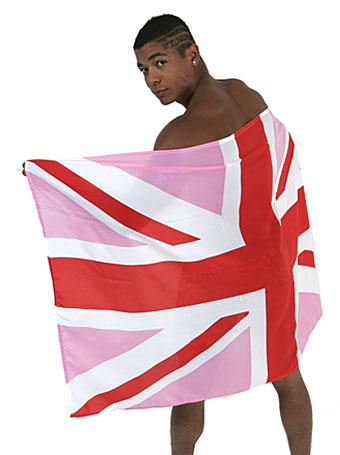
I was hoping to find a credit for the gay pastiche of Joe Rosenthal’s Iwo Jima photo but details about its creator seem elusive. If anyone knows who the photographer was, please leave a comment. I’ve noticed recently that this photo in particular, one of many pastiches of that famous image, annoys a certain type of knuckle-dragging American who sees it as an insult to the soldiers of the Second World War. In which case one has to hope they haven’t seen this Terry Pratchett book jacket. Here in Britain we regard it as bad taste to take flags too seriously, hence the increasingly common appearance at UK gay events of pink Union flags like the one below. Flags are signs, not religious icons, and as such they’re always open to change and reinterpretation; the evolution and appropriation of Gilbert Baker’s flag is the perfect example of that.

Update: The Joe Rosenthal pastiche is by Ed Freeman.

gay_flag3.jpg

Previously on { feuilleton }
The recurrent pose #2
Michael Petry’s flag

Aubrey by John Selwyn Gilbert

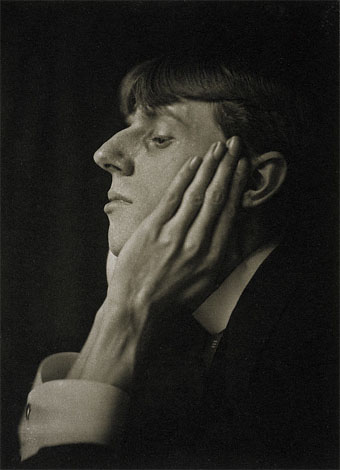
aubrey00.jpg

Aubrey Beardsley photographed by Frederick Evans (1894).

I’ve been going through the Coulthart VHS library recently, transferring to DVD recordings which can’t be purchased or found online. Among these is a drama from the BBC’s Playhouse strand, Aubrey by John Selwyn Gilbert, which was broadcast in 1982. This drama follows the life of artist Aubrey Beardsley from the time of Oscar Wilde’s arrest in April 1895—which event resulted in Beardsley losing his position at The Yellow Book—through the foundation of The Savoy magazine, to his tubercular death in March 1898.

aubrey01.jpg

John Dicks as Aubrey.

Playhouse was a BBC 2 equivalent of Play for Today (which usually ran on BBC 1) and Aubrey, like many other dramas of the period, was shot on video in the studio. This was done for convenience as well as being cheaper than shooting on film, since scenes could be filmed using several cameras simultaneously. The drawback is that the image looks very harsh, and historical works such as this often seem unreal and artificial as a result. If you can forgive this deficiency, Aubrey was an excellent production with some great performances, especially Ronald Lacey as Leonard Smithers and Rula Lenska as Aubrey’s sister, Mabel. The details of Beardsley’s life are very accurate, down to his beloved Mantegna prints on the walls, and many of the scenes are arranged to correspond with his drawings, the production design being largely monochrome.

Continue reading “Aubrey by John Selwyn Gilbert”