Weekend links 281

fini.jpg

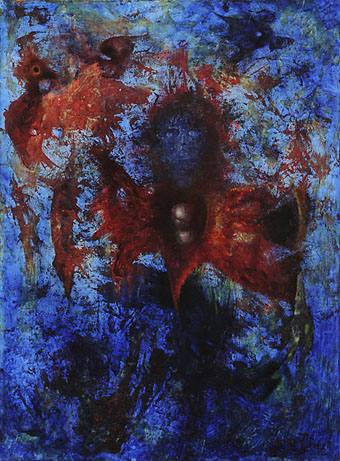
Chimère du soir (1961) by Leonor Fini. Réalisme irréel is an exhibition of Fini’s work currently running at the Weinstein Gallery, San Francisco.

• ” ‘Paris invented the flâneur,’ he notes, ‘and continues to press all leisurely and attentive walkers into exercising that pursuit, which is an active and engaged form of interaction with the city, one that sharpens concentration and enlarges imaginative empathy and overrides mere tourism.’ ” David L. Ulin reviewing The Other Paris by Luc Sante.

• “A lot of posters promise so much that how can they ever deliver?” Nicolas Winding Refn talking to Mat Colegate about his book, The Act Of Seeing, a collection of posters for exploitation films.

• “Sexuality is present throughout and often subverts a narrative we might read entirely differently from a straight poet.” Callum James reviews Physical by Andrew McMillan.

This movie will lose a lot of people along the way, but then again, as far back as 1962, Ballard wrote a manifesto for a new form of science fiction, Which Way to Inner Space?, in which he insisted that “from now on, most of the hard work will fall, not on the writer, but on the readers. The onus is on them to accept a more oblique narrative style, understated themes, private symbols and vocabularies.” This is exactly what Wheatley wants from his audience.

Mike Holliday comparing Ben Wheatley’s forthcoming film of High-Rise with JG Ballard’s novel. Ballard’s suggestion for a new SF now seems increasingly like a road not taken. But that’s another discussion entirely…

The Lost Library of John Dee, an exhibition of books owned by the Elizabethan magus, opens at the Royal College of Physicians museum, London, in January.

Clive Hicks-Jenkins has been writing about his illustration heroes including Alexander Alexeieff.

Cameron: Cinderella of the Wastelands. The exhibition has just finished but the art is still online.

• Mixes of the week: FACT Mix 518 by Fis, and Secret Thirteen Mix 165 by Damien Dubrovnik.

• At Dirge Magazine: Tenebrous Kate on Fantômas, the French King of Crime.

• Suitably seasonal: Polish Night Music by David Lynch & Marek Zebrowski.

Kickin’ In, a previously unreleased EP of music by Patrick Cowley.

Jean-Michel Jarre‘s favourite albums.

Seeing It As You Really Are (1970) by Hawkwind | Seeing Out The Angel (1981) by Simple Minds | Seeing Red (1998) by Red Snapper
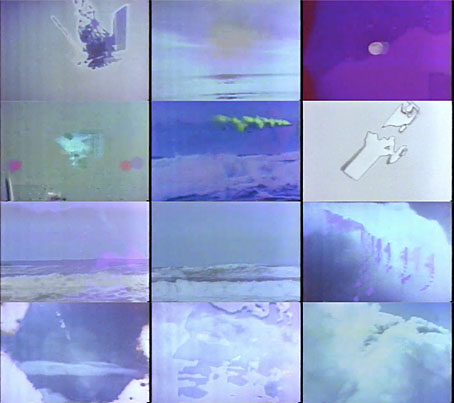
Moon 69, a film by Scott Bartlett

moon69.jpg

Scott Bartlett was the director of OffOn (1967), one of the key works of psychedelic cinema, and an earlier example of experimental film making use of video effects. Similar effects may be seen in Bartlett’s follow-up, Moon 69, which subjects footage from the NASA archives to a variety of processing techniques, especially solarisation. The copy linked here is the only available one at the moment, and is hosted by a channel where several similar films have amended soundtracks. Consequently, the soundtrack on this one may not be the original.

Elsewhere on { feuilleton }
The abstract cinema archive

Dream of the Wild Horses, a film by Denys Colomb de Daunant

horses.jpg

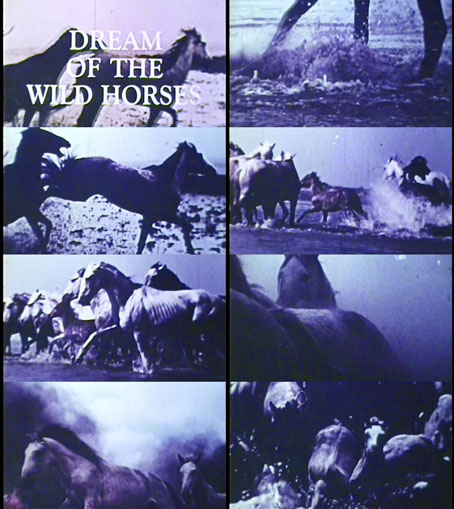
Denys Colomb de Daunant wrote and acted in Albert Lamorisse’s boy-meets-horse film, White Mane, in 1953. Lamorisse’s feature concerns the wild horses that roam the Camargue in France, and the same horses are the subject of Dream of the Wild Horses (1960), a kind of oneiric sequel to White Mane. There’s no narrative, only a succession of slow-motion shots of horses fighting, running, and—in a sequence you hope wasn’t set up for the cameras—stampeding through a wall of flames. Of note for me is the score by Jacques Lasry which is performed on the Cristal Baschet, a unique instrument of glass and metal developed by François and Bernard Baschet in the 1950s. (See this post.) Films such as this depend more than most on their musical accompaniment, and the eerie, rumbling timbres of Lasry’s music help sustain the dreamlike qualities of the piece.

Elaine Hanelock’s Hollywood stars

hanelock04.jpg

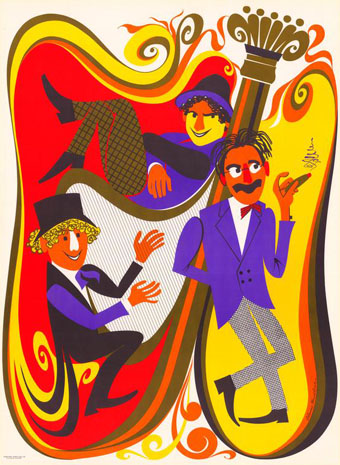
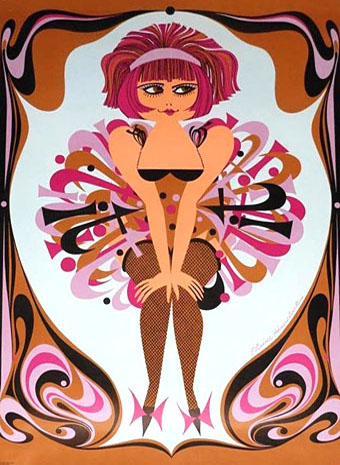
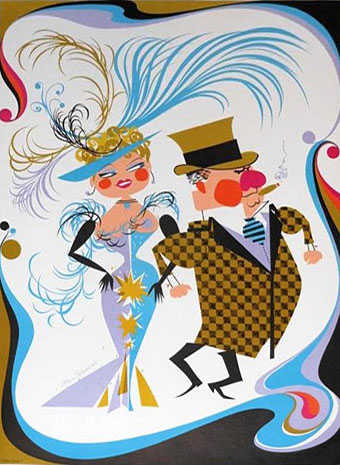
The essay I wrote about psychedelic art for Communication Arts earlier this year had a word limit so there was little mention of the way the psychedelic style was swiftly co-opted by advertising and commercial art as a means of reaching a youthful audience. This is a really a subject in itself, the way in which an aesthetic that was countercultural in 1965 was becoming mainstream by 1968, and was still rippling through the world of graphic design in the early 1970s.

Elaine Hanelock’s posters of Hollywood stars of the 1920s and 30s were published by Royal Screen Craft Inc, Los Angeles, in 1968, and combine two trends: psychedelic art and the nostalgia for old Hollywood that emerged in the mid-60s. There are ten posters in the set: The Marx Brothers, Clara Bow (the “It Girl”), Mae West & WC Fields, Laurel & Hardy, John Barrymore, Charlie Chaplin, Clark Gable, Jean Harlow, Will Rogers, and Wallace Beery & Marie Dressler. Nobody seems to know anything about Elaine Hanelock’s career elsewhere but her posters continue to find an audience among collectors.

hanelock07.jpg

hanelock01.jpg

Continue reading “Elaine Hanelock’s Hollywood stars”

Weekend links 279

ray.jpg

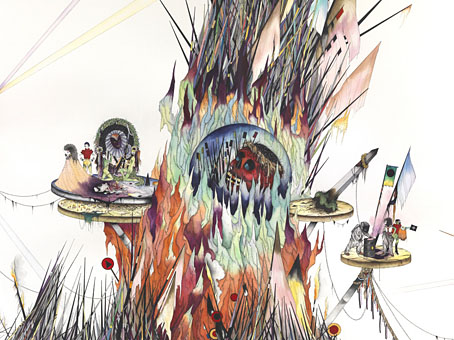
Untitled painting by Jen Ray.

• Lots of architecture links this week so it’s fitting that one of them is director Ben Wheatley talking to David Fear about his forthcoming film of JG Ballard’s High-Rise: “I was just thinking about this the other day, how hard it was to get a hold of stuff before the Internet. You really had to hunt down stuff or have someone who knew what was up to say, ‘You gotta read Naked Lunch, mate. You gotta read Crash.’ […] They were secretive things you had to ferret out, those books. It was the same with music and certain movies. And drugs.” Related: Souvenir d’un Futur, photographs by Laurent Kronental of the high-rise banlieues of Paris.

• “In Ancient Egypt, if a lowly official received the glyph of an owl from the Pharaoh, it was understood that the recipient should take his own life.” Carey McHugh in a brief history of the owl.

• I’d always thought the red buildings seen briefly in Blow-Up (1966) had been painted to Antonioni’s orders. Not so, says Another Nickel In The Machine.

He belongs right up there with Poe and Kafka. The best writer of weird fiction in the past half century. And the reason he belongs there is Ligotti’s both visceral and intellectual, formally experimental and able to tell a traditional horror story with equal ease. He’s also modernized the weird tale, from his early work on. The later workplace stories complete that process. The other thing he brings is a very dark sense of humor and a sense of the absurdity of the world—and a critique of that world that serves as subtext. All of these elements in harmony—symbiosis and contamination—equal genius. I read his work in a continuum that includes Kafka, Poe, Angela Carter, Bruno Schulz, Rikki Ducornet, and the great Caitlin R. Kiernan, but also absurdists and realists and flat-out surrealists. I appreciate that Ligotti stories can be revisited and reveal new dimensions.

Jeff VanderMeer on Thomas Ligotti

David Ferry talks to the people trying to excavate the remains of sets from Cecil B. DeMille’s first film of The Ten Commandments.

• As part of the ongoing vinyl reissue deluge, Crammed Discs are releasing a 10-disc box of albums by the great Tuxedomoon.

• At Strange Flowers: I see for it is night, remembering Marie Cermínová, better known as Surrealist artist Toyen.

Blue Sun Chiming, an animated video by Elisa Ambrogio for the song of that name by Six Organs of Admittance.

• At BLDGBLOG: Occult Infrastructure and the “Funerary Teleportation Grid” of Greater London.

• Enigmatic music makers Watch Repair are now selling their works at Bandcamp.

• Video by Harald Albrigtsen of whales basking under the Northern Lights.

• The urban explorations of Russian photographer Ralph Mirebs.

• Mix of the week: Secret Thirteen Mix 164 by Discipula.

The lost rivers that lie beneath London

Egypt (1985) by Tuxedomoon | Whales Tails (1986) by Cocteau Twins | London’s Lost Rivers (1996) by Coil