‘Father of LSD’ dies aged 102
| Albert Hofmann, RIP.
Category: {drugs}
Drugs
Absinthe girls
The classic absinthe poster from 1896 by Henri Privat-Livemont (1861–1936), one of the best exponents of the post-Mucha style. Don’t let anyone tell you that using unclad women’s bodies in advertising is a new thing.
And a couple more Mucha-esque examples circa 1900, both credited to “Nover”, from the wide selection of absinthe graphics at the Virtual Absinthe Museum.
The printer was L. Revon et Cie, situated in Paris at 93 Rue Oberkampf. The artist’s signature “Nover” is a mystery—no designer by that name is recorded. Since however the word is a palindrome of Revon, the assumption must be that the artist was Revon himself, or alternatively an anonymous employee of the firm. The same artist was responsible for the well-known Absinthe Vichet poster, also printed by Revon et Cie.
Interesting that so many of these posters show the women holding the glasses aloft as though receiving a libation from the gods. Privat-Livemont’s painting adds to the sacred effect by putting a halo behind the absinthe-bearer’s head.
Also at the Virtual Absinthe Museum is this warning against the dangers of the Green Fairy which would make a good addition to the Men with snakes post.
Previously on { feuilleton }
• 8 out of 10 cats prefer absinthe
• Smoke
• Flowers of Love
Happy birthday, Mr Hofmann
Albert Hofmann by Alex Grey.
Albert Hofmann, discoverer of LSD, 102 years old today. Last month Scientific American reported that hallucinogenic drugs are once again being considered as a way to treat psychiatric disorders.
Previously on { feuilleton }
• The art of LSD
• The trip goes on
• Albert Hofmann
• Hep cats
From LSD to OSX

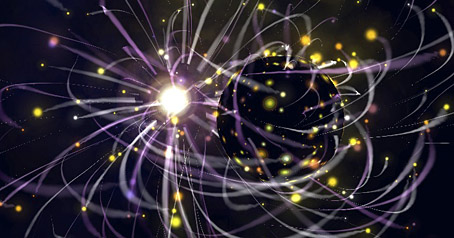
A few servings of iTunes jelly.
I’ve spent the past week or so enjoying the delights of Leopard, the 10.5 iteration of Apple’s OS X operating system, but have only just noticed the new Visualizer patterns in the latest version of iTunes. I don’t use the Visualizer much, especially since the introduction of Front Row, Apple’s home media management system, but it’s always nice to know it’s there. The original Visualizer isn’t so far removed from the graphic tricks I used to laboriously program into my old Spectrum computer in the 1980s, simple repeated shapes with coloured lines, albeit a lot faster and with far more detail and animation than a 48k Spectrum could ever manage. The latest Visualizer has been significantly supercharged, however, and the new “Jelly” setting creates some really beautiful (and it should be noted, trippy) patterns, reminiscent of Steven Spielberg’s Close Encounters UFOs or James Cameron’s Abyss inhabitants.
I can’t help but see a direct line of continuity here from Apple’s origin in the head culture of Sixties and Seventies’ California to the present. Writer John Markoff examined some of the connections between psychedelic culture and the nascent computer scene in What the Dormouse Said: How the Sixties Counterculture Shaped the Personal Computer Industry where we find Apple CEO Steve Jobs saying that “taking LSD was one of the two or three most important things he had done in his life.” Given this, the glowing, pulsating mandalas in the new iTunes can be seen as a vestigial remnant of that era, and it seems fitting that those patterns are integrated into a music player; it was upon the Sixties’ music scene, after all, that LSD originally had its greatest cultural impact.
Update: For anyone wanting to play with iTunes Jelly, there’s a couple of undisclosed features (this is for Macs but I imagine they’d be the same in the PC version). Pressing M tells you the name of the pattern currently being displayed, pressing 1 shrinks part of the pattern, 2 zooms it out and 8, 9 and 0 cause different colours to over-saturate. It’s a full-on psychedelic light-show, in other words.
Update 2: If you press M so it shows the pattern name then press the Up or Down arrow, you can flick through the various pattern settings.
• Watch Jelly in action
• Steve Jobs drops acid in Pirates of Silicon Valley
Previously on { feuilleton }
• iTunes 7
New things for October
“Mirage in time—image of long-vanish’d pre-human city.”
A couple pieces of news to catch up with here, both Lovecraft-related which is very apt for the month of Halloween. The first is the work I gave a teaser view of in August, a commission for Maison d’Ailleurs, the Museum of Science Fiction, Utopia and Extraordinary Journeys in Yverdon-Les-Bains, Switzerland. The brief for An Exhibition of Unspeakable Things: Lovecraft’s Commonplace Book was to choose an entry from HP Lovecraft’s Commonplace Book, his source of story ideas. The entry I chose implies some of the alien architecture which is a feature of At the Mountains of Madness although I’ll admit that the final result is debatable as architecture.