The skull beneath the skin

skull1.jpg

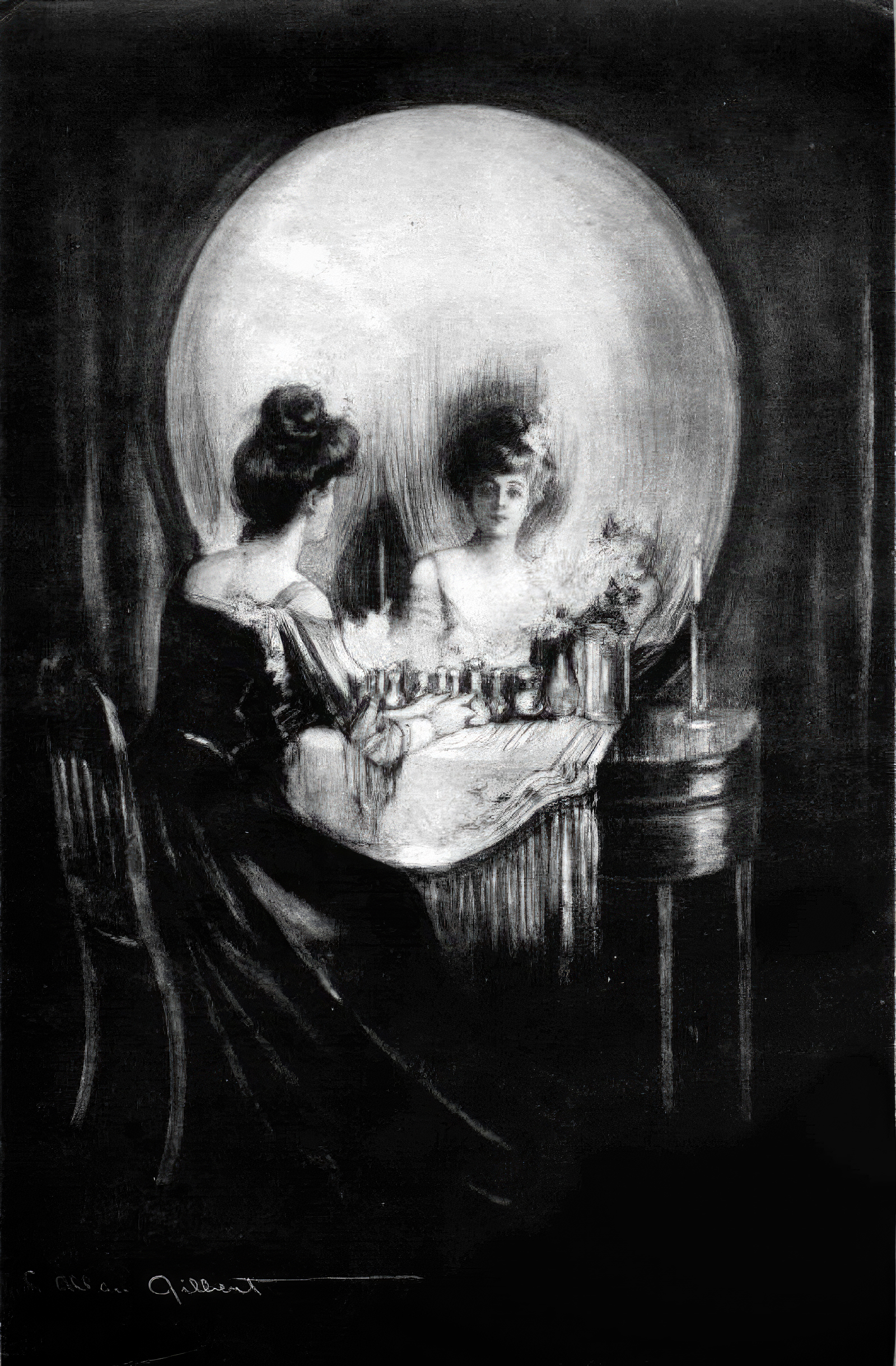
All Is Vanity by Charles Allan Gilbert (1892).

The subliminal skull is another of those perennial motifs that recur in art from time to time, and one which has become especially prevalent since the late 19th century. There seem to be a number of reasons for this, the most obvious being that if you’re going to show how clever you are by hiding one image inside another you may as well make the hidden thing something that everyone recognises. A secondary reason would seem to be the waning power of the vanitas theme. As painting became more pictorially sophisticated it wasn’t enough to simply show a skull and expect people to accept this with a stern moral as the principal content. Hence the development of death as a non-skeletal character in Symbolism and the reduction of skulls in pictures to a kind of playful game.

Holbein’s anamorphic skull in The Ambassadors is probably the grandfather of all the later versions but the more recent popularity of the hidden motif can be traced back to Charles Allan Gilbert whose 1892 picture, All is Vanity, drawn when he was just 18, was sold to Life Publishing in 1902, and subsequently spread all over the world in postcard form. Despite giving birth to a host of imitators, Gilbert’s picture is the one that still inspires artists and photographers up to the present day.

Continue reading “The skull beneath the skin”

Mouse Heaven by Kenneth Anger

mouse.jpg

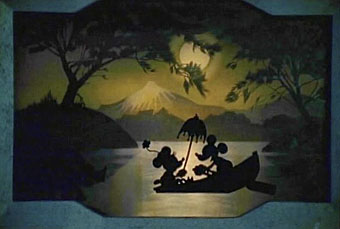
Mouse Heaven: Minnie and Mickey.

Kenneth Anger’s paean to Disney rodent memorabilia, and one of his most recent works, turns up at the Grey Lodge. Mouse Heaven is a distinctly minor piece, an awkward mix of film and video which juxtaposes shots of mouse figurines with a song-based soundtrack. Scorpio Rising this isn’t but the editing is up to his usual standard, and it has a curious, if rather grotesque, charm.
bugs1.jpg

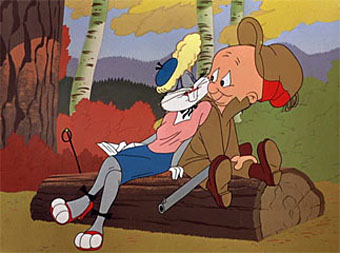
Rabbit heaven: Bugs drags up again.

I suspect I’m not the ideal audience for a film such as this, never having been very taken with Mickey and the rest of the Disney crew. This seems to be a generational thing. My parents are about Anger’s age and they watched Disney shorts regularly at the cinema, while older Americans would have seen the Mickey Mouse Club on TV in the 1950s. By the time my sisters and I were watching cartoons on television Disney had retreated into the pop culture background. Plenty of merchandise was available, of course, but the animations that gave birth to these characters were rarely seen on British TV since Disney was worried about over-exposure of their precious assets.

The consequence of this (which I doubt they realised) was that a new generation of kids could happily and eagerly watch all the Warner Brothers Merry Melodies (and MGM’s Tom & Jerry and Tex Avery cartoons) whereas I’ve still seen very few Mickey Mouse cartoons. Those that did turn up were either primitive (Steamboat Willie) or presented a Mouse character that was actually a suburban middle-class American. The contrast between Donald Duck’s irritating petulance and Daffy’s wisecracks, or between the Mouse in a house and a bisexual rabbit, could hardly be more striking. The last shred of any potential Disney charm was dispelled when I read the priceless demolition of Disneyworld and its inhabitants, Mickey Rodent!, by Harvey Kurtzman and Will Elder, in a reprint of MAD magazine:

Strolling in the foreground of the opening panel is Mickey himself, with a four-day stubble on his face and a snapped mouse trap on his snout; his left arm has a TV screen, smashed in the middle, with “Howdy Dooit” sunrays visible. (That’s an inside joke: in a previous issue, parodying “Howdy Doody,” Mickey was seen at the edge of the opening panel, grasping and shouting, “That’s MY sunray from MY movies behind his head and I wannit back!”) Around him a melodrama unfolds: Horace Horszneck is being dragged off to jail “for appearing without his white gloves.” The animal chorus behind him clucks, moos and barks their annoyance with “Walt Dizzy’s” rule about wearing white gloves at all times… “In this hot weather too!” “And it’s so hard to buy those furshlugginer three-fingered kinds!” (Read the rest of the description here and try and see the comic for yourself; it’s a masterpiece.)

There was no going back after that, and Wally Wood’s Disneyland Memorial Orgy was merely the icing on an already mouldering cake. So, sorry Kenneth, but I’m an apostate; Bugs Bunny rules my blue heaven.

The Look traces the history of Wally Wood’s scurrilous poster from hippie to punk to Alison Goldfrapp

Previously on { feuilleton }
The Man We Want to Hang by Kenneth Anger
Relighting the Magick Lantern
The Realist
Kenneth Anger on DVD…finally
Jessie M King’s Grey City of the North

advocates.jpg

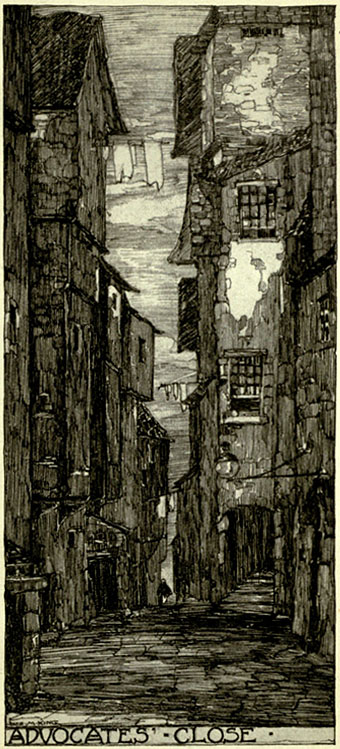
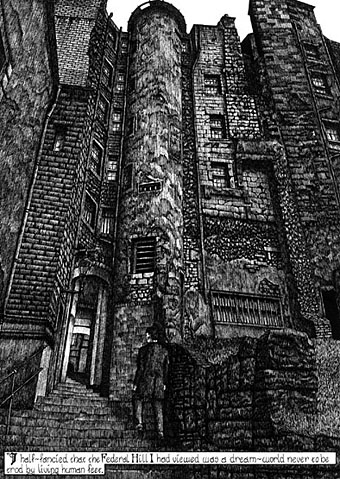
“This dark and steep alley took its name from Sir James Stewart of Goodtrees, Lord Advocate of Scotland, 1692–1713, whose mansion stood at the foot of the close. It was a fashionable quarter in the early 18th century, and here resided Andrew Crosby, the famous lawyer, the original of Scott’s ‘Andrew Pleydell,’ Lord Westhall, John Scougall, the painter of George Heriot, and many well-known people of the time.”

Another book scan from the Internet Archive, this time a title which plays to my fetish for Old Edinburgh. The illustration work of Jessie M King (1875–1949) was featured here in September with a delicate piece from A House of Pomegranates by Oscar Wilde. The Grey City of the North (1910) is quite a departure from her usual style, being a collection of monochrome views of buildings, streets and closes of the Old Town. Very nice lettering on all the plates which perhaps shows some influence from her colleague Charles Rennie Mackintosh.

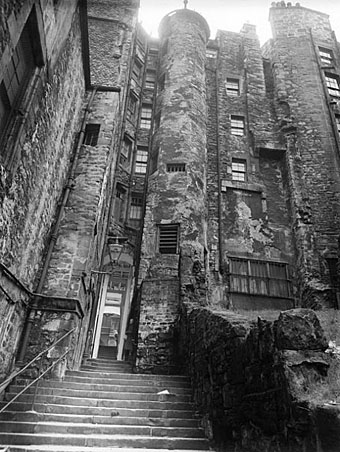
Advocates’ Close has particular significance for me since I copied a view of the alley for my adaptation of HP Lovecraft’s The Haunter of the Dark in 1986. Providence looks nothing at all like Edinburgh, of course, but I couldn’t find adequate reference at the time so used photographs of Scotland by Edwin Smith instead. You can see Smith’s photograph and my rendering of it below. Among the Internet Archive’s other Jessie King books there’s a follow-up to the Edinburgh volume, The City of the West; 24 drawings in photogravure of Old Glasgow.

advocates2.jpg

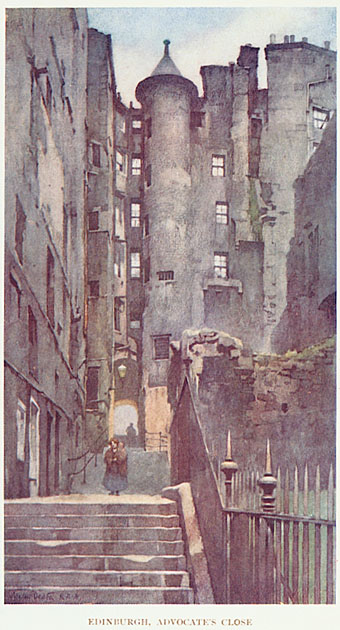
Another view of the close from Edinburgh and The Lothians by Francis Watt; illustration by Walter Dexter (1912).

advocates3.jpg

Advocates’ Close by Edwin Smith from Scotland (1955).

This book of photographs was an early Thames & Hudson title using their typically excellent photogravure reproduction. My copy was rescued from a waste bin near Manchester University and I’ve used it so much for reference over the years I’ve often wondered what I would have done without that chance encounter. You can see from my copy below (drawn with a 0.2mm Variant pen) how much detail I skimped and how much I embellished. I skimped rather more than I remember, as it happens. I think if I’d have drawn this a couple of years later I might have been more faithful to the original.

advocates4.jpg

Elsewhere on { feuilleton }
The illustrators archive

Previously on { feuilleton }
Ephemeral architecture
The Essex Street Water Gate

Design as virus 3: the sincerest form of flattery

mindscape.jpg

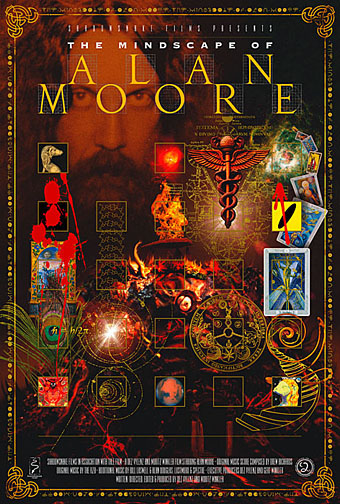
The Mindscape of Alan Moore; film poster by John Coulthart (2003).

moore_poster.jpg

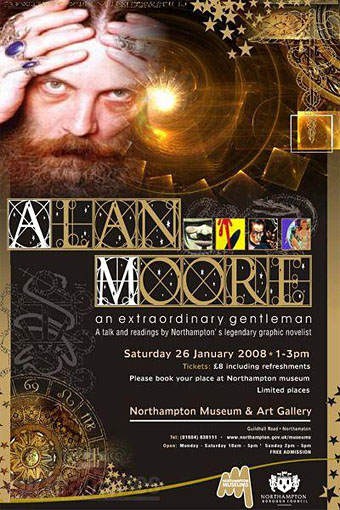
Alan Moore: An Extraordinary Gentleman;
event poster by unknown designer (2008).

Previously on { feuilleton }
Design as virus 2: album covers
Design as virus 1: Victorian borders

James Bond postage stamps

stamps1.jpg

stamps3.jpg

stamps2.jpg

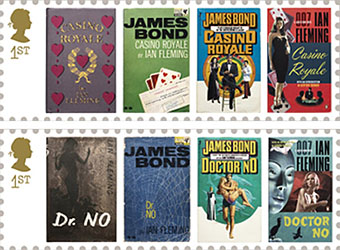
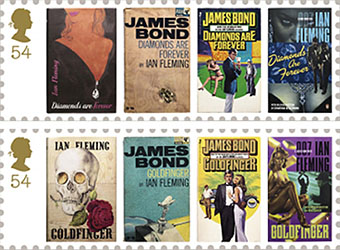
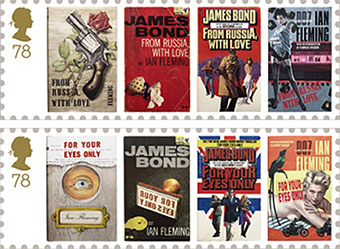
Proving once again the centrality of James Bond to contemporary British identity, the Royal Mail releases these stamps on January 8th, 2008, the 100th anniversary of Ian Fleming’s birth. If a sexist state assassin seems an awkward choice of cultural ambassador, Alan Moore and Kevin O’Neill present a more iconoclastic view of the super spy in the Black Dossier, the latest volume in their unfolding history of the League of Extraordinary Gentlemen.

Good to see that the stamp designs above include the Pan paperback covers from 1963. (The other examples are the first editions from Jonathan Cape, the 2006 Penguin reprints and what appear to be a set of Seventies reissues.) A friend of mine at school had a collection of the Pan books and they remain my favourite Bond book designs, not least because they were some of the first book covers to strike me as being well-designed rather than well-illustrated. What the Flickr link doesn’t show is the die-cut holes in the Thunderball jacket which made the cover seem as though it was pierced by bullets, the kind of expensive production detail you rarely see on anything other than a bestseller.

And while we’re on the subject of Bond design, Daniel Kleinman’s superb Casino Royale title sequence is on YouTube.

Elsewhere on { feuilleton }
The book covers archive

Previously on { feuilleton }
Please Mr. Postman