Ballard in Barcelona

ballard_barcelona.jpg

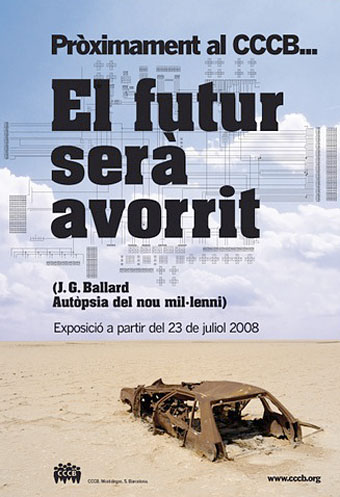
JG Ballard. Autòpsia del nou mil·lenni is an exhibition at the Centre de Cultura Contemporània de Barcelona which takes the work of everyone’s favourite Shepperton resident as its theme. The exhibition runs to November 2nd, 2008 and the website includes a blog where Spanish readers can explore the “Univers Ballard”. For Anglophones, curator Jordi Costa has a lengthy piece over at Ballardian where you can also see the Lynchian promo film, JG Ballard: In the Raw. I was in discussion there myself recently, exploring the very tenuous (some might say invisible) connections between Ballard and Lovecraft.

Previously on { feuilleton }
1st Ballardian Festival of Home Movies

Arthur Zaidenberg’s À Rebours

arebours1.jpg

“It had not been able to support the dazzling splendour imposed on it…”

It was a novel without a plot and with only one character, being, indeed, simply a psychological study of a certain young Parisian who spent his life trying to realize in the nineteenth century all the passions and modes of thought that belonged to every century except his own, and to sum up, as it were, in himself the various moods through which the world-spirit had ever passed, loving for their mere artificiality those renunciations that men have unwisely called virtue, as much as those natural rebellions that wise men still call sin. The style in which it was written was that curious jewelled style, vivid and obscure at once, full of argot and of archaisms, of technical expressions and of elaborate paraphrases, that characterizes the work of some of the finest artists of the French school of Symbolistes. There were in it metaphors as monstrous as orchids and as subtle in colour. The life of the senses was described in the terms of mystical philosophy. One hardly knew at times whether one was reading the spiritual ecstasies of some mediaeval saint or the morbid confessions of a modern sinner. It was a poisonous book.

The corrupting French novel which Lord Henry Wotton gives to Dorian Gray is never named by Oscar Wilde but its identity is no secret. À Rebours (Against Nature) by Joris-Karl Huysmans was published in 1884 and Wilde, Whistler and others were immediately impressed by what amounts to a manual for the lifestyle of a Decadent Aesthete. Wilde fell sufficiently under its spell to have Dorian Gray in the later chapters of his own novel indulge his senses much like Huysmans’ protagonist, Des Esseintes; where Des Esseintes grows poisonous blooms and fills his room with exotic perfumes, Dorian Gray luxuriates over a hoard of precious stones.

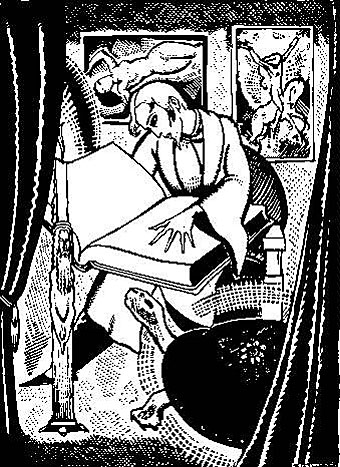
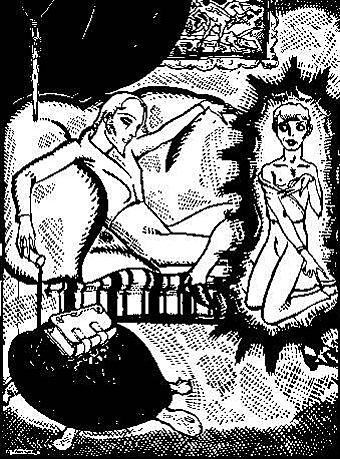
À Rebours features lengthy descriptions of Symbolist art, with particular attention given to Gustave Moreau and Odilon Redon. Yet despite the visual description Arthur Zaidenberg’s illustrations are the only ones I’ve come across to date. The book may be influential but it seems too obscure to have attracted illustrators. Zaidenberg’s drawings from a 1931 edition are executed in a woodcut style not far removed from Frans Masereel’s earlier work in books such as Die Stadt (1925), and as such the style is fashionably spare, not necessarily the right choice for a work concerned with sensory delirium. (This Zaidenberg street scene from 1937 shows a definite Masereel influence.) I’d much rather have seen Harry Clarke illustrate Huysmans. Zaidenberg’s drawings are also curious for their foregrounding of the sexual content which makes me think this edition may have been sold on the basis of a salacious reputation. The scene below, for example, doesn’t occur in the novel but can be implied from the description of Des Esseintes meeting a schoolboy in the Avenue de Latour-Maubourg.
arebours2.jpg

“Never had he experienced a more alluring relationship.”

The complete (?) set of Zaidenberg’s illustrations can be seen here. Pages from a later artists’ manual, Anyone Can Draw, are at VTS.

Elsewhere on { feuilleton }
The illustrators archive

Previously on { feuilleton }
John Osborne’s Dorian Gray
Because Wilde’s worth it
Whistler’s Peacock Room
Dorian Gray revisited
Frans Masereel’s city
The Poet and the Pope
The Picture of Dorian Gray I & II

Passages from James Joyce’s Finnegans Wake

finnegan.jpg

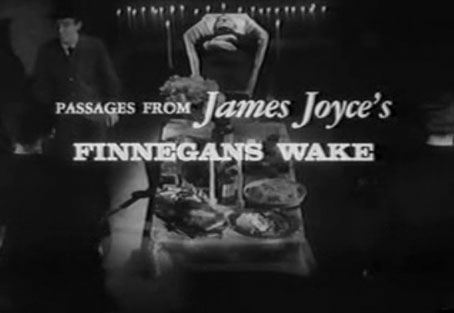
Ubuweb continues to come up with the very obscure goods. Mary Ellen Bute’s Passages from James Joyce’s Finnegans Wake is the kind of thing you would have been lucky to see on television even in the days when non-Hollywood fare was screened regularly. Joyce is almost the definitive example of the unfilmable author although that didn’t prevent Joseph Strick from having a go at Ulysses in 1967 and A Portrait of the Artist as a Young Man ten years later. Ulysses if it was filmed at all should probably be done as eighteen hour-long films rather than Strick’s truncated skate through the novel. Some passages work better than others but I’ve never been able to accept Milo O’Shea as Leopold Bloom. Bosco Hogan on the other hand is permanently fixed in my head as Stephen Dedalus having seen Portrait before reading the book.

As to the success of Mary Ellen Bute’s opus, I still haven’t watched it properly so you’ll have to go and look for yourself. It’s little more than an illustrated reading but that’s not necessarily as misguided as it seems. Finnegans Wake for many people is one of English literature’s impregnable fortresses; anything that helps break down the doors is surely worthwhile.

Passages from James Joyce’s Finnegans Wake
Directed by Mary Ellen Bute
Screenplay by Mary Manning
Cinematography by Ted Nemeth
Music by Elliot Kaplan

Cast (in alphabetical order)
Ray Flanagan . . .Young Shem
Peter Haskell . . . Shem
Page Johnson . . . Shaun
Martin J. Kelley . . . Finnegan
Jane Reilly . . . Anna Livia

There are currently no copies of this film availabe on VHS or DVD; but a 16 mm print is available for museums, universities, and Joycean institutions. Contact Mrs. Cecile Starr at (802) 863-6904; rental is $180.

A half-forgotten, half-legendary pioneer in American abstract and animated filmmaking, Mary Ellen Bute, late in her career as an artist, created this adaptation of James Joyce, her only feature. In the transformation from Joyce’s polyglot prose to the necessarily concrete imagery of actors and sets, Passages discovers a truly oneiric film style, a weirdly post-New Wave rediscovery of Surrealism, and in her panoply of allusion – 1950s dance crazes, atomic weaponry, ICBMs, and television all make appearances – she finds a cinematic approximation of the novel’s nearly impenetrable vertically compressed structure.

With Passages from Finnegans Wake Bute was the first to adapt a work of James Joyce to film and was honored for this project at the Cannes Film Festival in 1965 as best debut.

Previously on { feuilleton }
Wyndham Lewis: Portraits
Picasso-esque
Books for Bloomsday
Finnegan begin again