Weekend links 202

carrington.jpg

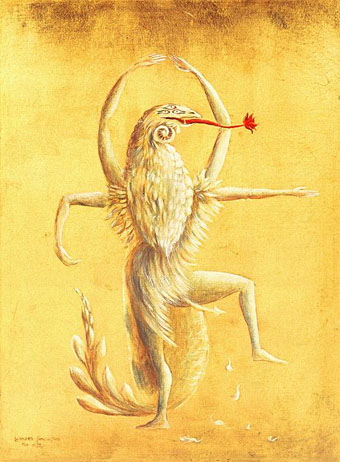
Figuras Miticas: Bailarin II (1954) by Leonora Carrington.

• The 26th Annual Lambda Literary Award Finalists have been announced. Ghosts in Gaslight, Monsters in Steam; Gay City: Volume 5 made the LGBT Anthology list, so congratulations to editors Evan J. Peterson & Vincent Kovar, and everyone else involved. I illustrated and designed the cover of that volume which also contains a piece of my fiction, Study in Blue, Green, and Gold.

Music in School (1969), episode 4: “A New Sound”. Amazing BBC TV programme for schools showing children playing avant-garde compositions using bowed metal sheets, tape loops, and primitive electronic equipment. I was at school then, and can’t help but feel a little jealous. Related: Delia Derbyshire Day approaches.

Voices Of Haiti (1953), recorded during ceremonials near Croix Des Missions and Petionville in Haiti by Maya Deren.

These days it’s hard to remember that Whistler’s Symphony in White, No. 1: The White Girl caused a bigger uproar at the Salon des Refusés of 1863 than Manet’s Déjeuner sur l’herbe, or that Monet was more influenced by Whistler than vice-versa. The delicacy of Whistler’s perceptions and his willingness to sacrifice everything for the sake of harmony make for an art less bracing than that of Degas or Pissarro. And yet how much life there is in his little Thames riverscapes. Perhaps we need another major exhibition—there hasn’t been one for twenty years—to re-evaluate him.

Whistler’s Battles by Barry Schwabsky

• Mix of the week (and a very good one it is): Abandoned Edwardian Schoolhouse by The Geography Trip.

Morton Subotnick tells Alfred Hickling how recording Silver Apples of the Moon blew his mind.

• The fantasy artwork of Ian Miller. A new book, The Art of Ian Miller, is published next month.

Queen for a Day by Alison Fensterstock. A look at the Mardi Gras Queens of New Orleans.

Tex Avery (1988): A 50-minute BBC documentary about the great animation director.

• The Gentle Revolutionary: Peter Tatchell talks to Joseph Burnett about Derek Jarman.

The Soaring and Nearly Forgotten Arches of New York City.

Dennis Hopper‘s photos of American artists in the 1960s.

Vodun at Pinterest.

Litanie Des Saints (1992) by Dr. John | Dim Carcosa (2001) by Ancient Rites | Far From Any Road (2003) by The Handsome Family
Heliotropic

heliotropic9.jpg

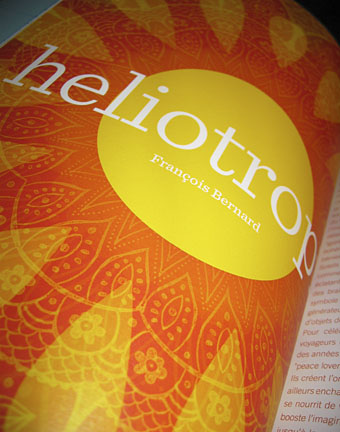
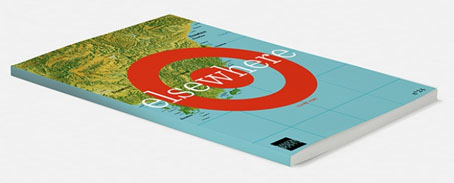
Arriving in the post this week was a catalogue for a Maison & Objet exposition of design and decoration which includes one of my paintings among the listed “Inspirations“. The event was held in Paris at the end of January but I’ve been so busy for the past few of months I forgot to see when it was on. Not that I could have said much about it since this is a showcase event you have to attend rather than experience remotely.

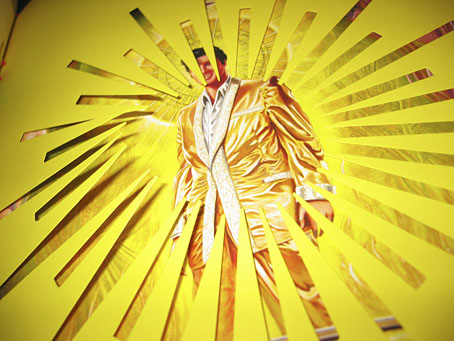
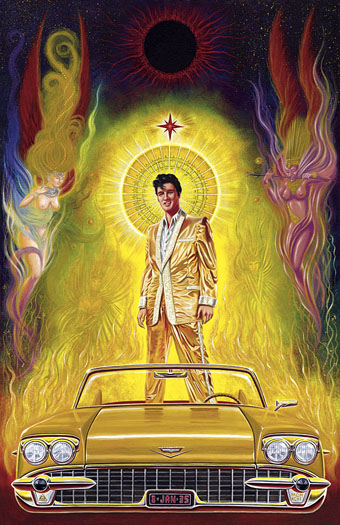
Catalogues for big art and design events often tend to the lavish and expensive but the Elsewhere book is the most lavish I’ve ever encountered. The production runs the gamut of the many expensive options which modern printing can provide: metallic inks, varnish effects, iridescent and translucent sheets, embossing, die-cutting, tipped-in inserts, and variable page sizes. The inflexible icing on the cake comes in the shape of a small square of polished marble glued to one of the pages. Excess aside, the print quality is excellent, and I’m very pleased with the way my Elvis painting appears.

sunking.jpg

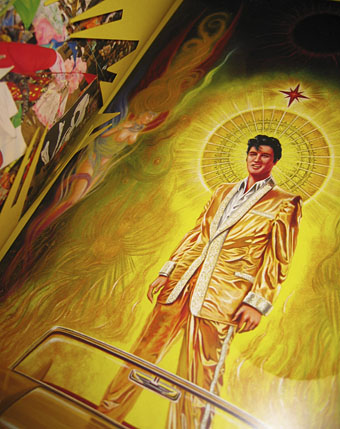
Sun King (1996).

Sun King was commissioned by Creation Books in 1996 as cover art for a Jeremy Reed novel which ended up being dropped by the company. The concept was the author’s, and while I’m pleased with the way it turned out I always felt it should have had more of a Gustave Moreau quality. This is the first time the picture been used anywhere although I did reuse the Elvis-in-a-Cadillac idea recently for one of the Alas Vegas Tarot cards.

heliotropic1.jpg

My painting is included in the Heliotropic section of the book which shows some of François Bernard’s inspirations. I’m pleased they placed one of the die-cut overlays before my piece. The photos below show some of the pages from the other sections which concern the inspirations of Elizabeth Leriche—her section includes the chunk of marble—and Vincent Grégoire whose section features futurism, space scenes, metallic effects, and Daft Punk.

heliotropic2.jpg

heliotropic3.jpg

Continue reading “Heliotropic”

Songs for the Witch Woman

cameron1.jpg

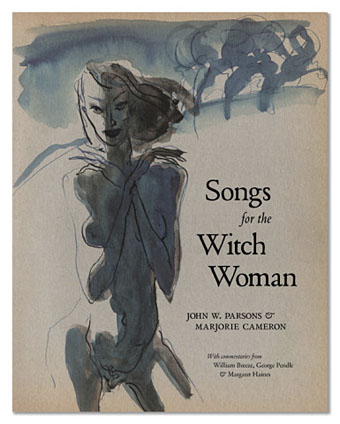
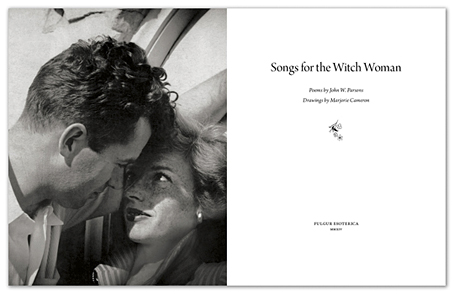
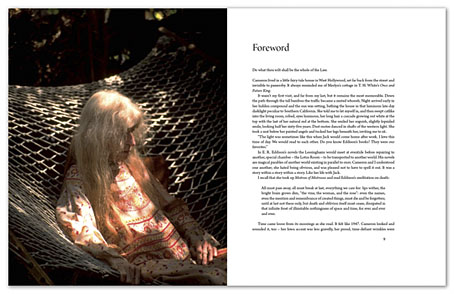
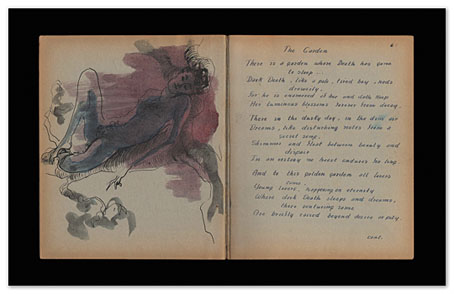
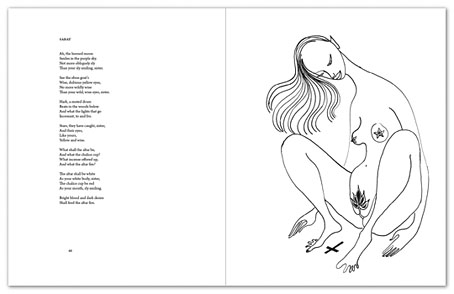
It wasn’t so very long ago that occult artist Marjorie Cameron (1922–1995) was visible only as a silent and enigmatic presence in films by Kenneth Anger and Curtis Harrington. Previous posts here have catalogued the resurrection of interest in her life and work which now includes a book of poems by husband Jack Parsons, embellished by Cameron’s drawings and paintings. This is another quality production from Fulgur Esoterica who provided me with these page layouts. Details of the book follow. See this page at Fulgur for a few more pieces of artwork.

cameron2.jpg

Songs for the Witch Woman
A Romantic Tragedy filled with Magic

‘He’ll be back some time. Laughing at you’

Fulgur Esoterica has announced today the publication of a collection of poems by rocket scientist Jack Parsons’ illustrated by his wife and magical partner Marjorie Cameron. The drawings and poetry have been gathered by Cameron after her husband’s death and are here published together for the first time. The book is the first publication to mark 100 years from Parsons’s birth (1914).

Jack Parsons was not only the most influential Californian magician of his day but was also at the heart of the US rocketry programme as one of the founder of the Jet Propulsion Laboratory before his untimely death at the early age of 37. He died in an explosion which was probably an accident but which has also been seen by some as either a result of his ‘Babalon Working’ or, by some occultists, as a direct result of tampering with dark forces.

Parsons’s wife Cameron continued to illustrate the poems he wrote for her years after his death. Cameron was an artist and actress who after Parsons’ death moved on to become one of most sought after faces in counter cultural Hollywood circles having appeared in Kenneth Anger’s Inauguration of the Pleasure Dome (1954) and Curtis Harrington’s Wormwood Star as herself and having figured on the cover of Wallace Berman’s first issue for Semina (1955).

The collaboration presented here creates a unique insight into an intense and unique romantic tragedy. As stated by Parsons’s official biographer and contributor to Songs for the Witch Woman George Pendle, “A collection of uneasy love poems, the language and meter of Songs for the Witch Woman owe a considerable debt to the Romantic poets. Keats’ “Lamia”, Byron’s Browning’s “Childe Roland to the Dark Tower Came”, Tennyson’s “Idylls of the King” are all referred to. […] But nothing is quite what it seems”. He further states that “many of the poems speak of entrapments and reversals, of women tricking or teasing men into their web to be devoured or eaten. And although a rich, pungent sensuousness overlays the poems, with datura and jasmine filling the lines with a somnolent musk, neurosis and fever, worry and sickness, never seem far away. In many ways the poems seem to act as a sort of testing ground for the emotions stirred up by the often masochistic relationship with the fiercely independent Cameron.”

The volume is complemented by critical essays and by a diary entry from Cameron’s magical diary. Some say this text constitutes the summoning of a magical entity while others looked at it as an invocation to her lost lover.

Price: Hardback £40.  Deluxe £140. Dimensions and info: large format (305mm x 240mm). 176 pages. Premium Italian Paper.

cameron3.jpg

Marjorie Cameron was born in Belle Plaine, Iowa in 1922. The fiery and uncompromising character for which she would later be known manifested from an early age. School friends and teachers alike saw her as a peculiar child who by nature looked at the world from a different angle. After the outbreak of the Second World War Cameron enrolled in the Navy and after a period of training became the cartographer for the Joints Chiefs of Staff. Discharged from the military in 1945, she joined her family in Pasadena where less than a year later she met the man who would change her life.

Cameron was twenty-four when she met Jack Parsons, a young and charismatic rocket scientist at the peak of his public career, associate founder of the Jet Propulsion Laboratory and acting master of the  ‘Agape Lodge of the Ordo Templis Orientis’. For the following seven years Cameron and Parsons worked together in magick, love and art giving birth to one of the most legendary magico-artistic partnerships of the century. Firmly believing that Cameron’s appearance in his life was the result of an intense series of magical workings carried out in the weeks preceding the encounter, Parsons famously wrote to Aleister Crowley ‘I have found my Elemental’. Be it as it may, in the first years of their relationship Cameron was not only unaware of such goings-on but also uninterested in Jack’s spiritual path, preferring art and love over the practice of magic.

But as time went by Parsons assumed another function in Cameron’s life as he quickly became her magical mentor. He renamed her Candida, recommended books, prescribed rituals and meditative practices to deal with her depressions. When Jack Parsons died in an explosion at the age of thirty-seven, Cameron was left alone, wondering whether she was human or elemental.

A very dramatic period follows for Cameron. For a time she withdraws into the desert, where she attempts to connect with the spirit of her lost lover through a series of magical workings. A few years later she comes back to Los Angeles, where in 1954 she appeared in Kenneth Anger’s landmark film Inauguration of the Pleasure Dome. She also met the director Curtis Harrington, for whom she appeared as herself in the short film Wormwood Star. In 1955 she was featured on the cover of the first issue of Wallace Berman’s artistic and literary journal Semina, so marking her firm arrival in the Hollywood artistic counter-culture.

Cameron spent the last decades of her life in West Hollywood, painting, writing and mastering the art of Thai Chi. She died of cancer in 1995 at the age of 73.

cameron4.jpg

cameron5.jpg

Previously on { feuilleton }
More Cameron
Inauguration of the Pleasure Dome: The Eldorado Edition
The Wormwood Star
Street Fair, 1959
House of Harrington
Curtis Harrington, 1926–2007
The art of Cameron, 1922–1995

Toute la mémoire du monde, a film by Alain Resnais

memoir.jpg

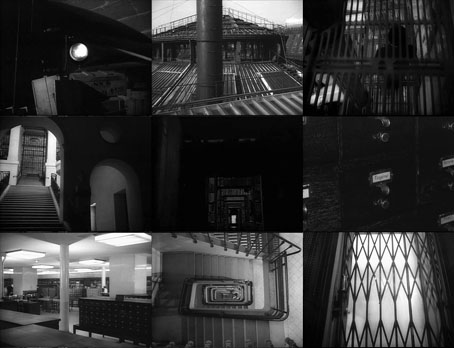
Before he directed his first feature, Hiroshima Mon Amour (1959), Alain Resnais had distinguished himself with a succession of short documentary films. His half-hour history of the Holocaust, Nuit et brouillard (1955), has always been the most prominent of these, although as a history it’s since been superseded by Claude Lanzmann’s exhaustive Shoah (1985). Toute la mémoire du monde, a study of the Bibliothèque Nationale in Paris, was made in 1956, and includes a certain Chris Marker (listed as “Chris and Magic Marker”) among its credits. The combination of drifting camera movements, and an interest in architectural space seems like such a precursor of Last Year at Marienbad that the film has found a new life as an extra on Marienbad DVDs. The Criterion people have very generously made it available in HD here.

Previously on { feuilleton }
Marienbad hauntings
Terminus by John Schlesinger

Marienbad hauntings

marienbad1.jpg

Last Year in Marienbad (1961). Via.

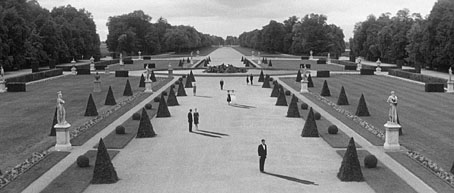
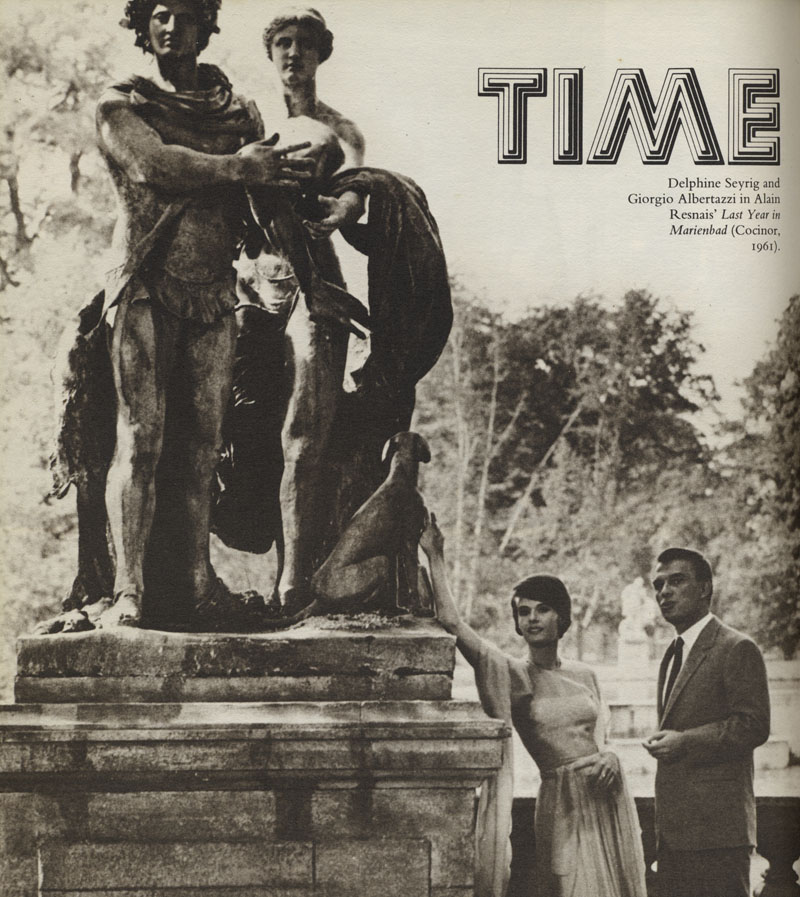
In our age of cultural plenitude it can be salutary to remember the time when many things were easy to discover but often impossible to experience; albums, books, and especially non-American films could all too frequently exist as rumours, referenced but always out of reach. Two films in particular dogged me for years in this remote manner: The Saragossa Manuscript (1965) by Wojciech Has, and Last Year at Marienbad (1961), the film that Alain Resnais made from a very novelistic screenplay by Alain Robbe-Grillet. Philip Strick alerted me to this pair of films with tantalising descriptions in a time-travel chapter of his book-length study, Science Fiction Movies (1976). Marienbad isn’t a time-travel film as such (a later Resnais film, Je t’aime, je t’aime [1968] does deal with the subject, however, and even features an actual time machine), but it is sufficiently open-ended to allow a science-fictional rationale into its enigmatic spaces. Strick’s book covered all the familiar SF territory as well as looking beyond the clichés of Hollywood and the SF genre, hence the inclusion not only of Marienbad and Saragossa, but also Je t’aime, je t’aime, Chris Marker’s La Jetée (1962), Bergman’s The Hour of the Wolf (1968), Pasolini’s Teorema (1968), and Buñuel’s Discreet Charm of the Bourgeoisie (1972). Most of these films, which were seldom shown on TV, I had to wait years to see.

marienbad2.jpg

Marienbad page from Strick’s Science Fiction Movies.

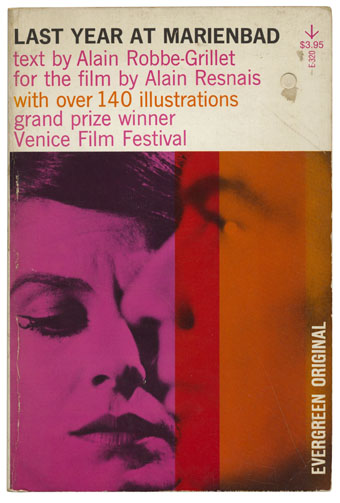
I was reading Strick’s book in 1979, and since I was bored with generic clichés, and also reading a lot of reprinted stories from New Worlds magazine, I became a little obsessed with these inaccessible films, Marienbad especially. It’s difficult to say what was so fascinating about a few words of description, and a single photograph, but the picture seemed an unlikely inclusion amid so many pages filled with robots and spaceships. It promised a film that approached the themes of science fiction at the same oblique angle as many of the stories in New Worlds. A couple of years later I found a copy of the Robbe-Grillet screenplay whose pages of dogged description read like the kind of forbidding and formal exercise that Brian Aldiss had attempted in Report on Probability A (1967), a novel that first appeared in New Worlds. Among other similarities, both works share a dismissive attitude to character, presenting a trio of ciphers indicated by no more than their gender, and some initial letters. This confluence of influences, Marienbad included, fed into the chunks of New Worlds-derived prose I was writing at the time, trying to fix inchoate impressions on the page. I always failed each time I returned to that photo from Marienbad, the real charge—as I didn’t see at the time—being a result of the gap between the promise of the image and the inaccessible film itself. Finally seeing Marienbad in the late 1980s was a curious thing, like meeting somebody face-to-face after years of remote correspondence; the same readjustments needed to be made to accept that this was the reality of the work of art, not Robbe-Grillet’s embryonic version, or my own baroque imaginings.

marienbad3.jpg

Screenplay book, 1962. Cover design by Roy Kuhlman.

If the above seems to strain for association by hauling a celebrated work of the Nouvelle Vague into a disreputable area then this essay by Thomas Beltzer is worth a read. Beltzer’s “Intertextual Meditation” compares Marienbad to The Invention of Morel (1940), a science-fiction novel by Adolfo Bioy Casares which Jorge Luis Borges described as “perfect” (and which I really ought to read). If I’ve not written much about Marienbad itself that’s because it really needs to be experienced rather than described or explained. It’s a film that’s easier to admire than actually enjoy—I need to be in the right mood to accept its formalities—and given the choice I’d often sooner watch Providence (1977). But where Providence and other Resnais films have inevitably dated, Last Year in Marienbad remains out of time, a 20th-century dream held captive in 18th-century architecture where the airless rococo chambers might easily share a labyrinth with the hotel waiting-room at the end of 2001: A Space Odyssey.

• Alain Resnais obituaries: The Guardian | The Telegraph
Last Year in Marienbad at film|captures
Marienbad (2012) by Julia Holter