Robert Lang’s origami insects

lang1.jpg

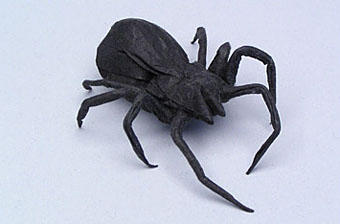
Black Widow; one uncut square of Origamido paper (2003).

I’ve been doing origami on and off since I was about 11 years old but the real measure of the art is whether you can invent your own folds rather than simply copying other people’s. This is something I’ve never managed since you have to devote yourself consistently to it until you can play with the paper, rather than fighting against it.

lang2.jpg

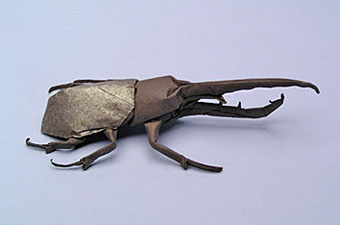
Hercules Beetle; one uncut square of Origamido paper (2003).

Robert E Lang is quite remarkable in this regard, with a host of unique folds on his site, the majority of which maintain the tradition of only using a single uncut square of paper. (Some of his more complex folds such as the Black Forest Cuckoo Clock deviate from this.) I love the insect folds but there are many other animals and objects there. You only have to compare the rudimentary classic frog fold (one of the few I can do from memory) with one of his tree frogs to see how far he is beyond the basics.

Previously on { feuilleton }
Lalique’s dragonflies
Lucien Gaillard
Wesley Fleming’s glass insects
Insect Lab
The Museum of Fantastic Specimens

The art of Jennifer Maestre

maestre1.jpg

Asteridae.

Jennifer Maestre is another artist who claims Ernst Haeckel’s Art Forms in Nature as an influence. Asteridae is part of a series of works made from pencils, while Dreaming comprises part of another series using nails and other materials to create what might be organic forms.

maestre2.jpg

Dreaming.

An interview with Jennifer Maestre

Previously on { feuilleton }
Kirsten Hassenfeld’s paper sculptures
Darwin Day
The glass menagerie

The art of Laurie Hassold

hassold.jpg

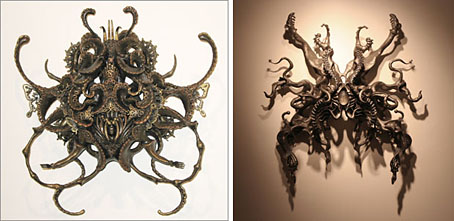
left: Bent Fork (The Beginning of Hunger) (2007).
right: Strange Attractor IV: Zygomorph (2006).

“My core interest in making art lies in blurring the boundaries between art, science, literature and psychology,” says Laurie Hassold, and seeing that this is the week the monstrosities of Cloverfield are unleased upon America, it’s perhaps appropriate that some organic weirdness is on display at Bert Green Fine Art in Los Angeles. Laurie Hassold’s show runs until March 1st, 2008.

Via Phantasmaphile.

Previously on { feuilleton }
The art of Jean Louis Ricaud

The Evanescent City

panama1.jpg

The cover of The Evanescent City shows a night view of Bernard Maybeck’s Palace of Fine Arts, one of the few remaining structures from the Panama-Pacific International Exposition that was held in San Francisco in 1915. After earlier posts about ephemeral architecture and the futuristic visions of Hugh Ferriss, I stumbled across the Books about California site which features a wealth of scanned volumes, including a number of books and pamphlets devoted to the Panama-Pacific Exposition. Expositions and World’s Fairs hold a particular attraction for enthusiasts of architectural invention, not least for the way they allow architects the opportunity to create structures that would otherwise never be built.

panama5.jpg

Palace of Horticulture—Dome and Spires by Night from The Architecture and Landscape Gardening of the Exposition.

At night, when the powerful searchlights within the dome are played upon the translucent glass, the effect is magical, the reflections weirdly changing in color and shape. The rich details of the decorations are softened in the night light.

The Panama-Pacific Exposition and the 1893 World’s Columbian Exposition in Chicago fascinate owing to the insight they give into the 19th- and early-20th century architectural imagination. This invariably meant huge towers, enormous domes and everything ladled with elaborate decoration, the Panama-Pacific Exposition being especially decadent in this respect, numbering a jewel-spangled tower among its attractions. With the Bauhaus innovations a few years away this was the last time the world would be offered a reflection of itself that was so excessively indebted to the past. If Hugh Ferriss shows us a vision of the world like that in Fritz Lang’s Metropolis, the Panama-Pacific architects invite us to imagine a world like the Slumberland that Winsor McCay created for Little Nemo.

The Internet Archive has a number of short films showing views of the exposition. Most interesting, if rather crudely made, is The Story of the Jewel City, a brief fantasy about two children exploring the exposition grounds.

The following pictures are a small sample of the amount of material at Books about California. The snake-entwined figure of Helios would have made a good addition to the Men with snakes post while it’s difficult not to smile at the suggestion that the figure of a naked man should be preserved for America’s future gay capital.

panama2.jpg

Tower of Jewels—the Illumination by Night from The Architecture and Landscape Gardening of the Exposition.

The Tower takes its name from the thousands of many-colored jewels so cut, polished and suspended that they reflect the sunshine with dazzling brilliancy by day and at night, under the white radiance of the searchlights, clothe the whole structure with shimmering splendor.

panama3.jpg

The Fountain of Earth from The Court of Ages by Beatrice Wright.

panama9.jpg

Part of Education Building and Court of Palms looking towards Horticultural Building from Panama-Pacific International Exposition—Popular Information.

panama4.jpg

Tower and Cascade in Court of Abundance from the Official View Book of the Panama-Pacific International Exposition.

Dedicated to Music and Pageantry. Water in the cascade flows over a scheme of brilliant illumination. Designed by Louis Christian Mullgardt.

panama6.jpg

Palace of Horticulture—The Dome and East Entrance from The Architecture and Landscape Gardening of the Exposition.

panama7.jpg

Helios by Robert I Aitken from The Sculpture and Mural Decorations of the Exposition.

panama8.jpg

The Rising Sun by Adolph Alexander Weinman from Sculpture of the Exposition Palaces and Courts by Juliet Helena Lumbard James.

This fresh, strong young Sun is about to start on his journey – dawn is soon to break upon the world. With muscles stretched, the wind blowing through his hair, the heavenly joy of the first move expressed upon his face, the vigor of young life pulsating through his body, he will start the chest forward and move those outstretched wings. Let us preserve this glorious figure for our western city. It would so admirably suggest the new light that has been shed upon San Francisco by the Exposition of nineteen hundred and fifteen, as well as the new light occasioned by the opening of the Panama Canal.

Elsewhere on { feuilleton }
The illustrators archive

Previously on { feuilleton }
Ephemeral architecture
Hugh Ferriss and The Metropolis of Tomorrow
Winsor McCay’s Hippodrome souvenirs
The World in 2030
Metropolis posters
Frank Lloyd Wright’s future city