Lumiere at Durham

lumiere.jpg

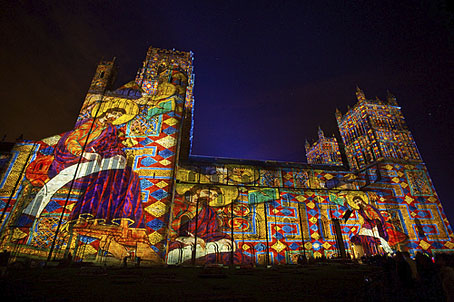
Durham Cathedral as it appeared this weekend as a part of the four-day Lumiere art event which illuminated the cathedral’s already spectacular location with projections and light installations. Flickr has a wide selection of photos documenting the various stages of the event.

The fluorescent bulbs on the banks of the Wear would have dazzled even Dan Flavin, the American founding father of light art. Durham’s river was a riot of neon and sci-fi lasers. What Flavin would make of this display is another matter. Light art has come a long way since the industrial minimalism that saw syncopations of strip bulbs arranged in white gallery spaces. Contemporary artists are using low-emission technology to produce site-specific work on a grand scale. Unlike the postwar modernists, their work has a social function: to transform cities. They are engineers of public space and sculptors of civic identity.

Durham’s Lumiere is part of a growing international movement. The organisers, Helen Marriage and Nicky Webb from the London-based events company Artichoke, loosely modelled the event on an annual Fête des Lumières in Lyon (5–8 December), a festival that hosts 80 light installations and attracts over 4 million tourists every year. (More.)

Previously on { feuilleton }
Tetragram for Enlargement
Eno’s Luminous Opera House panorama
The art of Rune Guneriussen
Lightmark
Giant Lantern Festival
Maximum Silence by Giancarlo Neri
Volume at the V&A

The art of Ralph Koltai

koltai.jpg

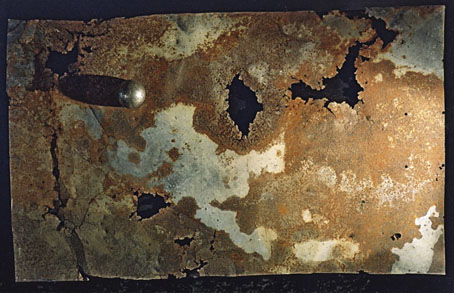
Ralph Koltai‘s contrasting of panels of corroded metal with smooth objects makes for some attractive combinations, reminding me of similar rough and smooth juxtapositions by artist and designer Russell Mills, notably on one of his Samuel Beckett covers and his design for Harold Budd and Brian Eno’s The Pearl. Koltai’s site also includes a gallery of his designs for theatre. Digital rust infiltrates my own work now and then via some photos I took of a Manchester railway bridge, the most recent use being in the background of the cover for Finch.

Previously on { feuilleton }
Finch posters
Samuel Beckett and Russell Mills
The art of Jo Whaley

The Dark Monarch: Magic and Modernity in British Art

ayrton.jpg

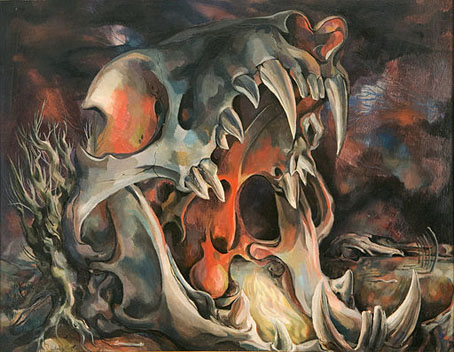
Skull Vision by Michael Ayrton (1943).

The Dark Monarch: Magic and Modernity in British Art: great title for an exhibition, a shame that it’s all the way down in Cornwall at Tate St Ives.

This group exhibition takes its title from the infamous 1962 book by St Ives artist Sven Berlin. It will explore the influence of folklore, mysticism, mythology and the occult on the development of art in Britain. Focusing on works from the beginning of the twentieth century to the present day it will consider, in particular, the relationship they have to the landscape and legends of the British Isles. (More.)

Artists featured include Graham Sutherland, Paul Nash, Barbara Hepworth, Henry Moore, Ithell Colquhoun, Cecil Collins, John Piper, Leslie Hurry and John Craxton. Among the contemporary artists there are Cerith Wyn Evans, Mark Titchner, Eva Rothschild, Simon Periton, Clare Woods, Steven Claydon, John Stezeker and Derek Jarman. Austin Osman Spare is notable by his absence but then that’s no surprise, the major occult artist of the 20th century never rates more that a passing mention from the art establishment. One nice surprise is seeing Ithell Colquhoun (1906–1988) featured in her second major British exhibition this year. (Her work is also present in the Angels of Anarchy exhibition running at the Manchester Art Gallery.) Colquhoun was a contemporary of Spare’s whose work turns up in occult encyclopaedias or overviews of the minor current of British Surrealism but she’s still largely unheard of outside those circles.

The Tate exhibition may be awkward to visit but there’s an illustrated catalogue available featuring contributions from quality writers including Brian Dillon, Philip Hoare, Jon Savage, Jennifer Higgie, Marina Warner, Michael Bracewell, Alun Rowlands and Martin Clark. Michael Bracewell has a piece about the exhibition at Tate Etc while Brian Dillon has an excellent essay in the Guardian connecting John Dee’s mysterious obsidian scrying mirror with some of the works on display.

noonan.jpg

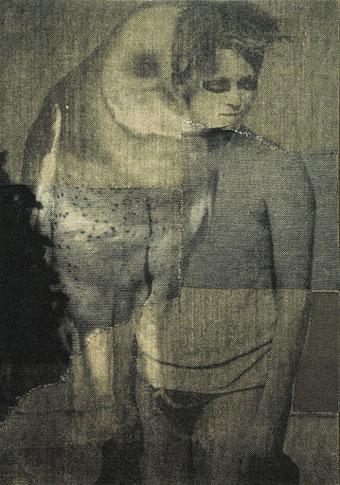
Untitled by David Noonan (2009).

Artist of the week: David Noonan
Ithell Colquhoun at A Journey Round My Skull

Previously on { feuilleton }
Angels of Anarchy: Women Artists and Surrealism
A=P=P=A=R=I=T=I=O=N
In the Shadow of the Sun by Derek Jarman

Blast

blast.jpg

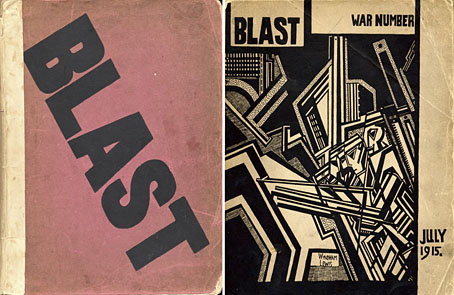
Both issues of Wyndham Lewis’s avant garde art and literature journal can be found in a collection of similar publications from the Modernist years at Brown University here and here. I’ve always liked the bold graphics of Lewis and his fellow Vorticists, and BLAST 2, “the War Number”, is especially good in that regard. The MJP site reminds us that BLAST is still under copyright control outside the US and is also available in facsimile editions from Gingko Press.

BLAST was the quintessential modernist little magazine. Founded by Wyndham Lewis, with the assistance of Ezra Pound, it ran for just two issues, published in 1914 and 1915. The First World War killed it, along with some of its key contributors. Its purpose was to promote a new movement in literature and visual art, christened Vorticism by Pound and Lewis. Unlike its immediate predecessors and rivals, Vorticism was English, rather than French or Italian, but its dogmas emerged from Imagism in literature and Cubism plus Futurism in visual art.

The original BLAST was published by Aubrey Beardsley’s first publisher, John Lane, and it’s fascinating to see Lane advertising back issues of The Yellow Book in pages which include Lewis’s anti-Victorian polemic. Meanwhile I’m still waiting for copies of the Art Nouveau journal Ver Sacrum to turn up somewhere. If anyone runs across quality scans, please leave a comment.

Via Things Magazine.

Previously on { feuilleton }
Wyndham Lewis: Portraits

Jeppe Hein’s mirror labyrinth

hein.jpg

Follow Me by Jeppe Hein. Photo by Jamie Woodley.

More mirror art. Yes, I really like this kind of thing, and this particular example, Follow Me by Danish artist Jeppe Hein, looks especially fine with the sunlight and trees reflected from its panels. Hein’s labyrinth is a new and permanent installation in the grounds of Royal Fort House at the University of Bristol; the grounds are open to the public so anyone can pay the work a visit.

The artwork comprises a square labyrinth of 76 vertical polished steel plates sited at the base of an incline leading down from Royal Fort House. Visitors will be encouraged to enter the labyrinth to experience the effect of the work. Once inside, the reflections of participants and surrounding plants and trees are multiplied.

Jeppe Hein was inspired by the University as a place of self-discovery, as well as by the history of the gardens – particularly the designs of 18th-century landscape gardener Sir Humphry Repton, who similarly sought to promote imaginative encounters. (More.)

Previously on { feuilleton }
A=P=P=A=R=I=T=I=O=N
The art of Josiah McElheny