Weekend links 809

hubacher.jpg

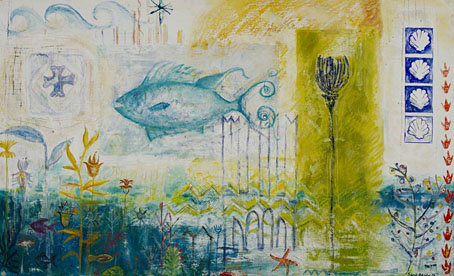
Atlantis by Sarah Hubacher.

• Regular readers will know Leigh Wright from his Wyrd Daze creations which I’ve linked here many times in the past. (The same goes for his frequent Mixcloud compilations.) Leigh’s wife died recently which means he now has to return to the UK from Canada where he doesn’t have permanent resident status. His request for help is here.

Melinda Gebbie’s Greatest Fits: “Ranging from painting, illustration, Comix, portraiture, eroticism and so much more, this fully illustrated and beautifully presented book is a glimpse into the unique mind of a woman forged in the fire of counterculture.”

• At The Daily Heller: Adrian Wilson’s collection of elaborate vintage fabric stamps is explored in a two-part feature here and here.

• Mixes of the week: DreamScenes – December 2025 at Ambientblog, and ASIP – Reflection on 2025 at A Strangely Isolated Place.

Dennis Cooper’s favourite fiction, poetry, non-fiction, film, art, and internet of 2025. Thanks again for the link here!

• At Colossal: “Field Kallop meditates on universal patterns through bold chromatic compositions.”

• “Scientists discover massive underwater ruins that may be a lost city of legend.”

• New music: The King In Yellow by Blarke Bayer.

• RIP Rob Reiner.

Atlantis (1955) by Les Baxter | The Atlantis Healing Harp (1982) by Upper Astral | A Man For Atlantis (2000) by Broadcast

Weekend links 806

wilson.jpg

Cover art by George Wilson for The Twilight Zone #45, September 1972. Via.

• At Public Domain Review: Thea Applebaum Licht on the history of art within art, or cabinets of curiosity and paintings within paintings.

• The final 2025 catalogue of lots for the After Dark: Gay Art and Culture online auction. Homoerotic art, photos, historic porn. etc.

• At Smithsonian Mag: See the “Mona Lisa of Illuminated Manuscripts,” a 600-Year-Old Bible covered in intricate illustrations.

It’s amazing, the number of people out there who love everything about queer life except for queer sex, who would prefer that sex and sexual orientation live in entirely different zip codes, that they exist as non-overlapping magisteria; it’s so much safer that way. Who wants gay sex polluting their enjoyment of the abstraction that is Being Gay?

That is what gay love is, now, in the collective imagination of American commerce: a set of identity relations projected onto bored and indifferent celebrities who will half-heartedly play along with the idea because doing so moves units and, anyway, what does it cost them? The more that sexual orientation slouches to the point of pure abstraction, the less effort it takes. Anyone and anything can be gay, now, because gay is just a set of pompous liberal cultural signifiers that have no earthly material relation to homosexuals.

“I miss when homoeroticism was erotic,” says Freddie deBoer. I’ve made similar complaints myself over the years. For some genuinely erotic homoeroticism, see the latest auction link above.

• At Ultrawolveunderthefullmoon: Illustrations for Edmund Weiss’s Bilderatlas der Sternenwelt.

• DJ Food’s latest harvestings of psychedelic ephemera may be seen here.

• At Dennis Cooper’s: Bruce Connor’s Day.

• The Strange World of…David Lynch.

• RIP Udo Kier and Tom Stoppard.

Atlanta Surrealist Group

Menergy (1981) by Patrick Cowley | Eros Arriving (1982) by Bill Nelson | Erotic City (“Make Love Not War Erotic City Come Alive”) (1984) by Prince & The Revolution

Weekend links 805

strausfeld.jpg

A poster by Peter Strausfeld for a 1966 screening of Alphaville and La Jetée.

• At Bandcamp Daily: “Caroline True obsesses over compilations so you don’t have to,” says Erick Bradshaw. I recommend CTR’s compilations.

• At The Wire: Read an extract from Music Stones: The Rediscovery Of Ringing Rock by Mike Adcock.

• At Colossal: Pastoral landscapes brim with patterns in luminous paintings by David Brian Smith.

One of the markers that sets Mamoru Oshii apart from his peers is his willingness to allow place to speak for itself. From the seasonality captured in his works, like the first two Patlabor films, to the otherworldly environments of Ghost In The Shell 2: Innocence (all projects in which Ogura was also involved heavily) and even the fantasy scapes of his Angel’s Egg, Oshii’s attention to place, and allowing it to be a player in the story, gives as much voice to world building, as he does to characterisation. This attentiveness and patience for place, allows us to settle deeply inside a worldview that is often simultaneously familiar but unerringly alien.

Lawrence English talks to art director Hiromasa Ogura and composer Kenji Kawai about their work on Oshii’s Ghost in the Shell

• At the BFI: Leigh Singer suggests where to begin with the films of Lucile Hadžihalilović.

• Necromodernist Architectures in Contemporary Writing: an essay by David Vichnar.

• New music: Hydrology by Loula York; Love Letters Via Echelon by Nerthus.

• There’s more Intermittent Eyeball Fodder at Unquiet Things.

• The Strange World of…Early Cabaret Voltaire.

• Winners of the Drone Photo Awards 2025.

Lautréamont’s Apocrypha

Drone Um Futurisma (1992) by Cusp | ABoneCroneDrone 1 (1996) by Sheila Chandra | Suspicious Drone (2009) by Demdike Stare

Sphinxes

sphinx09.jpg

Bei den Pyramiden (1842) by Leander Russ.

A horde of sphinxes from NYPL Digital Collections and Wikimedia Commons, a pair of sites I was searching through last week. I was looking for a very particular kind of sphinx, not the Great Sphinx that sits near the Pyramids at Giza. What I wanted was something smaller and less ruined, like the sentinels that proliferated during the fads for Egyptian art and design in the early 1800s and the 1920s. My search was satisfied eventually, the results of which will be revealed in the next post.

sphinx06.jpg

Approach of the Simoom. Desert of Gizeh (c. 1846–49) by David Roberts. 

As for the Great Sphinx, I enjoy seeing artistic representations of the monument, especially those which place the creature in a dramatic setting. Older depictions tend to look bizarre or even comical, especially the ones made during the centuries when the figure was little more than a head protruding from the drifting sands. The photographs I prefer are those that show the Sphinx in the 19th century before all the restorations began, when the creature was another half-buried fragment of antiquity, not something that seems to have just been removed from a box in a museum.

sphinx08.jpg

The Sphinx and Great Pyramid, Geezeh (1858–1859).

sphinx10.jpg

The Questioner of the Sphinx (1863) by Elihu Vedder.

sphinx07.jpg

The Sphinx by Harry Fenn (1881–1884). “Called by the Arabs “Father of terrors.” It faces the east, and is hewn out of the natural rock.”

Continue reading “Sphinxes”

Weekend links 802

grimshaw.jpg

November (1879) by John Atkinson Grimshaw.

• As usual, the first links in November are heavy with the spirit of Halloween. At the BFI: Zombies in the Lake District: how locations from The Living Dead at Manchester Morgue look today; Adam Scovell looks back at one of the more curious zombie films of the 1970s, a Spanish/Italian production directed by Jorge Grau in and around my home city. Also at the BFI: Georgina Guthrie selects 10 great erotic horror films.

• “We must recognise that reality without mystery is impossible.” In a recently digitised film clip, René Magritte is interviewed (in French) by Belgian TV in 1961.

• The Italian edition of The Moon and Serpent Bumper Book of Magic is out now from Panini. Thanks to Smoky Man for posting photos!

• Among the new titles at Standard Ebooks, the home of free, high-quality, public-domain texts: Short Fiction by Saki.

• At Smithsonian Mag: Elizabeth Djinis explains how an Italian town came to be known as the “City of Witches”.

• New music: The Whole Woman by Anna von Hausswolff ft. Iggy Pop; Forces, Reactions, Deflections by Scanner.

• RIP Jack DeJohnette, jazz drummer; Prunella Scales, actor; Peter Watkins, film-maker.

Space Type Generator

Algiers November 1, 1954 (1965) by Ennio Morricone | November Sequence (2011) by Pye Corner Audio | Richter: November (2019) by Mari Samuelsen