Yayoi Kusama

kusama.jpg

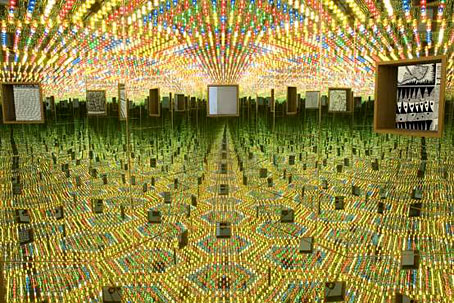
Infinity Mirrored Room—Love Forever (1994).

“It is not controversial to describe Yayoi Kusama as Japan’s greatest living artist,” says Hannah Duguid in The Independent. I made a post about Kusama’s artworks in 2006 and now her work is in exhibition at the Victoria Miro gallery, London.

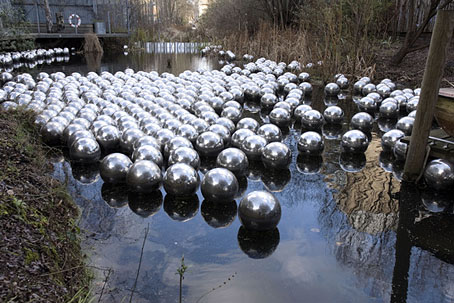
For this exhibition, revered Japanese artist Yayoi Kusama has conceived a new installation Dots Obsession—Infinity Mirrored Room (2008) especially for the upper gallery and in the lower galleries will install 50 new silkscreen works that will be shown alongside two significant sculptural pieces from the early nineties. At Victoria Miro 14 the artist will present a series of new dot paintings and an environmental installation I’m Here, but Nothing (2000-2008). The exhibition will continue outside the gallery where Kusama will install one of her most infamous works, Narcissus Garden in Regents Canal—a work which has never before been exhibited in the UK.

More pictures here. The exhibition runs until 20 March, 2008
kusama2.jpg

Narcissus Garden (1966—2008).

Previously on { feuilleton }
Maximum Silence by Giancarlo Neri
The art of Yayoi Kusama
Atomix by Nike Savvas

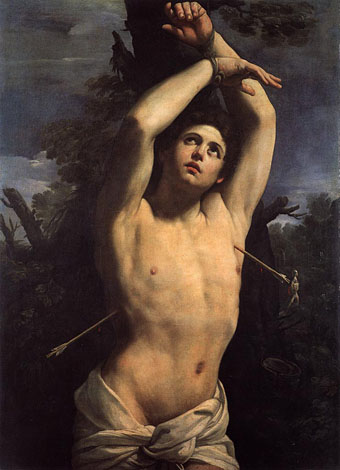
Guido Reni’s Saint Sebastian

sebastian.jpg

Saint Sebastian by Guido Reni (c. 1616).

The Agony and the Ecstasy is an exhibition at the Dulwich Picture Gallery, London, based around Guido Reni’s paintings of the martyr, six of which are on display.

This will be a once-in-a-lifetime opportunity to compare directly the six masterpieces which are coming from all over the world to join the St Sebastian owned by Dulwich Picture Gallery. The paintings are coming from New Zealand, South America, Madrid, Genoa and Rome.

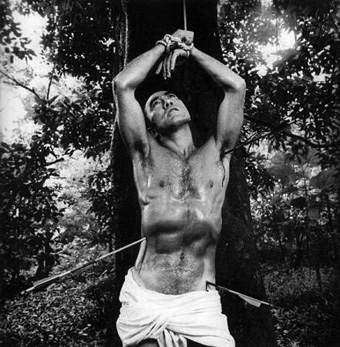
The claim for masterpieces is stretching the truth when art experts apparently believe that only two of the martyr paintings credited to Reni are original—the Genoa picture above and the Dulwich’s own version—the rest being later copies. The Genoa version became a favourite of Oscar Wilde and it was a Sebastian by Guido Reni that also excited the illicit passion of the 12 year-old protagonist in Yukio Mishima’s novel Confessions of a Mask. Wilde used the name Sebastian when he went into exile in Paris but he never took his identification with the saint as far as Mishima who adopted the typical pose in the famous photo taken shortly before the writer’s suicide. Wilde had no need of borrowed martyrdoms, his own was more than enough.

mishima.jpg

Yukio Mishima (1970).

The Agony and the Ecstasy runs until 11 May 2008. For further images of Saint Sebastian, this site is as comprehensive as it gets.

Elsewhere on { feuilleton }
The gay artists archive

Previously on { feuilleton }
Dorian Gray revisited
Beardsley’s Salomé
The art of Takato Yamamoto
Alla Nazimova’s Salomé
Fred Holland Day
The Poet and the Pope
The Picture of Dorian Gray I & II

Whistler’s Peacock Room

whistler1.jpg

Random browsing this week turned up some nice high-res photos of Harmony in Blue and Gold, as James Abbott McNeill Whistler named the room he decorated for Frederick R. Leyland in 1878. Leyland had bought one of Whistler’s paintings, La Princesse du pays de la porcelaine (1864), and architect Thomas Jeckyll was concerned that the painting and furnishings would clash, hence the invitation for Whistler to help with the colour scheme.

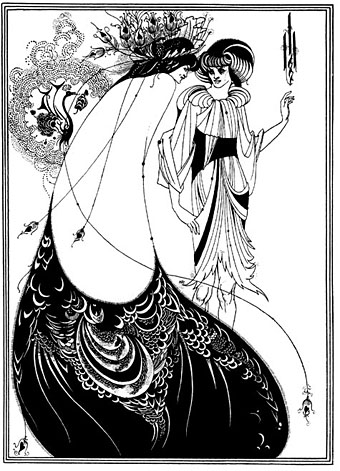
I’ve always preferred this luscious, gold-leafed design to the worthy medievalism of contemporary William Morris. Even though Whistler completed the work prior to the 1890s, the combination of Orientalism and peacocks (the signature bird of the Decadence) seems very much tied to the fin de siècle not least because of Aubrey and Mabel Beardsley’s visit to the room in 1891. Beardsley was very impressed with the painting and with the golden birds, the style of which later formed the inspiration for his famous Peacock Skirt illustration in Salomé (1894).

whistler2.jpg

There’s a good overview here of the history of the room, including details of the falling out between the combative artist and his client, and the story of the room’s removal to America and subsequent restoration.

Previously on { feuilleton }
Beardsley’s Salomé
Alla Nazimova’s Salomé

Yoshitaka Amano in Berlin

amano1.jpg

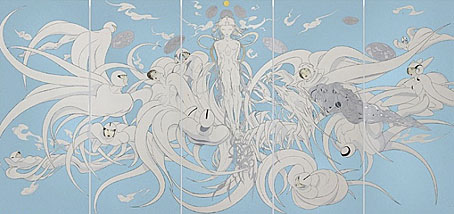
Deva-loka (2007).

Big new paintings by one of my favourite Japanese artists at Galerie Michael Janssen, Berlin, until February 29, 2008. The wild details in Deva-loka are completely lost at this size but there’s a larger version on Amano’s site.

amano2.jpg

Creation (2007).

These works are being sold as fine art but Amano’s reputation rests upon his commercial art which embraces anime, manga and book cover illustration. As is often the case, the art world has a problem with this, regarding work for hire as lower than work for galleries, the latter being no less commercial in the sense that the works are sold to collectors who frequently demand more of the same; Andy Warhol’s studio was named The Factory with good reason. A comment at Creative Europe acknowledges the dilemma:

“There are two reasons why it is necessary to bring Yoshitaka Amano’s immensely successful professional biography into the equation here: on the one hand, the work he has done as a creator of mangas and animes (animations) provides an undisputed frame of reference for his pictures; on the other, it has become difficult where Amano’s oeuvre is concerned to uphold the differentiation popular in German speaking quarters between a more commercial applied visual art and the personally expressive variety.” (My italics.)

Amano’s non-commercial work at Galerie Michael Janssen is for sale, prices on request.

Previously on { feuilleton }
The art of Takato Yamamoto