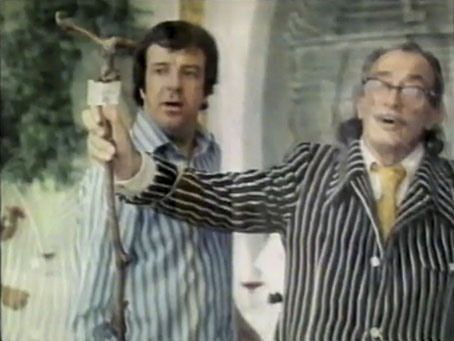
Hello Dali!

hellodali.jpg

Russell Harty and Salvador Dalí, 1973.

This would have been a real find if the quality wasn’t so poor. Hello Dali! was a 50-minute documentary film about Salvador Dalí broadcast in the UK in 1973 as part of ITV’s Aquarius arts strand. The whole thing is on YouTube chopped into five parts and is unfortunately blighted by severe ghosting throughout. Apart from that it’s perfectly watchable.
hellodali2.jpg

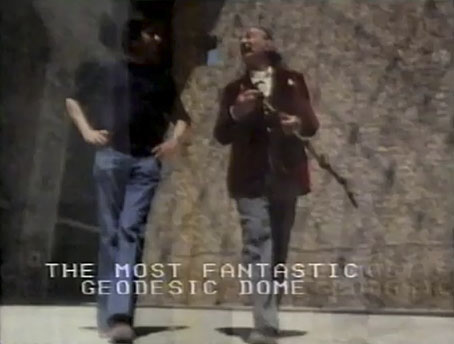
Some conversations are subtitled so viewers are better able to make sense of Dalí’s English/Spanish/French dialect.

Brits who are old enough may remember Aquarius which was replaced in the late 70s by The South Bank Show, a programme using the same format of a short studio introduction followed by a self-contained film. In place of the SBS‘s Melvyn Bragg we have Humphrey Burton introducing a film directed by Bruce Gowers. Russell Harty is the front man, seen here in the days before he achieved greater fame as a gossipy chat-show host. I’d been wanting to see this for a long time, having lost a video tape of it years ago. I never saw the original broadcast but it was screened again after Dalí’s death in 1989, and I remembered it as being particularly good for showing a slightly more human side to the eccentric and occasionally annoying artist. So it is, giving us a brief portrait of Dalí in his 69th year, preoccupied at that time with the construction of his museum in Figueres. The nature of Harty and Gowers coup in getting the artist to allow a film crew into his home can be found in subsequent documentaries many of which use uncredited extracts from these interviews. It’s the brief moments of interview which make this even though they reveal little, it’s refreshing seeing Dalí talking conversationally rather than putting on a performance.
hellodali3.jpg

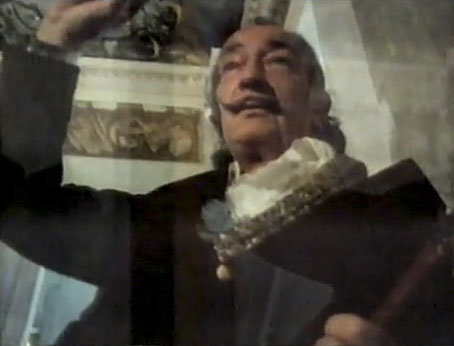
The early 70s saw the last flare of real interest in Dalí from the world at large. Dalí and Surrealism in general had a resurgence of popularity in the late 60s as a consequence of psychedelic culture: a number of books by or about the artist were published or reprinted, among them Peter Owen’s 1973 revival of the novel Hidden Faces which Dalí had written in 1944. About the same time Alejandro Jodorowsky was circling the Dalí camp trying to inveigle the artist into portraying the Emperor in his planned film adaptation of Dune. One detail worthy of note in the conversation with Russell Harty is mention of a golden toilet, something which Jodorowsky says Dalí wanted as his throne if he was going to be filmed. We never got to see Jodorowsky’s Dune but it’s good to find this documentary available once again. Here’s hoping a better copy turns up eventually.

Hello Dali! Pt 1 | Pt 2 | Pt 3 | Pt 4 | Pt 5

Previously on { feuilleton }
Dalí and the City
Dalí’s Elephant
Dalí in Wonderland
Alejandro Jodorowsky’s Dune
Dirty Dalí
Impressions de la Haute Mongolie revisited
Dalí and Film
Salvador Dalí’s apocalyptic happening
Dalí Atomicus
Impressions de la Haute Mongolie

Clive Barker, Imaginer

barker.jpg

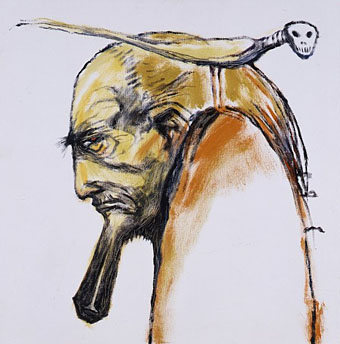
Sea Captain by Clive Barker.

The inhabitants of Carlisle in the north of England are fortunate that the town’s Crown Gallery is hosting the first exhibition of Clive Barker’s artwork outside the US with a show entitled Clive Barker, Imaginer which opens this weekend. The artist will be attending the opening this Saturday, July 16th, and there’s also a signing planned the day after. Tickets are required for both these events so anyone interested will need to contact the gallery. No details as to what will be on display but the exhibition will run to August 23rd, 2011. Barker’s paintings, drawings and photo prints can be purchased through Bert Green Fine Art, Los Angeles.

Rossetti and His Circle by Max Beerbohm

beerbohm1.jpg

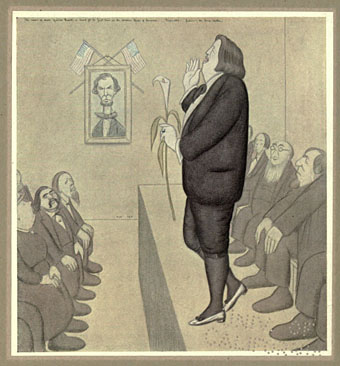
Rossetti’s name is heard in America (Oscar Wilde).

The Happy Hypocrite was Max Beerbohm’s words illustrated by George Sheringham; here we have Beerbohm’s caricatures from a 1922 collection depicting notable figures among the Aesthetes and Pre-Raphaelites from the 1860s on. Beerbohm wasn’t born until 1872 so there’s something of a younger generation’s mockery in these drawings. That said, he was just as happy to mock his London friends of the 1890s, Oscar Wilde included, and often poked fun at himself in his cartoons and his writings.

Some of the pictures in Rossetti and His Circle are familiar from books about the period, the Wilde picture in particular is often reprinted. You don’t always see them in colour, however, so once again the scans at the Internet Archive give us a fuller view provided you ignore the security perforations on each print.

beerbohm2.jpg

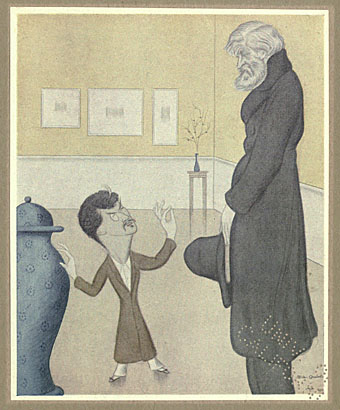
Blue China (JM Whistler and Thomas Carlyle).

A drawing which complements Wilde’s description of Whistler as a “miniature Mephistopheles”. Beerbohm was more succinct in one of his verbal portraits: “Tiny”.

beerbohm3.jpg

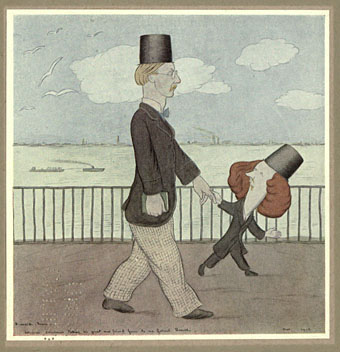
Algernon Swinburne taking his great new friend Gosse to see Gabriel Rossetti.

Swinburne, it seems, was another diminutive figure.

beerbohm4.jpg

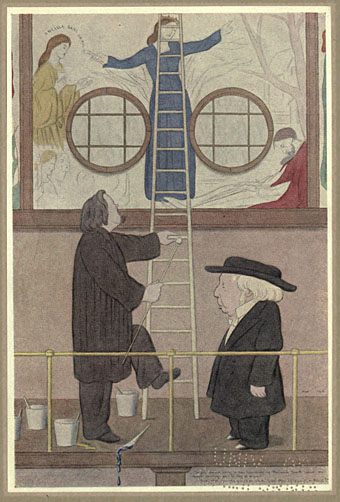
The sole remark likely to have been made by Benjamin Jowett about the mural paintings at the Oxford Union: “And what were they going to do with the Grail when they found it, Mr. Rossetti?”

Previously on { feuilleton }
The Happy Hypocrite by Max Beerbohm

Weekend links 64

magritte.jpg

The Sixteenth of September (1956) by René Magritte.

To Magritte admirers, The Sixteenth of September is a deceptively realistic work painted in 1956, one of a series in which the artist plays tricks with light and time of day. It shows a crescent moon impossibly shining through the dark mass of a tree, against a dawn sky.

To [Marc] Bolan fans, the painting has an entirely different significance: 16 September 1977 was the date the singer was returning home in the small hours from a night out, in a Mini driven by his girlfriend Gloria Jones. […] Fans say the tree in the painting closely resembles the sycamore the car crashed into, and the moon was at the same phase on 16 September 1977. (more)

• New Yorkers finally got a successful vote for gay marriage making New York state the sixth and largest in the US giving full marriage rights to its gay citizens. One of America’s conservative journals, National Review, made the striking point that forty years ago New York was in the vanguard of gay liberation while Spain under Franco was a dictatorship with no gay rights at all. No one then would have bet on Spain beating New York to gay marriage rights as it did in 2005. Allow me to note that we still only have civil unions here in the UK.

• Related: Queer Beacon: LGBT spaces in New York City by Kian Goh, and at Scientific American: The Intelligent Homosexual’s Guide to Natural Selection and Evolution, with a Key to Many Complicating Factors by Jeremy Yoder.

• A pair of intrepid photographers breach the midnight security at St Paul’s Cathedral to bring back photos of the building rooftop. Related (and looking like a good location for a British equivalent of Stalker), photos of the disused Thorpe Marsh Power Station, Yorkshire.

• Mixtape of the month: the ATP I’ll Be Your Mirror collection by Portishead, a great blend of rock, rap and electronic odds-and-ends. Also a dash of Alan Moore & Stephen O’Malley.

Eddie Campbell is blogging again. Welcome back to the madhouse, Eddie. His smart and witty daughter, Hayley Campbell, continues to file regular bulletins from her London bunker.

• Your Tumblrs this week: Fuck Yeah Ken Russell and Fuck Yeah Powell & Pressburger.

Robot Flâneur: Exploring Google Street View.

Paris Visages by Marco Gervasio.

• “Push the button, Max!

Written On The Forehead (2011) by PJ Harvey.

Friedrich and Schinkel

friedrich1.jpg

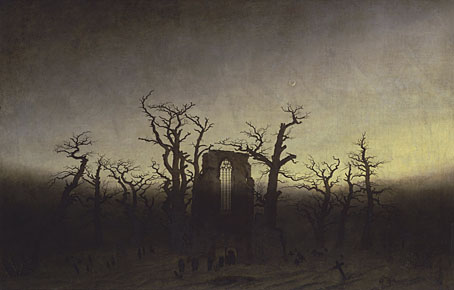
Abbey among Oak Trees (1809 or 1810) by Caspar David Friedrich.

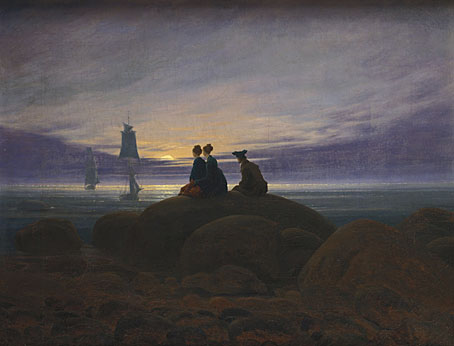
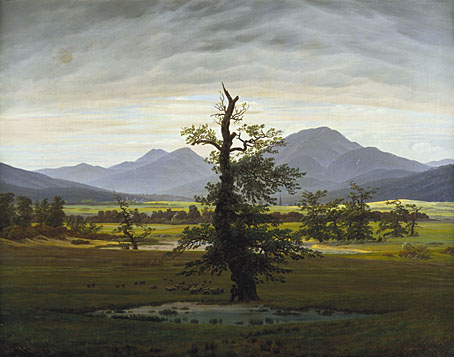
More from the Google Art Project. In these views we get to see some of the subtleties in the work of Caspar David Friedrich (1774–1840), a master at rendering fine gradations of light and shade. The paintings are from the Alte Nationalgalerie, Berlin, and Google’s photographs look far better than any book reproductions I’ve seen (assuming you have a decent monitor).

friedrich2.jpg

Moonrise over the Sea (1822) by Caspar David Friedrich.

friedrich3.jpg

Solitary Tree (1822) by Caspar David Friedrich.

Continue reading “Friedrich and Schinkel”