Olafur Eliasson’s Serpentine Pavilion

eliasson.jpg

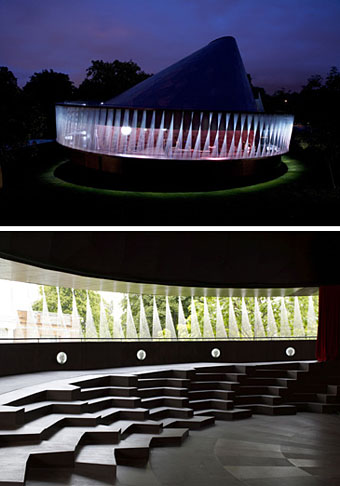
The Serpentine Gallery Pavilion 2007, designed by the internationally acclaimed artist Olafur Eliasson and the award-winning Norwegian architect Kjetil Thorsen, of the architectural practice Snøhetta, is now open to the public and will remain on site until November 2007.

The Pavilion acts as a “laboratory” every Friday night with artists, architects, academics and scientists leading a series of public experiments. The programme, conceived by Eliasson and Thorsen with the Serpentine, will begin in September and culminate in an extraordinary, two-part, 48-hour marathon laboratory event exploring the architecture of the senses.

The Serpentine Pavilion 2007 is a spectacular and dynamic building. The timber-clad structure resembles a spinning top and brings a dramatic vertical dimension to the more usual single level Pavilion. A wide spiralling ramp makes two complete turns, ascending from the Gallery’s lawn to the seating area and continues upwards, culminating at the highest point in a view across Kensington Gardens and down into the chamber below.

Danish-Icelandic artist Olafur Eliasson is based in Berlin where he established Studio Olafur Eliasson, a laboratory for spatial research. His work explores the relationship between individuals and their surroundings, as experienced in his awe-inspiring large-scale installation The weather project, 2003, at Tate Modern. Publisher of a new magazine that melds artistic and architectural experimentation, Eliasson is currently involved in numerous architectural projects such as the Icelandic National Concert and Conference Centre in Reykjavik (design of the building envelope).

He is collaborating with the Hirshhorn Museum and Sculpture Garden, Washington D.C., on a project that reconsiders the Museum’s communicative potential, and he recently won the competition for a large rooftop extension at ARoS Aarhus Kunstmuseum, Denmark.

Kjetil Thorsen is co-founder of Snøhetta, one of Scandinavia’s leading architectural practices, with offices in Oslo and New York. The Bibliotheca Alexandrina, Egypt, 1995–2001, is the commission that brought Snøhetta to international acclaim. Thorsen is responsible for the design of award-winning public buildings globally, and has collaborated with Eliasson several times, including The Opera House, Olso, currently under construction. He is a founder of Galleri Rom, Oslo, which focuses on the intersection of architecture and art, and is a member of the Norwegian Architectural Association (NAL) and the American Institute of Architects (AIA). He is also Professor at the Institute for Experimental Studies in Architecture at the University of Innsbruck, Austria.

Previously on { feuilleton }
The London Oasis
New Olafur Eliasson

Lussuria, Invidia, Superbia

lussuria.jpg

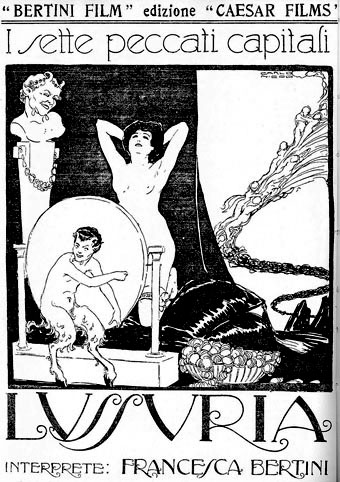
Or Lust (1919), Envy (1919) and Pride (1918). Very Beardsley-esque posters by Carlo Nicco for a series of Italian films from the silent era starring Francesca Bertini. Doubtless the prolific Ms. Bertini’s demonstrations of the Seven Deadly Sins inspired similar promotional artwork for the other films in the series but these are the only ones visible from this Flickr collection of Italian cinema memorabilia. As with Alla Nazimova’s Salomé (and Gabriel D’Annunzio’s excessive Salammbô-esque epic, Cabiria), this confirms again that fin de siècle Decadence lived on in the early days of cinema, having been banished (for a time) from the worlds of art and literature.

Via Fabulon. (Thanks Thom!)

Continue reading “Lussuria, Invidia, Superbia”

The art of George Sheringham, 1884–1937

sheringham.jpg

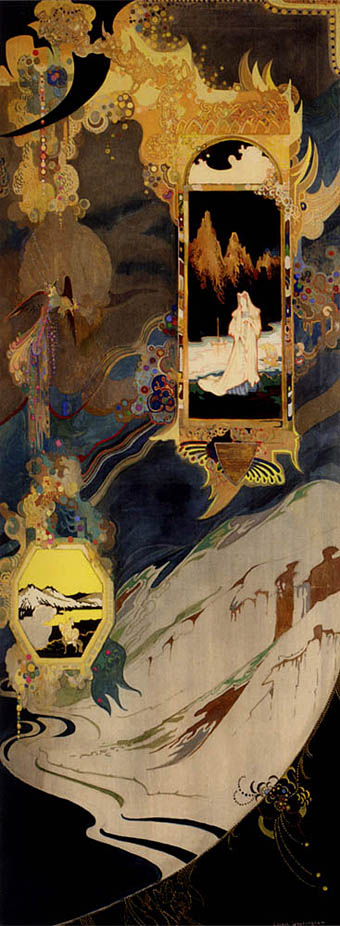
Baptism of Dylan, Son of the Wave from The Cauldron of Anwn (c. 1902).

About the artist:

George Sheringham was born in London. He studied art first at the Slade School (1899–1901) before leaving for Paris, where he studied from 1904–1906. Chiefly known as a designer of stage sets and decorative artist he was also illustrator of works by Arthur Conan Doyle and Max Beerbohm. He was the author of Drawing in Pen and Pencil (1922) and Design in the Theatre (with James Laver, 1927). An invalid from 1932, he continued to paint flowers until his death.

About the work:

This striking series of paintings were commissioned by the 8th Lord Howard de Walden (Baron Seaford) to illustrate his Celtic poem, The Cauldron of Anwn. It has been suggested that they were part of a decorative sceme for de Walden and it is therefore likely that they were part of his remodelling on the interior of Seaford House in Belgravia which he undertook from 1902 onwards. The modifications at Seaford House included the panelling of the dining room and installation of an onyx staircase and frieze carved from marble imported from South America. No expense was spared and it is said that to ensure a supply of the right kind of marble, Baron Seaford bought the mine.

The series of The Cauldron of Anwyn reflects Sheringham’s interest in oriental ornamentation and also reflects modern approaches to book illustration. A close comparison can be drawn between Sheringham’s work and that of Edmund Dulac and Sheringham’s work is also suggestive of a more exotic continental approach to decoration. Sheringham had studied at the Slade School between 1899 and 1901 and in Paris between 1904 and 1906. The qualities of his work were recognised in Paris before they were in Britain and his first exhibits were at the Paris Salon. He was born and lived in London all his life and became well known as a decorative artist, applying his talents to costume and scenery design for various theatrical productions. He also illustrated many books including The Happy Hypocrite and Design in Theatre and this interest in intricate decoration was transposed into his interior design work.

The Cauldron of Anwyn at ARC.

Elsewhere on { feuilleton }
The illustrators archive

Hugo Steiner-Prag’s Golem

golem1.jpg

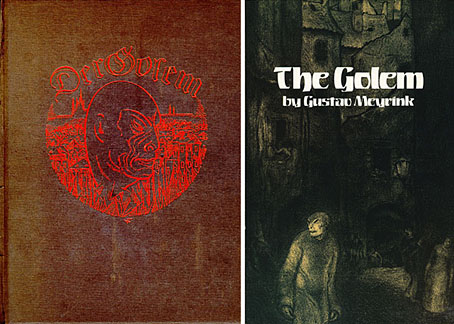
Der Golem, first edition (1915) and Dover reprint (1986).
Illustrations by Hugo Steiner-Prag.

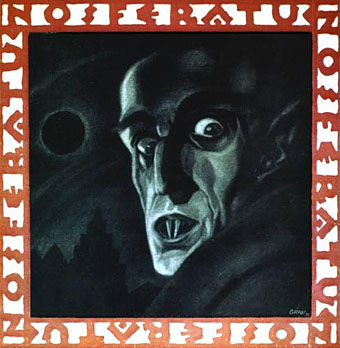
Before leaving Prague (for the time being), it’s worth mentioning the lithograph illustrations by Hugo Steiner-Prag (1880–1945) for Gustav Meyrink’s The Golem. These atmospheric drawings always remind me of the production sketches Albin Grau created for Murnau’s Nosferatu, eine Symphonie des Grauens in 1922. Grau was an occultist as well as a horror aficionado and would certainly have read Meyrink’s book which was a Europe-wide bestseller when first published. The success of the novel inspired Paul Wegener’s first Golem film (now lost) which in turn helped fuel the demand for horror films that led eventually to Nosferatu.

nosferatu.jpg

Nosferatu poster by Albin Grau (1922).

There’s little of Steiner-Prag’s work available on the web but the Dover paperback above contains all the illustrations. The novel has been re-translated recently but I’ve yet to read one of the more recent editions to see how it compares with Dover’s 1928 Madge Pemberton version.

golem3.jpg

The Golem by Hugo Steiner-Prag (1915).

Elsewhere on { feuilleton }
The illustrators archive

Previously on { feuilleton }
Nosferatu
Barta’s Golem

Kafka and Kupka

kafka_kupka.jpg

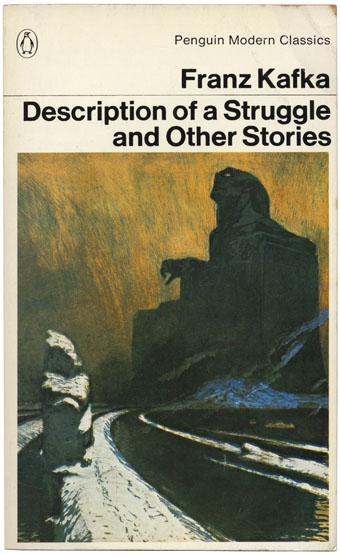
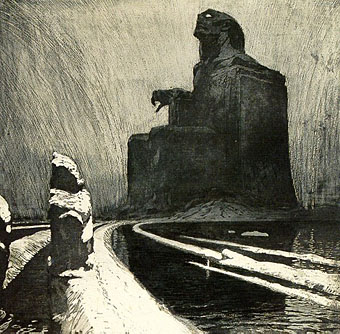
And speaking of Kafka, today’s book purchase was this 1979 story collection. The picture on the cover is a coloured aquatint and my favourite work by Czech artist František Kupka (1871–1957).

kupka2.jpg

Resistance, or The Black Idol (1903).

Kupka is one of the more unique artists of the period, having begun his career in the Symbolist mode then abruptly changed course, post-Cubism, to become one of the earliest abstract painters. Kandinsky and Mondrian followed a similar evolution but little of their early work is valued, whereas Kupka’s Symbolist pastels and etchings are still regarded as significant. This page has several of his pictures on mystical themes.

As well as being a good match for Kafka, The Black Idol was also the model for the ruined castle in Francis Coppola’s Dracula. There aren’t any decent pictures around, unfortunately, but if you must you can go and squint at the screen grabs here.

Elsewhere on { feuilleton }
The book covers archive