A=P=P=A=R=I=T=I=O=N

apparition.jpg

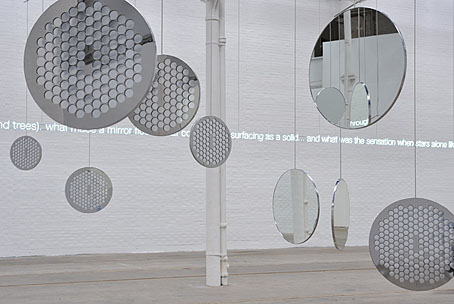
A=P=P=A=R=I=T=I=O=N is a collaboration between artist Cerith Wyn Evans and Throbbing Gristle, the once notorious Industrial music act now enjoying a resurgence of activity and attention. Evans and TG have an earlier connection via Derek Jarman, for whom Evans worked as an assistant. Given how much I enjoy seeing mirrors used in art, I’m very taken with these, and knowing that they function as drifting speakers transmitting specially recorded TG audio makes them doubly interesting. The mirrors-plus-audio aspect is reminiscent of Josiah McElheny’s recent Island Universes with Paul Schütze but that’s not to imply any influence, both artists have been following their individual paths for some time.

The title of this work comes from a poem by Stephan Mallarmé (1842–1898), a poet closely associated with the Symbolists. Looking at an English translation, the piece ends with the line “a snow of white bouquets of perfumed stars”; that final, impossible flourish—perfumed stars—is a very Symbolist touch. Claude Debussy, who took the title of his Prélude à l’après-midi d’un faune from Mallarmé, set Apparition to music in 1884.

A=P=P=A=R=I=T=I=O=N can be seen at Tramway, Glasgow until September 27, 2009.

A=P=P=A=R=I=T=I=O=N test run on Chris Carter’s Flickr pages.

Previously on { feuilleton }
In the Shadow of the Sun by Derek Jarman
The art of Josiah McElheny

The Studio & Studio International

studio1.jpg

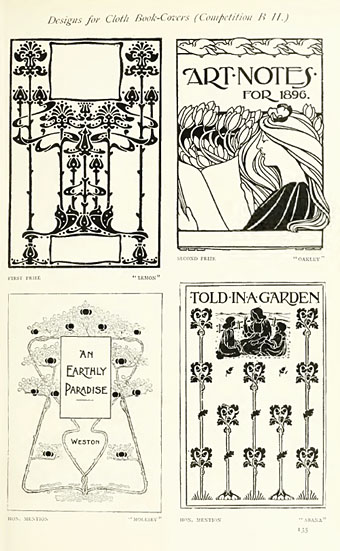
Back in February I posted some pictures from a 1971 collection of Art Nouveau illustration and design, some of which were competition entries from The Studio magazine. The Studio, which later became the long-running Studio International, can be seen from issue 11 onwards at the Internet Archive now that they’ve started uploading Google’s book scans. I’ve only looked at one of these so far, Volume 11–13 which runs over 850 pages and so takes some time to go through, as do all these rather unwieldy PDF books. The issues are missing their covers and so aren’t dated but would appear to be from around 1896 to 1898, one of the final entries being a memorial piece for Aubrey Beardsley who died that year; The Studio was the magazine which had introduced Beardsley to the public only five years earlier.

studio2.jpg

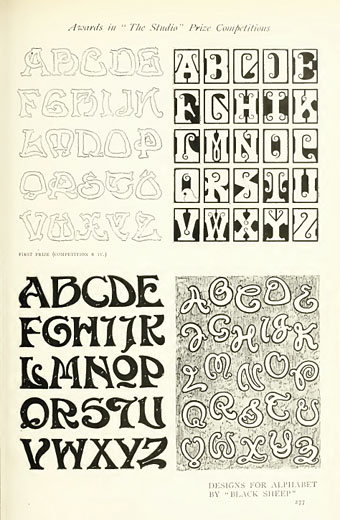
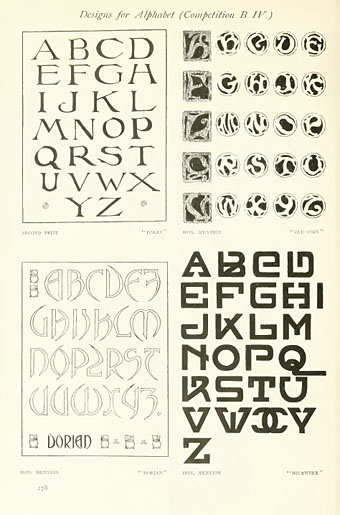
The Studio ran regular competitions among its readers and the examples shown here are from some of those. I especially like these type designs; dare we assume that the “Dorian” design below is named after Dorian Gray? As a whole the magazine is an odd mix of very dull Victorian art of the landscapes and artisans type, with occasional flares of interest when they devote a feature to the emerging Art Nouveau style or profile a Symbolist artist such as Giovanni Segantini.

studio3.jpg

A note for anyone wishing to download Google scans from the Internet Archive: some of the PDF links lead you to a Google page where they’re trying to sell you an e-text or get you to buy a book. To see the available files you need to click “All Files: HTTP”.

Previously on { feuilleton }
The Great God Pan
Art Nouveau illustration
Jugend Magazine

Nicoletto Giganti’s naked duellists

fencers.jpg

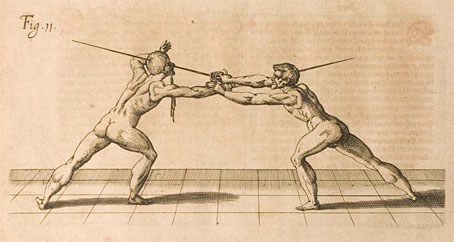
This is something you don’t generally see in swashbuckling films, a duellist being stabbed through the eye. To judge by the plates in Nicoletto Giganti’s sword-fighting manual it seems to have been a very common form of attack; duels with bare blades were a serious business. For some reason most of the combatants in these pictures also have bare bodies, possibly to better display the positioning of their limbs.

I found this 1644 book by accident last year while searching for something completely unrelated then forgot to bookmark the page. Good job, then, that the indispensable Mr Peacay at BibliOdyssey had come across the same pages. He also found plates from an older book dealing with different forms of hand combat.

Elsewhere on { feuilleton }
The men with swords archive
The etching and engraving archive

Previously on { feuilleton }
Battle of the Naked Men

The art of Warwick Goble, 1862–1943

goble1.jpg

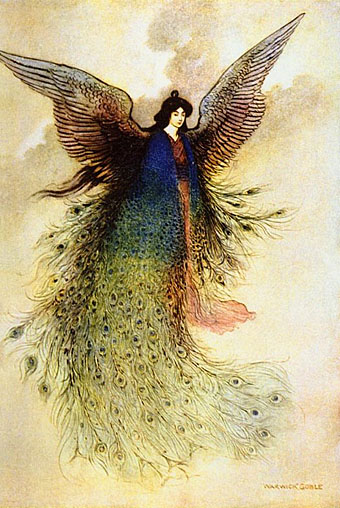
Moon Maiden (1910).

Goble’s Moon Maiden, an illustration from Green Willow and Other Japanese Fairy Tales, is proof that a peacock train needn’t be the sole preserve of masculine birds, but then Ruth St Denis had already shown us that. Art Passions has a decent selection of Goble’s fairy pictures although if you want to see the full complement of drawings made for these books you need to consult the Internet Archive. As usual with illustrators of this period, I find I prefer many of the black-and-white works over the paintings; Art Passions doesn’t have any of those, unfortunately, while the book scans are too low-res to do them justice. Once again, Bud Plant provides an overview of the artist’s career.

goble2.jpg

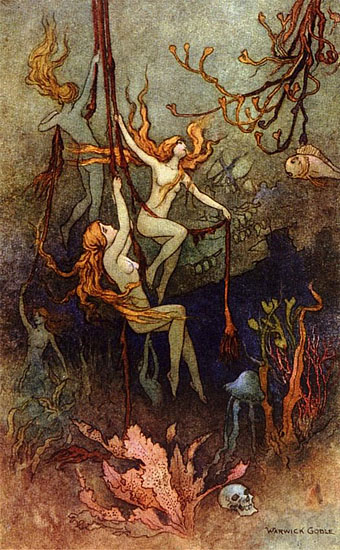
Sea-Nymphs – Ding-Dong, Bell (1920).

Elsewhere on { feuilleton }
The illustrators archive

Previously on { feuilleton }
Ruth St Denis