John Austen’s Tales of Passed Times

austen01.jpg

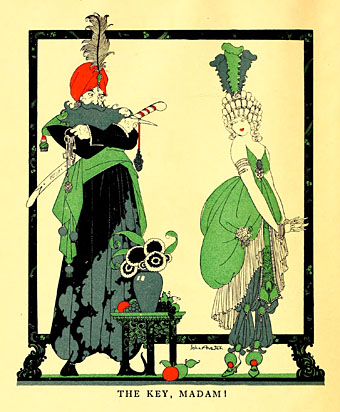
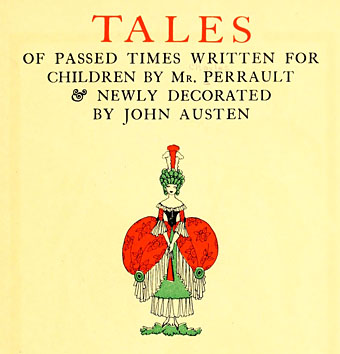
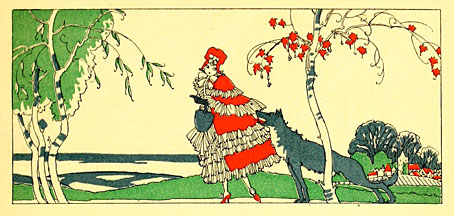
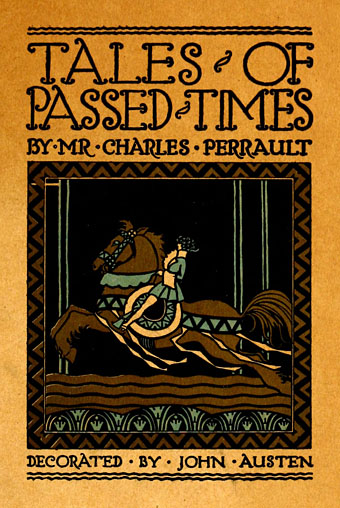
The retellings of old folk tales by Charles Perrault (1628–1703) became the earliest examples of what we now call fairy tales, but Perrault’s versions of Little Red Riding Hood, Puss in Boots, Sleeping Beauty, Cinderella et al have tended to be overshadowed by the more copious works of the Brothers Grimm and their followers. Perrault has attracted illustrators, however, including major figures such as Gustave Doré and Harry Clarke. This edition by John Austen is one of the artist’s earliest books dating from 1922. Perrault collections are often short; this one is only 74 pages but Austen fills the book with many small illustrations and vignettes. It’s a surprise seeing his work in colour when the more familiar drawings are all striking black-and-white. Spot colours help highlight Little Red Riding Hood’s outfit and Bluebeard’s beard. See the rest of the book here or download it here. (Thanks again to Nick for the tip!)

austen02.jpg

austen03.jpg

austen04.jpg

Continue reading “John Austen’s Tales of Passed Times”

Birth of a Zimbu

zimbu1.jpg

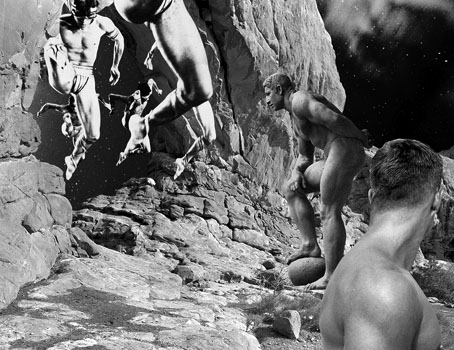
Birth of a Zimbu by Christopher Schulz is another addition to the growing collection of artworks based on William Burroughs’ The Wild Boys (1971), in this case a 52-page collection of “visual reveries made from collaged parts of dated gay porn, ancient ruins, and other various unrelated sources.” The book costs $10 and may be previewed and ordered here.

zimbu2.jpg

The Zimbus are Burroughs’ solution to the problem of reproduction (or regeneration) among the Wild Boys, his army of eternal teenage boys at war with the world at large in a dystopian 1988. Warfare means casualties so in order to maintain their homosocial, homoerotic tribal existence they gather at special times to perform sex-magic rituals that summon the “Zimbu” spirit forms of dead Wild Boys. The Zimbus are incarnated as new Wild Boys after being inseminated and fully materialised.

Burroughs wasn’t short on fantastic concepts but his ideas are often delivered and dismissed in a few lines. By contrast, the creation of the Zimbus is given pages of detailed description, the separatist, semi-human world of the Wild Boys being one to which he devoted a great deal of imaginative attention. I’ve linked before to Phil Hine’s essay, Zimbu Xototl Time, which examines the Zimbu idea at some length, drawing comparisons to similar ideas in anthropology and other fiction. If I ever get round to finished the long-gestating Wild Boys portfolio I may be able to show some Zimbu manifestations of my own.

Elsewhere on { feuilleton }
The William Burroughs archive

Weekend links 244

scarpulla.jpg

MMOB :: Far West (2013) by Alison Scarpulla.

• “…although same-sex love is as old as love itself, the public discourse around it, and the political movement to win rights for it, arose in Germany in the late nineteenth and early twentieth centuries. This message may surprise those who believe that gay identity came of age in London and New York, sometime between the Oscar Wilde trials and the Stonewall riots.” Alex Ross reviewing Robert Beachy’s Gay Berlin: Birthplace of a Modern Identity. Beachy talks about his book here.

• “I was in a room with tube synthesizers, where you had to tune them up to play them. It was unbelievable.” John Carpenter talking to Joseph Stannard about composing with electronics. Carpenter’s album of new music, Lost Themes, may be previewed here.

• From 2010: John Ridpath on Mervyn Peake’s illustrations for Lewis Carroll’s Alice Through the Looking Glass and Alice in Wonderland. Related: “The most twisted version of Alice in Wonderland you’ll ever see.”

I was brought up in a world where art was something owned and insured—usually inherited: but seldom if ever made by anyone one I knew.

I had an early inkling that there was fun to be had over the hill, like the feeling when faced with a sunset that someone’s throwing a mega awesome party just beyond the nearest cloud, and I set off to join the caravan. Let’s just say I was in search of company, headed towards the glow, and I found it.

Tilda Swinton‘s speech at the Rothko Chapel

• “Her art often touches on alchemy and magic; and in her memoir of insanity she writes of misreading an Imperial Chemicals sign as ‘chemistry and alchemy’.” Charlotte Higgins on Leonora Carrington.

Shadows Over Main Street, an anthology of small-town Lovecraftian terror, is out this week from Hazardous Press. 20 stories and poems plus interior illustrations including a contribution of my own.

• “With Fantastic Planet, I felt torn about using it, because it’s…the title of an animated film.” Guitarist Sarah Lipstate, aka Noveller, talks to Ned Raggett about her new album.

Jim Jupp of Belbury Poly and the Ghost Box record label answers 15 questions.

• A DeLorean driving through a Tron cityscape: Retrowave by Florian Renner.

• Powell & Pressburger’s Tales of Hoffmann (1951) has been restored.

Music from Forbidden Planet (1956) by Louis & Bebe Barron | The Four Horsemen (1972) by Aphrodite’s Child | Assault on Precinct 13 (Main Theme) (1976) by John Carpenter

January

january2.jpg

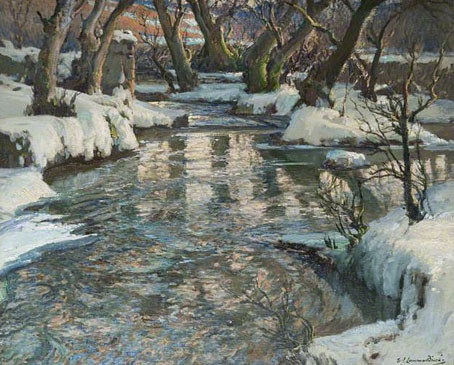
January, Where Daffodils Lie Sleeping (no date) by Samuel John Lamorna Birch.

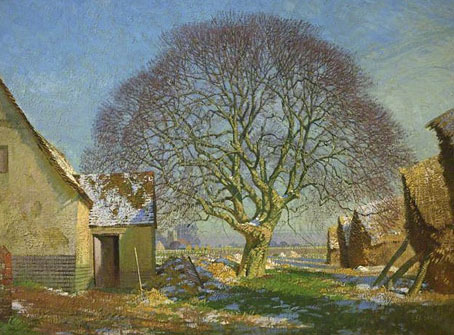
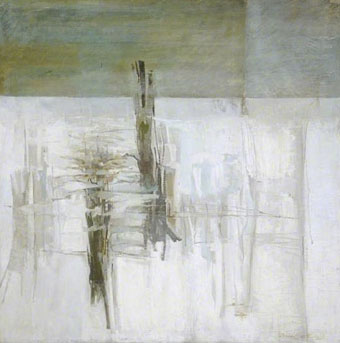
One day left to post some more January paintings. These are mostly British scenes, and the snowier ones give a good sense of how it’s been here for the past few days.

january8.jpg

Morning in January (no date) by Gerald Gardiner.

january6.jpg

January (1960) by Denis Booth.

Continue reading “January”

Alphonse Mucha record covers

mucha01.jpg

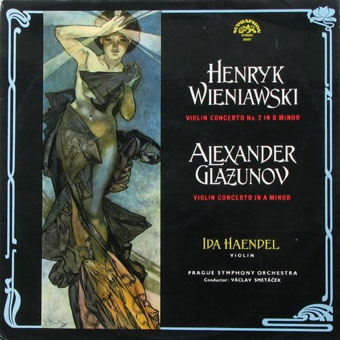
Henryk Wieniawski / Alexander Glazunov: Violin Concerto No. 2 In D Minor / Violin Concerto In A Minor (1965); Ida Haendel, Prague Symphony Orchestra, Václav Smetácek. Artwork: Morning Star (1902).

Continuing an occasional series about artists or designers whose work has been used on record sleeves. Note that this is a selection of works by Alphonse Mucha only. Pastiches of the Mucha style are plentiful, and some—like Barney Bubbles’ cover for Space Ritual by Hawkwind—are very familiar, but I’ll leave it to someone else to go looking for those.

mucha04.jpg

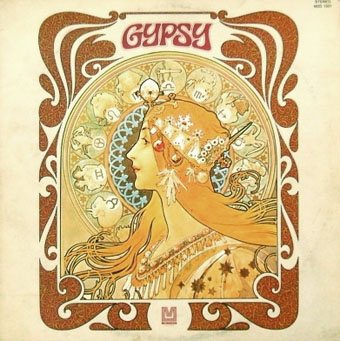
Gypsy (1970) by Gypsy. Artwork: La Plume: Zodiac (1896).

mucha02.jpg

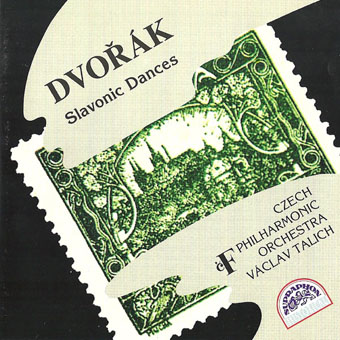
Dvorák: Slavonic Dances (1993); Czech Philharmonic Orchestra, Václav Talich.

Mucha is one of the most celebrated of all Czech artists so it’s no surprise his work appears on releases from Czech label Supraphon. This is one of a series of orchestral recordings that use a Mucha postage stamp for the cover art.

Continue reading “Alphonse Mucha record covers”