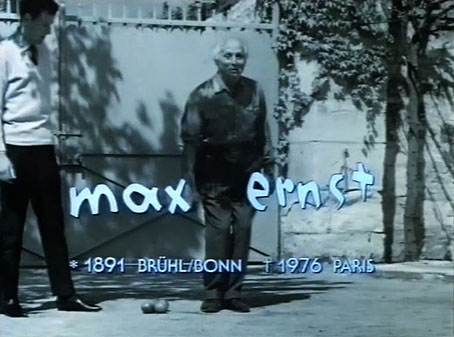
Max Ernst by Peter Schamoni

me1.jpg

The English version of Peter Schamoni’s feature-length documentary from 1991 has finally reached YouTube. I think copyright reasons may have prevented it from doing so in the past in which case the usual caveats apply: if it’s of interest then watch it while you have the opportunity, it may not be there for long. The German version of the film has a longer title, Max Ernst: Mein Vagabundieren—Meine Unruhe, which auto-translates to “my vagabondingmy restlessness”, a reference to Ernst’s peripatetic life as well as to his artistic wanderings.
me2.jpg

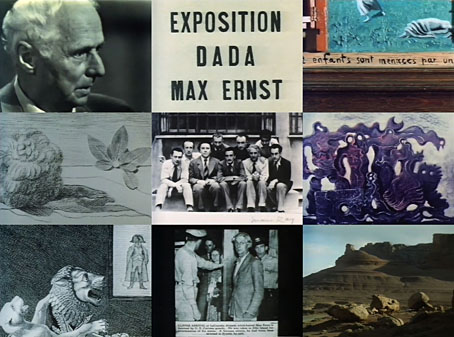
I mentioned in the previous post my having spent some time last year watching a number of documentaries about Surrealism. This was one of them, and it’s the film about Max Ernst. Films about Salvador Dalí are plentiful but other Surrealist artists are lucky if they receive a single worthwhile appraisal. Peter Schamoni had filmed Ernst in 1966 for a short, Maximiliana oder die widerrechtliche Ausübung der Astronomie, so was already sympathetic to the artist’s work. Max Ernst resembles one of the BBC’s classic Arena documentaries in being a biographical account threaded with documentary material and pictures of significant artworks. Detail is supplied by actors reading from writings by Ernst, Dorothea Tanning and others.
me3.jpg

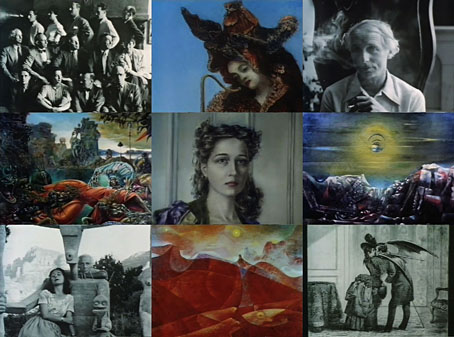
There’s a lot of interview footage here, mostly from TV appearances in later life, in which Ernst’s intelligent conversation makes a striking contrast to Dalí’s bluster and evasions. Schamoni interleaves the historical footage with shots of the various locations of Ernst’s wanderings: the south of France, New York City, California, Arizona, Paris. Several of the Dalí documentaries note the degree to which the coastal landscape of Cadaqués informed Dalí’s painting; Schamoni makes a similar comparison between Ernst’s American paintings and the desert landscapes of Arizona. It’s good to see some of the Microbes that he painted while he was there, a series of tiny landscape pictures that books about Ernst don’t always mention, let alone reproduce.

Previously on { feuilleton }
The nightingale echo
Max Ernst’s favourites
Viewing View
Max Ernst album covers
Maximiliana oder die widerrechtliche Ausübung der Astronomie
Max and Dorothea
Dreams That Money Can Buy
La femme 100 têtes by Eric Duvivier
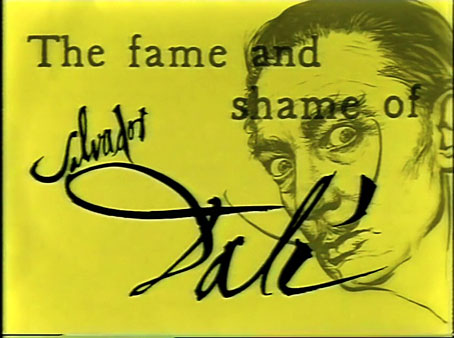
The Fame and Shame of Salvador Dalí

fasosd1.jpg

…one ought to be able to hold in one’s head simultaneously the two facts that Dalí is a good draughtsman and a disgusting human being.

George Orwell

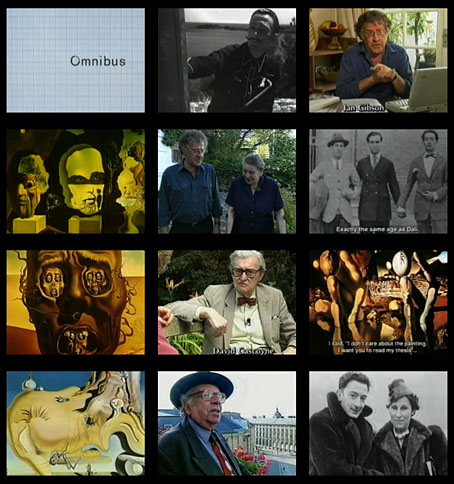
This two-part, two-hour TV documentary from 1997 has a title that makes it sound like more of an exercise in audience pandering than was typical for the BBC’s Omnibus arts strand, fame and shame being qualities that might be considered of greater interest for the general viewer than art history. But Michael Dibb’s film is more insightful than those made 20 years earlier when access to the Dalí circle, and to Dalí himself, required flattery and capitulation to the artist’s whims and attention-grabbing antics. In place of the impersonal approach taken by the BBC’s Arena documentary from 1986 we have writer Ian Gibson serving as a guide to Dalí’s life while conducting research into a major biography, La vida desaforada de Salvador Dalí (The Shameful Life of Salvador Dalí), which was published a year later. “Shame” here refers more to Dalí’s numerous fears and phobias, especially those of the sexual variety, rather than to scandal and public opprobrium, while “Shameful Life” echoes the “Secret Life” title of the artist’s autobiography. Dalí’s sexual neuroses were always to the fore in his art but they remained concealed in his personal life, although the evasions—his frequent declarations of impotence, for example—don’t prevent Gibson from speculating. I saw this documentary when it was first broadcast but had forgotten the discussions of a possible homosexual relationship with Dalí’s adoring friend, Federico García Lorca, as well as the mention of the artist’s voyeurism, all of which was explored in more detail (and with some personal experience) by Brian Sewell a decade later in the TV documentary with the most prurient title of them all, Dirty Dalí: A Private View.

fasosd2.jpg

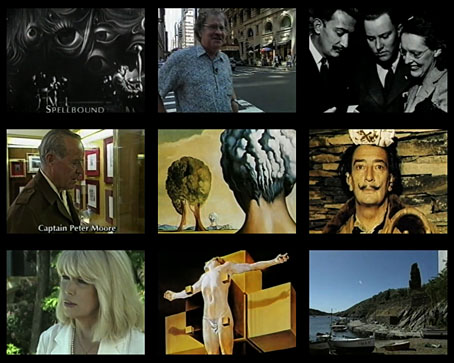
Gibson is a guide with the advantage of being a fluent Spanish speaker able to engage in conversation with those who knew or worked for the artist. Several of the interviewees are familiar faces in Dalí films: Amanda Lear, art collectors Reynolds and Ellen Morse, Dalí’s first secretary and business manager, Captain Peter Moore, and painter Antoni Pitxot. 1997 was about the last time it was possible to make a documentary about Dalí that might feature interviews with people who knew the artist in his younger days, although José “Pépin” Bello, born the same year as Dalí in 1904, lived on until 2008. Bello was the sole surviving member of a Madrid student group in the 1920s whose other members were Dalí, Luis Buñuel and Federico García Lorca. He also turns up in The Life and Times of Don Luis Buñuel (1984), another BBC film which really ought to be on YouTube, where he makes unsubstantiated claims about having contributed ideas to Un Chien Andalou. It’s easy to be sceptical about the assertions of an uncreative man whose youth had been spent in the company of three great talents but according to this obituary both Dalí and Buñuel confirmed the claims. (The image of a rotting donkey, however, had appeared in Dalí’s paintings before the film was made.)

fasosd3.jpg

Among the other people talking to Gibson are Surrealist poet David Gascoyne, and also George Melly, a man who for a long time was a ubiquitous presence whenever Surrealism was being discussed on British TV. The interviews are separated by clips from other films, two of which have featured in earlier posts: Hello Dalí! (which I keep hoping someone will upload to YouTube in better quality), and Jack Bond’s film of Dalí in New York in 1965. I watched both these again last year when I followed my viewing of the Švankmajer oeuvre with a number of Surrealist documentaries. Jack Bond’s film is especially good for its verité qualities, and for Jane Arden’s attempts to persuade Dalí to talk seriously for once about his art.

The Fame and Shame of Salvador Dalí: Part One | Part Two

Previously on { feuilleton }
Figures of Mortality: Lawrence versus Dalí
Être Dieu: Dalí versus Wakhévitch
Chance encounters on the dissecting table
Salvador Dalí’s Maze
Dalí in New York
Dalí’s discography
Soft Self-Portrait of Salvador Dalí
Mongolian impressions
Hello Dalí!
Dirty Dalí
Impressions de la Haute Mongolie revisited

Weekend links 569

lehr.jpg

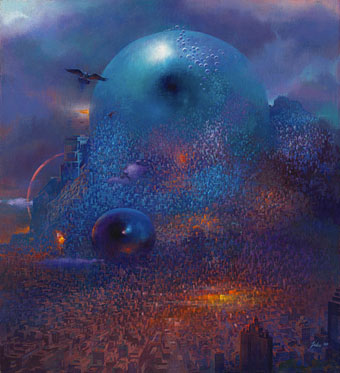
City with Eyes in Blue (1989) by Paul Lehr.

• “Lehr chose science fiction illustration because he saw it as a path to making a living and an opportunity to ‘depict the epic’. ‘War, destruction, celebration, congestion, marching armies, waving flags and banners—the strange and mysterious atmosphere of it all, rather than the literal illustration.'” Jane Frank on the art of Paul Lehr (1930–1998).

• “Time isn’t the only thing Harrison treats as firmly malleable. The same is true of his willingness to play with genre conventions…” Tobias Carroll on M. John Harrison, and an article where you have to ignore the clickbait clichés in the headline.

• The narrators for the forthcoming audiobook of Voice of the Fire by Alan Moore have been revealed.

• At Public Domain Review: A remembrance of aerial forms: Odilon Redon’s À Edgar Poe.

• The weight of the ritual: Frank Rynne on The Master Musicians of Joujouka.

• “Cerne Giant in Dorset dates from Anglo-Saxon times, analysis suggests.

Aaron Moth, the artist creating exquisite collages from vintage [gay] porn.

Clive Hicks-Jenkins on revision in illustration.

• At Wikimedia Commons: Lesbian pulp fiction.

• Mix of the week: A Wire mix by BLK JKS.

• At Dennis Cooper’s: Psychedelics.

Colleen‘s favourite albums.

Ritual Fire Dance (1969) by Tuesday’s Children | Ritual (1973) by Vangelis | Rituals (1981) by Bush Tetras

Weekend links 568

gekko.jpg

Dragon Rising to the Heavens (1897) by Ogata Gekko.

• “Electronic music of the past is often portrayed in a dreamy, magical light—a hazy historical landscape filled with misty, otherworldly sounds. But while the music of a bygone era may seem ineffable, it is not inaccessible.” Geeta Dayal reviews Reminded by the Instruments: David Tudor’s Music by You Nakai.

• Modular Therapy: Mute Records boss Daniel Miller and former snooker champ turned kraut-psych powerhouse Steve Davis discuss their love of modular synthesisers, ill-fated Jools Holland collaborations, commandeering Elton John’s ARP 2600 and more.

• “Some contemporary art is a little bit like an intellectual game…I’m not a big fan of this kind of stuff, because I’m a musician.” Ryoji Ikeda presents: point of no return.

One of the tunnels that Turrell has completed is 854 feet long. When the moon passes overhead, its light streams down the tunnel, refracting through a six-foot-diameter lens and projecting an image of the moon onto an eight-foot-high disk of white marble below. The work is built to align most perfectly during the Major Lunar Standstill every 18.61 years. The next occurrence will be in April 2025. To calculate the alignment, Turrell worked closely with astronomers and astrophysicists. Because the universe is expanding, he must account for imperceptible changes in the geometry of the galaxy. He has designed the tunnel, like other features of the crater, to be most precise in about 2,000 years. Turrell’s friends sometimes joke that’s also when he’ll finish the project.

Wil S. Hylton on an exclusive visit to James Turrell’s astronomical art complex at Roden Crater, Arizona. Related: 147 Orbiting 1 Through 6 for 5, Music for Roden Crater by Paul Schütze (with free download of an excerpt from the 5-hour piece)

• New music: The Black Mill Tapes, Volume 5 by Pye Corner Audio, and Interreferences by Richard Chartier.

• At Spoon & Tamago: Dense pencil drawings of retro-future worlds by Yota Tsukino.

“‘I’m bursting with fiction’: Alan Moore announces five-volume fantasy epic”.

• At Dennis Cooper’s: Lindsay Anderson Day.

Beverly Glenn-Copeland’s favourite music.

Volcano Diving (1989) by David Van Tieghem | Crater Scar (1994) by Main | Eye Of The Volcano (2006) by Stereolab

Pynchon and Varo

varo.jpg

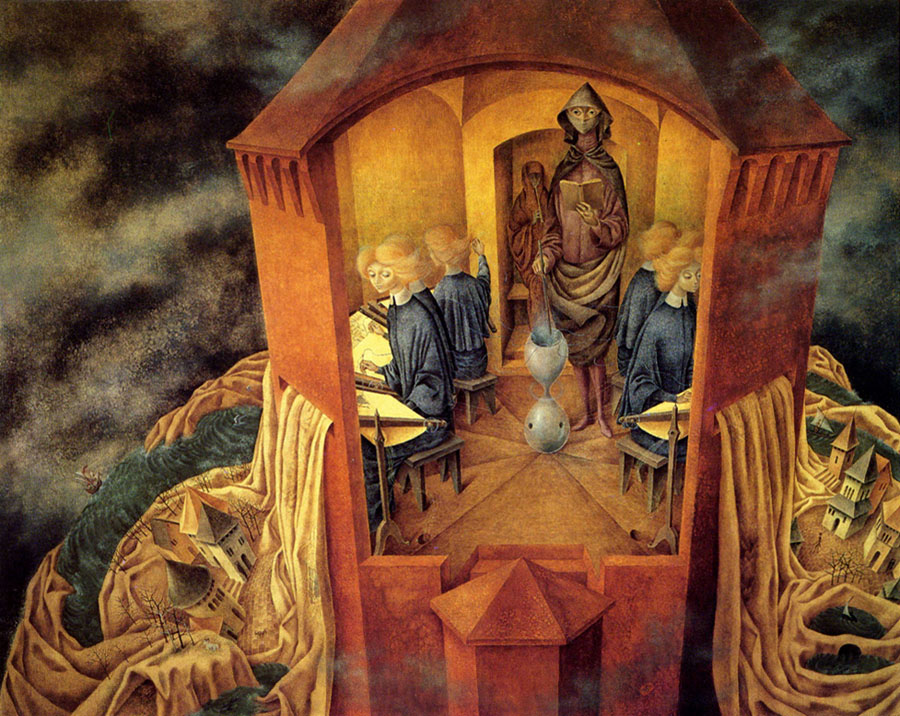
Bordando el Manto Terrestre (Embroidering the Earth’s Mantle) (1961) by Remedios Varo.

Re-reading The Crying of Lot 49 by Thomas Pynchon, this passage near the end of the first chapter stood out:

In Mexico City they somehow wandered into an exhibition of paintings by the beautiful Spanish exile Remedios Varo: in the central painting of a triptych, titled “Bordando el Manto Terrestre,” were a number of frail girls with heart-shaped faces, huge eyes, spun-gold hair, prisoners in the top room of a circular tower, embroidering a kind of tapestry which spilled out the slit windows and into a void, seeking hopelessly to fill the void: for all the other buildings and creatures, all the waves, ships and forests of the earth were contained in this tapestry, and the tapestry was the world. Oedipa, perverse, had stood in front of the painting and cried. No one had noticed; she wore dark green bubble shades. For a moment she’d wondered if the seal around her sockets were tight enough to allow the tears simply to go on and fill up the entire lens space and never dry. She could carry the sadness of the moment with her that way forever, see the world refracted through those tears, those specific tears, as if indices as yet unfound varied in important ways from cry to cry.

My earlier reading was in the mid-1990s, remote enough to have forgotten that Remedios Varo is mentioned twice (there’s another brief reference later on) in a novel otherwise unconcerned with painting. I didn’t remember much at all of the narrative, come to that, apart from the long description of a Jacobean revenge play, and all the post horn business. (And by coincidence—or is it? etc—I was amused to encounter a description of James Clerk Maxwell’s famous demon of entropy only a few days after reading this.) I did know who Varo was but at the time had only seen a couple of her paintings. She turns up in the better books on Surrealist art—one of mine has her filed under “Remedios”—but she didn’t have the connections or the longevity of her friend Leonora Carrington so any mention tended to be brief. In the 1990s it wasn’t possible to easily find a picture of a painting like Bordando el Manto Terrestre unless you worked in a major library or collected exhibition catalogues. Many complaints may be levelled against the internet but I never tire of having instant access to the entire history of art, so of course I had to stop reading for a moment to look for a copy of the picture. If I hadn’t done so I wouldn’t have discovered this lengthy discussion by Bill Brown of both novel and painting, and of the connections between the two. The Crying of Lot 49 is a slight work by Pynchon standards, one that the author disparages in his introduction to Slow Learner. In the same introduction he mentions Surrealism being an important factor in his literary evolution although he doesn’t name any specific influences. Pynchon’s Surrealism is like Varo’s, not the poetry of haphazard collisions but a thing of stylised figures in a world where hidden meanings may be present but also reluctant to reveal themselves. No wonder he liked the painting.

Previously on { feuilleton }
Remedios Varo’s recipe for erotic dreams
Thomas Pynchon – A Journey into the Mind of [P.]