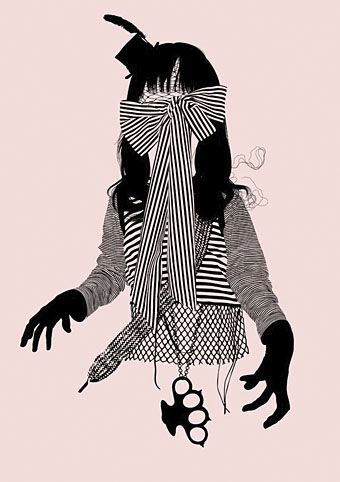
Striking black-and-pink art for Diesel Japan’s Cadavres Exquis exhibition by French artist Jules Julien. His site includes other work for exhibitions and magazine features as well as a downloadable portfolio. Via Behance.
A journal by artist and designer John Coulthart.

Black and white art
Striking black-and-pink art for Diesel Japan’s Cadavres Exquis exhibition by French artist Jules Julien. His site includes other work for exhibitions and magazine features as well as a downloadable portfolio. Via Behance.
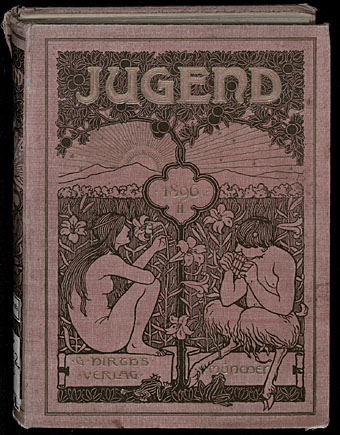
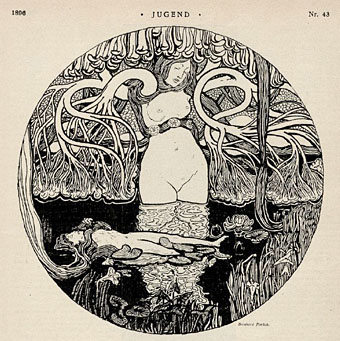
It was just over a year ago that I was wishing there was some way to see whole issues of Jugend magazine, the German periodical launched in 1896 whose Art Nouveau style gave its name to the movement in Germany, Jugendstil. Yesterday’s search for Heinrich Vogeler artwork turned up that very thing, scanned editions of Jugend at the University of Heidelberg’s digital archive. Whole numbers from 1896 to 1925! I am aghast. As well as the scanned pages being very high quality you can download the bound collections as PDFs, each one totalling over 400 pages. Leafing through pages of old magazines in a foreign language doesn’t sound very stimulating if you can’t read German but Jugend was a very visual publication. Each issue is crammed with a variety of drawings in styles which range from black-and-white Art Nouveau motifs and quasi-Symbolist illustration to humorous drawings and cartoons. Each issue also featured a large drawing or painting on a fold-out spread.

It’s a curious feeling when a drawing which is nearly 26 years old makes it out into the world. The image above is the cover of a new 7″ single release, Dominion of Avyaktam by metal band Orator, the picture being something I drew in 1984 entitled Mahakala after the Tibetan deity which it depicts. The inspiration was the cover of another recording, a Nonesuch Explorer album, Tibetan Buddhism – Tantras Of Gyütö: Mahakala, and also the track Mahakala by 23 Skidoo from their 1983 album The Culling is Coming. The skull is drawn from a real one I was given. Looking at this today none of the elements seem to work together—and the landscape stuff looks like a lazy way of filling in space—but it’s nice to see it find a home. Dominion of Avyaktam is out now on the Legion of Death label.
• Surprise of the week: two books I’ve worked on were nominated for Nebula Awards, Jeff VanderMeer’s Finch, and Kage Baker’s The Hotel Under the Sand whose interior I designed.
• More music: a recording of Paul Schütze’s Third Site played live in 1999 (with Clive Bell, Raoul Björkenheim, Simon Hopkins & Thomas Köner’s voice) is now available as a free download on his website. More Schütze: Paul Schütze & Simon Hopkins playing a set at the Horbar in Hamburg on December 28, 2009.
• The incredible pinscreen animations of Alexander Alexeieff and Claire Parker are finally available on DVD. Also new to DVD, Alan Bennett at the BBC, a four-disc set of some of his TV plays including a particular favourite of mine, his Kafkaesque drama The Insurance Man.
• More Ghost Box business: Jon Brooks aka The Advisory Circle has a blog. And Ghost Box’s Jim Jupp was interviewed recently by Peter Bebergal at Mystery Theater. Related (forgot to mention this last week): The ASDA Mix, a great mixtape of spooky retro weirdness by Moon Wiring Club available for free at The Wire.
• The trailer for Mellodrama, a documentary about the Mellotron by Dianna Dillworth.
• The Parajanov Festival will be screening some of the director’s films in London and Bristol.
• Lots of weird and wonderful exhibits at the ~Wunderkammer~.
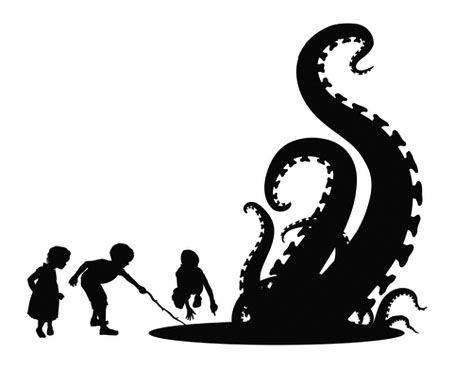
One of a series of creepy children’s illustrations by Alexander Ovchinnikov which look like the work of pioneering animator Lotte Reiniger pushed into a darker world. Ovchinnikov’s Behance portfolio has a similar set mixing silhouettes with photography.
Elsewhere on { feuilleton }
• The illustrators archive
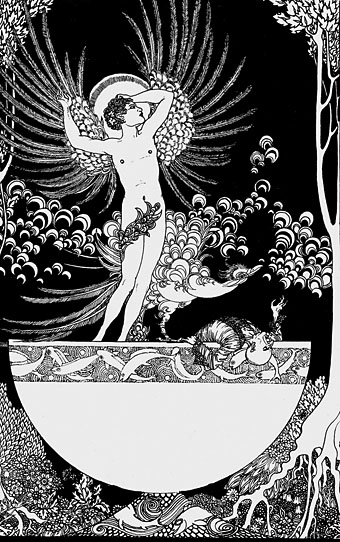
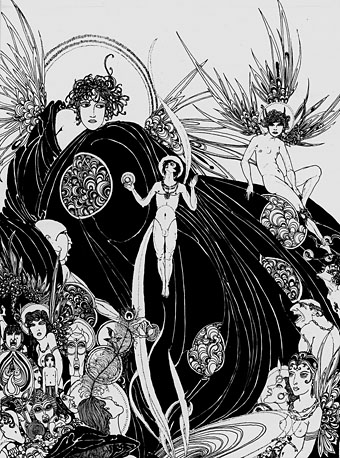
If the work of illustrator Ronald Balfour (1896–1941) isn’t as well-known as it should be it’s probably because his 1920 edition of the Rubáiyát is his sole major work according to a recent feature in Book & Magazine Collector. These illustrations were produced when he was 24 and while the drawing can be uncertain in places, they’re really splendid examples of the post-Beardsley style, owing far more to Aubrey’s flourishes and details than to the usual Arabian exotica found in other Omar Khayyam adaptations. As usual I love the profusion of peacocks and winged figures, and, unlike many rare editions of this period, we’re fortunate that someone has put all the illustrations onto Flickr. Feast your eyes here.
Elsewhere on { feuilleton }
• The illustrators archive