Taj Mahal panoramas

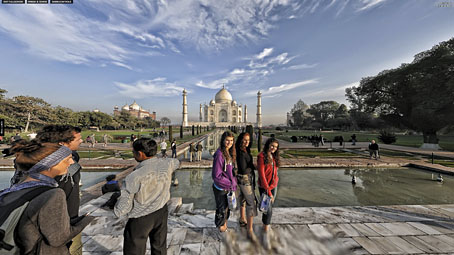
tajmahal1.jpg

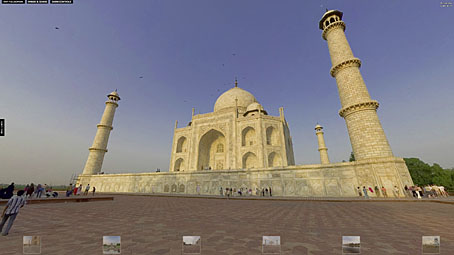
The standard view plus tourists by Michael Maniezzo.

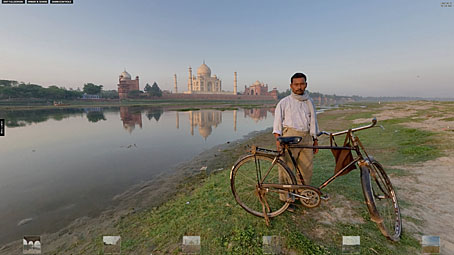
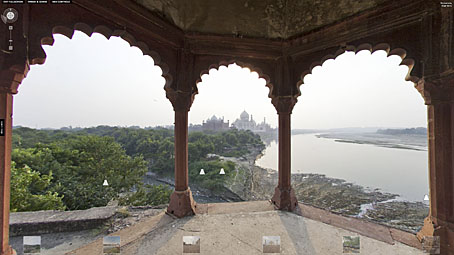
Jeffrey Bartholet has a lengthy piece at Smithsonian Magazine entitled How to Save the Taj Mahal?, a brief history of the monument and also an examination of the preservation problems the site faces. Reading his essay it occurred to me that despite the Taj Mahal being one of the world’s most famous and recognisable buildings the pictures we’re shown of it are nearly always the same, showing a view along one of the canals that runs through the gardens towards the monument. The panoramas at 360cities immediately rectify this with some stunning shots showing the site up close or from a considerable distance. The latter selection are unlike any I’ve seen before, and give a great sense of the river which runs around the Taj Mahal complex and the countryside around the city of Agra. Bartholet notes that five million people visited Agra between March 2010 and March 2011, many of them adding to the damage the monument has already sustained. People may rail against virtual tourism as an iniquity but where sites such as this are concerned it’s a lot less polluting and destructive than the alternative.

tajmahal2.jpg

Sunset by Justin Imhoff.

tajmahal3.jpg

The Yamuna River by Justin Imhoff.

tajmahal4.jpg

A view by Roger Berry from nearby ruins.

Elsewhere on { feuilleton }
The panoramas archive

Weekend links 74

johnnyyesno.jpg

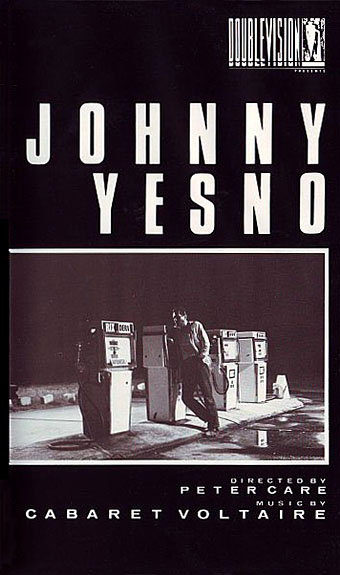
Johnny YesNo video cover, 1983. Design by Neville Brody.

Being a Cabaret Voltaire enthusiast of long standing it was good to hear last week about the imminent reappearance of Johnny YesNo, an hour-long film by Peter Care for which the Cabs provided the soundtrack. Mute Records will be releasing Care’s debut on DVD in a set which includes two versions of the film together with two music CDs. I never got to see the original release on CV’s VHS label, Doublevision; for most of the 1980s I didn’t even have a colour TV never mind a video recorder so I missed all CV’s videocassettes aside from Gasoline In Your Eye. The new edition will be available in November. Brainwashed has a list of the contents while The Quietus posted a clip from the new “redux” version. (And before anyone tells me it’s on YouTube…yeah, everything is on YT in shitty quality and barnacled with the misanthropy-inducing drivel which passes there for comment. If I’m going to watch something for the first time I’d prefer it to be on a shiny disc, thanks.)

• The world has noticed Terrence Malick again following the release of The Tree of Life. Malick’s second feature is returning briefly to UK cinema screens, an event which prompted David Thomson to ask Is Days of Heaven the most beautiful film ever made?

• This week in imaginative art: S. Elizabeth on The Fantastical Fairy Tale Art of Sveta Dorosheva, AS Byatt on the strange paintings of Richard Dadd (there’s another Dadd article here), and Rick Poynor on Chris Foss and the Technological Sublime.

Ethan Hein demonstrates how Alan Lomax came to have copyright control over many songs he had nothing to do with simply by recording traditional music.

Visual Vitriol:  The Street Art and Subcultures of the Punk and Hardcore Generation, a book by David Ensminger.

• More Club Silencio: Inside David Lynch’s Paris nightclub and a gallery of photos.

Histoire un-Naturelle, selected works by Ruth Marten.

Come hither: The deceptive beauty of orchids.

Facsimile Dust Jackets.

• More Peter Care: Just Fascination (1983) by Cabaret Voltaire | Sensoria (1984) by Cabaret Voltaire | Rise (1986) by Public Image Ltd.

Thom Ayres

ayres1.jpg

Mr Ayres is a blogger at Form is Void, an occasional commenter on these pages and also a photographer with a keen eye for detail and the occasional outbreak of alarming taxidermy. I especially like the architectural pieces, and I never tire of seeing rusted surfaces and flaking paintwork (one of the best things about growing up in a seaside town). There’s a lot more to be seen here, and at Thom’s Flickr pages.

ayres2.jpg

ayres3.jpg

Continue reading “Thom Ayres”

Bruno Taut’s Glass Pavilion

taut2.jpg

Some speculative architecture that for once isn’t from Paris in 1900. Bruno Taut (1880–1938) gets labelled an Expressionist architect although it’s always a hazardous business connecting people in other disciplines to whatever art movement may be around at the time. The Glass Pavilion was a showcase structure commissioned by the German glass industry for the 1914 Werkbund exhibition in Cologne. The colour photo is a model from this V&A page where we learn that:

Bruno Taut’s structure demonstrated the various ways glass could be used in a building, but also indicated how the material might be used to orchestrate human emotions and assist in the construction of a spiritual utopia. Taut’s interest in this aspect of glass (explored more intensively during the First World War and later in his book Alpine Architecture and in the Glass Chain letters) had been stimulated by the writer Paul Scheerbart whom he had met in 1912 and who argued for an earthly paradise based on a new architecture of glass and colour. Subsequently, Scheerbart wrote Glasarchitektur (Glass Architecture) in 1914, which he dedicated to Taut, while Taut produced his Glass Pavilion and inscribed aphorisms from Scheerbart on the lintels of the 14 side walls. […] The glazed walls were topped by a dome of reinforced concrete ribs and a double skin of glass: reflecting glass on the outside and coloured prisms inside. In the interior, the colour effects produced by sunlight were enhanced by the reflections of the pool and water cascade on the lower level, visible through a circular opening in the floor. Two flights of glass steps enclosed with glass walls produced the sensation of descending to the lower level ‘as if through sparkling water’. The cascade was made of yellow glass, while the pool was of its complementary colour, violet. A mechanical kaleidoscope overhead projected images, an early version of a light show, intensifying the overall impression on the visitor.

All of which makes one wish there were more colour photos available. There’s another photo of the model here which shows a very different arrangement of light and colour.

taut1.jpg

Le Corbusier apparently disliked Taut’s obsession with vivid colours, accusing him of being colour blind. There’s more about Taut’s philosophy of colour here. Taut wasn’t the only architect at the time interested in glass, his contemporary Hermann Finsterlin designed a “dream in glass” in 1920 that still looks radical today, as do many of Finsterlin’s other designs, all of them a good reminder that biomorphic architecture isn’t exactly new, it’s just become easier to build.

See also: Lebbeus Woods on Taut’s plan to refashion the Alps into a range of crystalline buildings.

taut3.jpg

The cascade.

taut4.jpg

The dome interior.

Six Suites of Engravings

suite1.jpg

Something discovered following another delve through the collections of etchings and engravings at the Internet Archive where a frustrated search for one subject turns up something else. This 1549 folio of architectural engravings is credited to architect and designer Jacques Androuet du Cerceau (1510–1584), and the plates are based on earlier renderings by Agostino Veneziano and Hieronymus Cock, he of the incredible map of the Americas. Among the details of columns and caryatids there’s a series of the kind of imaginary perspective views I always like to see, lots of sparsely-populated courtyards in various states of ruin. It’s easy to imagine these prospects being transformed into scenarios from Paul Delvaux or Giorgio de Chirico after a suitable change of lighting.

suite2.jpg

suite3.jpg

suite4.jpg

Elsewhere on { feuilleton }
The etching and engraving archive