Bruges in photochrom

bruges01.jpg

Maison du France.

I’ve looked through the Library of Congress collection of photochrom prints many times but somehow never noticed the 20 or so prints of Bruges until now. The Belgian Symbolists recorded their fascination with the Belgian town in paintings, drawings, photographs and Georges Rodenbach’s novel, Bruges-la-Morte (1892). The latter came illustrated by photographs that showed the town’s depopulated streets and empty canals, an early example of a novel using photography to support its text. Rodenbach’s photographs are all black-and-white, of course, and not the greatest quality (see this copy of the book). These photochrom prints may not be strictly accurate in their colours but they date from the same period as Rodenbach’s pictures; they also contain much more detail, and many of them replicate Rodenbach’s views. The ones here show the canals and gates but the library archive includes several views of the squares and the famous medieval Belfry of Bruges.

bruges02.jpg

St. Croix Gate.

bruges03.jpg

Ghent Gate.

Continue reading “Bruges in photochrom”

Weekend links 462

chanctonbury.jpg

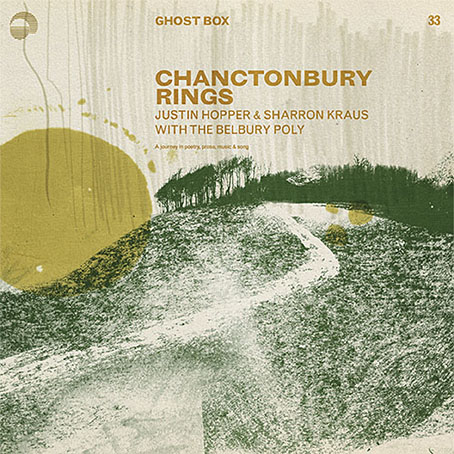
The next release on the Ghost Box label, Chanctonbury Rings is “a blend of folk, electronic music, poetry, prose and environmental sound” by Justin Hopper & Sharron Kraus with The Belbury Poly. The album will be available in June. Design, as always, is by Julian House.

• Clumsy and insensitive translations can ruin the enjoyment of a foreign-language film. Don’t blame us, say the subtitlers pressing film-makers for more appreciation of their art. Anne Billson on the difficulties of translating for a medium of moving images.

• At Expanding Mind: Hypermedia researcher and author Konrad Becker talks with Erik Davis about algorithms from hell, the madness of rationality, media seances, and the martial art of freedom.

The HP Lovecraft Cat Book: a limited collection of Lovecraft’s writings about cats edited by ST Joshi and illustrated by Jason C. Eckhardt.

Amacher was also inspired by a short story she found in the 1986 cyberpunk anthology Mirrorshades, edited by Bruce Sterling—a tale called Petra by Greg Bear, about a grand cathedral, possibly Notre Dame in Paris, in a ravaged, postapocalyptic landscape. Stone gargoyles and other statues mate with humans, creating new hybrids who wander the labyrinthine chambers of the battered house of worship.

Geeta Dayal on composer Maryanne Amacher

• The novel that wouldn’t leave Anthony Burgess alone: Alison Flood on the discovery of a non-fiction continuation of the themes in A Clockwork Orange.

Kristina Foster on photographs of Central Asia’s Striking Soviet Architecture.

Adrian Shaughnessy‘s ten favourite design and visual culture books.

William Joel on the process behind Helvetica’s 21st century facelift.

• The Stupid Classics Book Club by Elisa Gabbert.

The Haunted Generation by Bob Fischer.

Haunted Cocktails (1983) by Intro | Haunted Gate (1997) by David Toop | The Universe Is A Haunted House (2002) by Coil

Weekend links 461

meryon.jpg

Le Stryge (The Vampire) (1853) by Charles Méryon.

Notre-Dame-de-Paris in art and photography. Related: Chris Knapp on the Notre-Dame fire, and John Boardley on the print shops that used to cluster around the cathedral. Tangentially related: Mapping Gothic France.

The Bodies Beneath: The Flipside of British Film & Television by William Fowler and Vic Pratt will be published next month by Strange Attractor. With a foreword by Nicolas Winding Refn.

• “In his new biweekly column, Pinakothek, Luc Sante excavates and examines miscellaneous visual strata of the past.”

I also gathered underland stories, from Aeneas’s descent into Hades, through the sunken necropolises of Italo Calvino’s Invisible Cities and the Wind Cave cosmogony of the Dakota Sioux, to accounts of the many cavers, cave-divers and free-divers who have died seeking what Cormac McCarthy calls “the awful darkness inside the world”—often unable to communicate to themselves, let alone others, what metaphysical gravity drew them down to death. Why go low? Obsession, incomprehension, compulsion and revelation were among the recurrent echoes of these stories—and they became part of my underland experiences, too.

Robert Macfarlane on underworlds real and imagined, past, present and future

• Mixes of the week: FACT Mix 703 by Mary Lattimore, and The Colour Of Spring by cafekaput.

• A witty appraisal by Anna Aslanyan of a lipogrammatic classic and its smart translation.

• “Unseen Kafka works may soon be revealed after Kafkaesque trial.”

• “Why do cats love bookstores?” asks Jason Diamond.

Sunn O))) pick their Bandcamp favourites.

Le Grand Nuage de Magellan

Cathedral In Flames (1984) by Coil | The Cathedral of Tears (1995) by Robert Fripp | Cathedral Et Chartres (2005) by Jack Rose

The art of Maurice Wade, 1917–1991

wade1.jpg

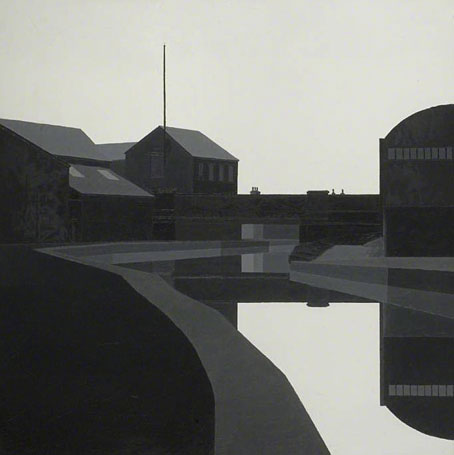
Canal at Longport (1970s).

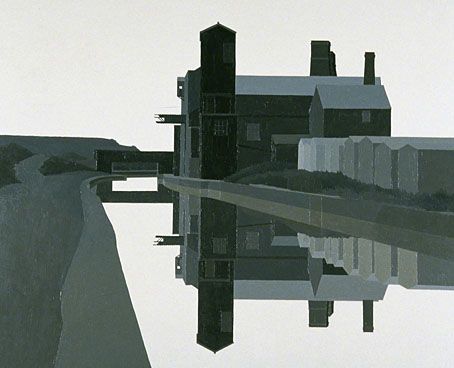
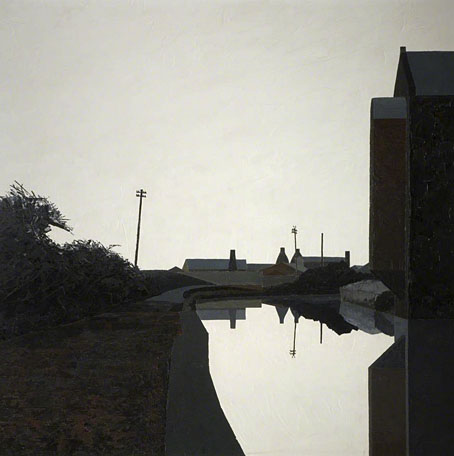
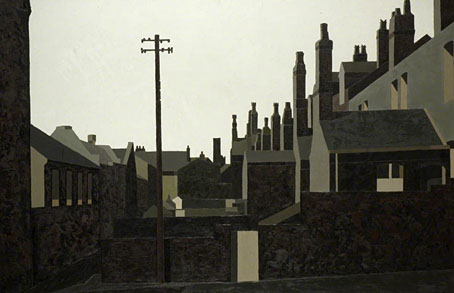
Maurice Wade‘s paintings of factories and back streets in Staffordshire are perfect examples of what the I Ching would call “accumulation through restraint”, using a flat rendering and a limited palette to achieve effects that a more detailed examination would fail to capture. Many of Algernon Cecil Newton‘s paintings possess the same stillness, and also depict the parts of urban Britain that are usually shunned as artistic subjects—in the case of canals, the literal backwaters—but Wade’s paintings are even more depopulated, silent and still. Henry Birks discusses Wade’s life and work here, noting that the artist painted over 300 landscapes. He’s evidently overdue for greater recognition.

wade2.jpg

Canal at Middleport (1976).

wade3.jpg

Canal at Longport III (1970s).

wade4.jpg

Kitchen Chimneys (1964).

Previously on { feuilleton }
Valette’s steam and smoke

Weekend links 460

treister.jpg

Black Hole (1987) by Suzanne Treister.

• “Most people who are considered heroes are always to be found messing about in someone else’s affairs, and I don’t think that’s very heroic.” Robert Altman talking in 1974 to Jan Dawson about The Long Goodbye.

• “Tea is calming, but alerting at the same time.” Natasha Gilbert on the science of tea’s mood-altering magic.

• Alien spaceship, Hammer horror? Philip Hoare on the pulsating visions of Harry Clarke.

“…world cinema, particularly European cinema…hasn’t shied away from sex and, in fact, has often found ways of using sex to tell a story. Movies like The Duke of Burgundy or Sauvage or BPM gracefully integrate eroticism into the narrative—even when the sex itself is far from graceful. Even the American films that have focused on sex tend to do it with a leer and luridness, regarding sex with a certain narrative fetishism, as opposed to matter-of-factly.”

Rich Juzwiak talking to Catherine Shoard about the current state of sex in the cinema

• Chernobyl again: photographs by David McMillan from inside the exclusion zone.

Lasting Marks: the 16 men put on trial for sadomasochism in Thatcher’s Britain.

• Before Tarkovsky: Michael Brooke on the Russian TV adaptation of Solaris.

• Mix of the week: XLR8R Podcast 588 by Rouge Mécanique.

• Dustin Krcatovich on The Strange World of Mark Stewart.

• Your Surrealist literature starter kit by Emily Temple.

John Peel’s Archive Things (1970)

5fathom: Things rich and strange

Hole In The Sky (1975) by Black Sabbath | Thru The Black Hole (1979) by Metabolist | Black Hole (1993) by Total Eclipse