Sphinxes

sphinx09.jpg

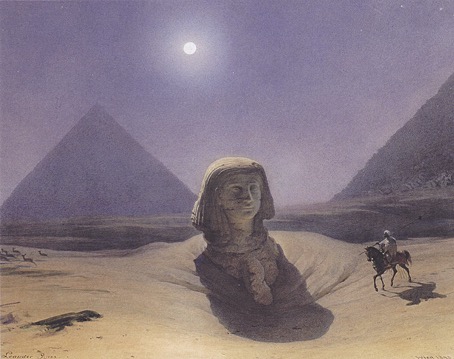
Bei den Pyramiden (1842) by Leander Russ.

A horde of sphinxes from NYPL Digital Collections and Wikimedia Commons, a pair of sites I was searching through last week. I was looking for a very particular kind of sphinx, not the Great Sphinx that sits near the Pyramids at Giza. What I wanted was something smaller and less ruined, like the sentinels that proliferated during the fads for Egyptian art and design in the early 1800s and the 1920s. My search was satisfied eventually, the results of which will be revealed in the next post.

sphinx06.jpg

Approach of the Simoom. Desert of Gizeh (c. 1846–49) by David Roberts. 

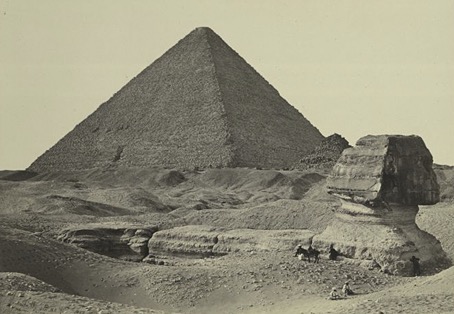
As for the Great Sphinx, I enjoy seeing artistic representations of the monument, especially those which place the creature in a dramatic setting. Older depictions tend to look bizarre or even comical, especially the ones made during the centuries when the figure was little more than a head protruding from the drifting sands. The photographs I prefer are those that show the Sphinx in the 19th century before all the restorations began, when the creature was another half-buried fragment of antiquity, not something that seems to have just been removed from a box in a museum.

sphinx08.jpg

The Sphinx and Great Pyramid, Geezeh (1858–1859).

sphinx10.jpg

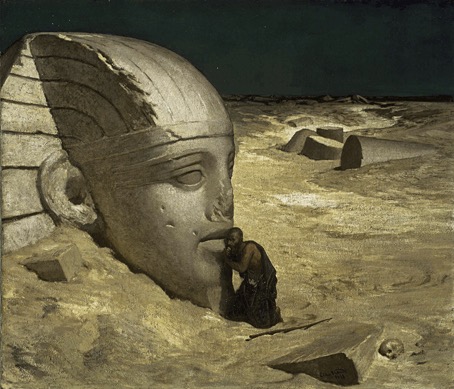
The Questioner of the Sphinx (1863) by Elihu Vedder.

sphinx07.jpg

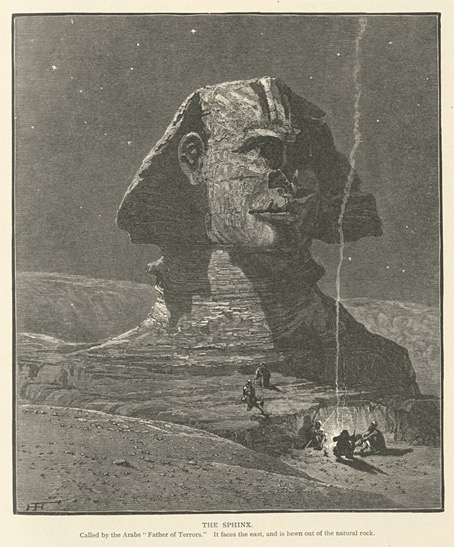
The Sphinx by Harry Fenn (1881–1884). “Called by the Arabs “Father of terrors.” It faces the east, and is hewn out of the natural rock.”

Continue reading “Sphinxes”

Weekend links 800

goya.jpg

Plate 43 from Los Caprichos: The sleep of reason produces monsters (El sueño de la razon produce monstruos) (1799) by Francisco Goya.

• At Senses of Cinema: An interview with Jacques Rivette from 2001 in which the director passes judgment on a variety of feature films, old and new. Having read a couple of Cocteau-related books recently, I was pleased to see his comments about the importance of Cocteau’s example for his own film-making. Via MetaFilter.

• “Why is sleep, which literally occurs daily on a planetary scale, so often taken for granted, and not only by most people but even by scientists? Perhaps because its essence, its key property, is to be elusive, out of sight?” A long read by Vladyslav Vyazovskiy on the nature of sleep.

• “Often one cannot be sure if an object in a Welch picture is drawn from life or from other depictions of it, in sculpture, porcelain, woodwork or embroidery.” Alan Hollinghurst on the paintings and drawings of Denton Welch. (Previously.)

• At Colossal: Sinister skies set the scene for derelict buildings in Lee Madgwick’s surreal paintings.

• New music: The Mosaic Of Starlight Slips Back Like The Lid Of An Opening Eye by Paul Schütze.

• At Public Domain Review: Charles le Brun’s Human-Animal Hybrids (1806).

• Mix of the week: DreamScenes – October 2025 at Ambientblog.

• At the BFI: Anton Bitel chooses 10 great French horror films.

Winners of the 2025 Photomicrography Competition.

• RIP Diane Keaton.

Sleep (1981) by This Heat | Sleep (1995) by Paul Schütze | Sleep (2006) by DJ Olive

Weekend links 798

atlantis.jpg

Atlantis (1971) by Bartolomeu Cid dos Santos.

• “Given the workaday settings of many of his movies (a hotel, a summer camp, a science fair), their mortal stakes may come as a surprise, or at least as a paradox—yet paradox is at the heart of his entire body of work.” Richard Brody explores the New Yorker roots of Wes Anderson’s The French Dispatch.

• “The power of the Kelmscott Chaucer is in how all the elements harmonise to create something visually spectacular.” Michael John Goodman on William Morris and his reinvention of book design.

• At Smithsonian Mag: “What actually sparks Will-o’-the-Wisps? A new study traces the science behind the mysterious, wandering lights“.

• At Dennis Cooper’s: A chronology of 26 things with Clive Barker’s name on them and what he thinks about that.

• At Wormwoodiana: The novels of Derek Raymond and the type of crime fiction he called “The Black Novel”.

• At Colossal: Untamed flora subsumes abandoned greenhouses in Romain Veillon’s Secret Gardens.

• At The Wire: Read an extract from James Tenney: Writings and Interviews on Experimental Music.

• The Strange World of…Mulatu Astatke.

• RIP Patricia Routledge.

The Garden (1981) by John Foxx | The Secret Garden: Main Title (1993) by Zbigniew Preisner | Secret Garden (2011) by Sussan Deyhim

Weekend links 797

robertson.jpg

Bloomsbury Roofs (no date) by J. Elspeth Robertson.

• “Lud Heat and Suicide Bridge…are only offshoots of a huge central corpus of mad experimental writing, prose and poetry and just research notes. Pages and pages and pages of this lunacy.” Iain Sinclair describing to Robert Davidson the genesis of his influential poem/book Lud Heat. Related: Serious houses: The Lud Heat Tapes.

• At Criterion Current: Deeper into Robert Altman, a look at five lesser-known films from the director’s expansive filmography. Good to see Quintet receiving some attention, a science-fiction film that’s not without flaws but is still closer to the written SF of the 1970s than the decade’s box-office hits.

• Among the new titles at Standard Ebooks, the home of free, high-quality, public-domain texts: Short Fiction, by Charles Beaumont.

• Mix of the week: Ambient Focus 26.06.21 by Kevin Richard Martin aka The Bug.

• At the BFI: Rory Doherty chooses 10 great films set in 1970s America.

• At Colossal: Frédéric Demeuse’s photos of ancient forests.

• RIP Claudia Cardinale and Danny Thompson.

• New music: If the Sun Dies by Greg Weeks.

• The Strange World of…Rafael Toral.

Silver Forest (1969) by Organisation | A Forest (1980) by The Cure | A Forest In The Sky (2024) by Hawksmoor

Weekend links 793

junichiro.jpg

Shinagawa, Tokyo Tower (Tokaido Station 1) (1967) by Sekino Jun’ichiro.

• “The historical figures who interested [Cormac] McCarthy the most, judging by the number of books he owned about them, were Albert Einstein (114 books), Winston Churchill (88) and James Joyce (78). Architecture is the dominant subject in the collection, with 855 books. The human being whom McCarthy most admired, Dennis confirms, was Ludwig Wittgenstein. The team catalogued a staggering 142 books by or about the philosopher, with a high proportion annotated.” Richard Grant for Smithsonian Magazine reports on the cataloguing of Cormac McCarthy’s personal library.

• The Real City of the Future: a long read by Charles T. Rubin taking in William Gibson’s urban fictions and Paolo Soleri’s towering Arcologies.

• At Colossal: “Atmospheric oil paintings by Martin Wittfooth illuminate nature’s timeless cycles.”

• Old music: White Souls In Black Suits by Clock DVA, receiving its first reissue since 1990.

• At the BFI: Carmen Gray on where to begin with Sergei Parajanov.

• At Ultrawolvesunderthefullmoon: The art of Sekino Jun’ichiro.

• At Dennis Cooper’s: Unica Zürn Day (restored and expanded).

• New music: Imploded Versions by The Bug vs. Ghost Dubs.

• The Strange World of…Van Morrison.

Dev Hynes’ favourite albums.

Carnival Of Souls (1989) by David Van Tieghem | All Souls (1989) by Opal | The Cult Of Souls (2011) by The Wounded Kings