Winter light

friedrich1.jpg

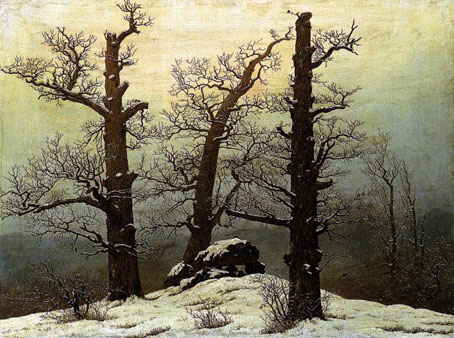
Dolmen in the Snow (1807).

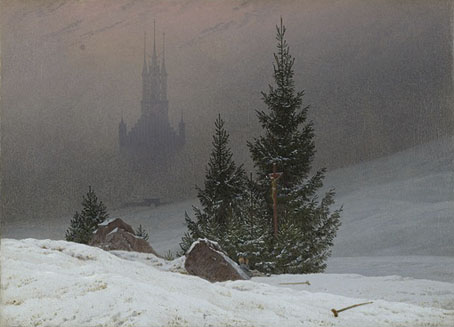
Some paintings for the Winter Solstice by one of my favourite Romantic artists, Caspar David Friedrich (1774–1840). Snow scenes tend to inspire picturesque cliché but in Friedrich’s paintings winter is merely another season in which to evoke his Christian mysticism through the depiction of landscape. The pagan dolmen above is an unusual subject, far more common are churchyard ruins and mountainside crosses although he was also happy enough painting luminous landscapes, especially of mountains and the sea. His treatment of natural light is quite extraordinary and his photo-realist style makes an interesting contrast with the similar effects captured by JMW Turner‘s palette of blurs and smears.

friedrich2.jpg

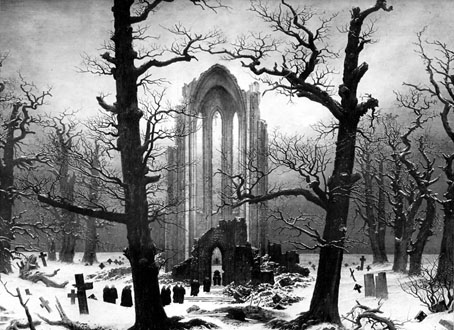
Monastery Graveyard in the Snow (1819).

I hadn’t noticed before until I looked through some online galleries that Friedrich was painting the same trees over and over. The gnarled trunks in the dolmen painting are almost identical (but reversed) to the foreground trees in the graveyard picture and similarly-shaped trees occur in other paintings. If you’re wondering why the graveyard picture is in black and white, the original was destroyed during the Second World War. Colour copies can be found but I think these may have been tinted from a monochrome photo print.

friedrich3.jpg

Winter Landscape (1811).

Previously on { feuilleton }
Winter Solstice
The art of John Atkinson Grimshaw, 1836–1893
The art of Karl Friedrich Schinkel, 1781–1841

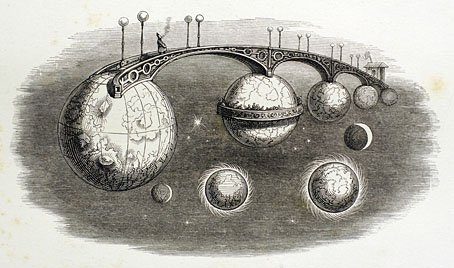
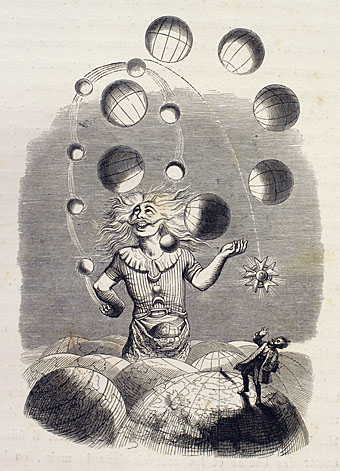
Grandville’s Un Autre Monde

grandville1.jpg

Un Autre Monde by JJ Grandville is a satire from 1844 whose wittily inventive illustrations were among that select group of prior works which received praise from the Surrealists. Some of them also act as early examples of humorous science fiction, and the two pieces shown here have been reprinted endlessly, they even turn up in histories of astronomy. The other illustrations are rarely seen, however, so it’s good to find a Flickr set with scans of the entire book. Comic artist Philippe Druillet took the bridge between worlds as the inspiration for his Lone Sloane story Torquedara Varenkor: The Bridge Over the Stars in 1970, turning the already unlikely construction into a galaxy-spanning edifice.

grandville2.jpg

Elsewhere on { feuilleton }
The etching and engraving archive

Previously on { feuilleton }
Druillet meets Hodgson

Tite Street then and now

tite1.jpg

This LIFE magazine photo of Oscar Wilde’s home at 34 Tite Street, Chelsea, is fascinating for Wilde aficionados in being a far more detailed view of the “House Beautiful” exterior than one ever finds in books about the writer. No information as to when it was taken but from the look of the print it was probably some time just before or after 1900.

tite2.jpg

Google Earth lets us examine Tite Street as it is today, with Oscar’s house looking relatively unchanged aside from the blue plaque which informs people that he once lived there. What you can’t see in this picture is the opposite side of the street which now contains a particularly dreary housing development from the 1960s. Oscar and his contemporaries in the area—many of whom were artists—wouldn’t have been impressed at all.

Elsewhere on { feuilleton }
The Oscar Wilde archive

Prague panoramas

prague1.jpg

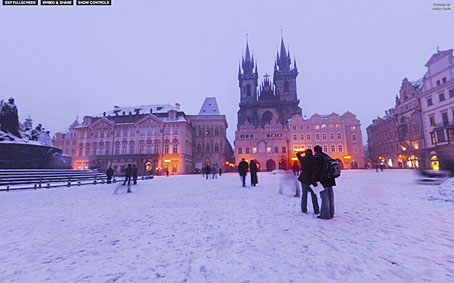
Now that we’re into the dismal weather, sombre views of Old Prague’s splendour seem appropriate. The pages at 360 Cities have a lot of Prague panoramas—76 in all—including many more of the Viriconium-esque Giant Mantis performance I linked to a few years ago. A shame they don’t do this every year.

prague2.jpg

Previously on { feuilleton }
Eno’s Luminous Opera House panorama
Callanish Standing Stone panoramas
Jaipur Observatory panoramas
Infinite reflections
Large Hadron Collider panoramas
Passage des Panoramas
Bruges panoramas
Paris panoramas
Venice panoramas
St Pancras in Spheroview
Karel Plicka’s views of Prague
Giant mantis invades Prague
Whirling Istanbul

The art of Sydney R Jones, 1881–1966

jones1.jpg

Church of St Michael Paternoster Royal and Innholder’s Hall (1927).

One of the better secondhand book discoveries of the past couple of years was London Triumphant, a collection of etchings and pencil drawings of the city’s streets and buildings by Sydney R Jones. The etchings immediately seized my attention, being the kind of closely-hatched architectural renderings which I enjoy, but the book as a whole is very good as it details the artist’s wanderings with a young student friend through the city. Jones established himself as an illustrator of books with titles like The Manor Houses of England and The Charm of the English Village. His London book appeared in July 1942 and collected many of his earlier views of the city as a deliberate morale boost for the populace who were watching the capital’s historic buildings yield to the bombs of what he calls “the foul Hun”. Jones catalogues the destruction with dismay as he recounts the history of the city from Roman times but ends on a note of defiant optimism, wondering what new metropolis might rise from the destruction. He mentions in passing that cult locale of mine, the Essex Street Water Gate, but doesn’t provide a drawing unfortunately. The book proved to be very popular, and the copy I found is a fifth printing from 1947.

jones2.jpg

Serjeant’s Inn, Fleet Street (1926).

This week’s book purchase was a welcome find, then, being London Triumphant‘s sequel, Thames Triumphant, in which Jones follows the course of the river from its spring at Coberley, through Oxford and on down to Greenwich. There aren’t as many dramatic views this time, and many of the country scenes have that kind of polite blandness about them which you find in much book illustration of the period. But Jones does provide a couple of his speculative and spectacular views over the city, including the one below which shows the City of London as it was in 1939. Much of the foreground was bombed flat during the war so a drawing such as this provides a valuable record of how London’s financial centre looked before the arrival of the Luftwaffe and the office blocks. Jones lived to see much of the subsequent reconstruction—I can’t help but wonder what he made of it all.

city.jpg

The City of London, 1939; click for a bigger view.

Elsewhere on { feuilleton }
The etching and engraving archive
The illustrators archive

Previously on { feuilleton }
Pite’s West End folly
Jessie M King’s Grey City of the North
Architectural renderings by HW Brewer
The Essex Street Water Gate, London WC2