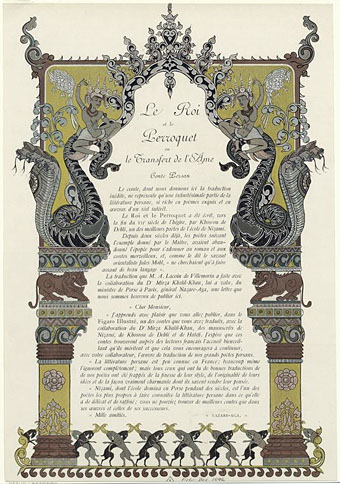
I’ve been having trouble doing anything online today due to a recurrent fault with the phone line so here’s something florid and serpentine from Figaro illustré for December, 1896. The title is something about a king and a parrot but that’s as much as I’m able to tell you.
Author: John
The recurrent pose 43
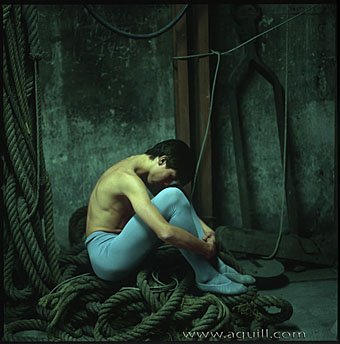
Not had one of these posts for a while but the theme still seems inexhaustible. The cute dancer above is Mathieu from a set I linked to earlier by Jean-Philippe Guillemain.
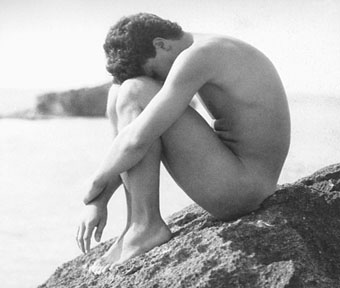
Below there’s a pose that’s closer to Flandrin’s original, complete with seascape and a no doubt uncomfortable rocky perch. This one is from a set of photos by Tony Patrioli at Homodesiribus, and was a tip from Mexicology. (Thanks!)
Elsewhere on { feuilleton }
• The recurrent pose archive
Weekend links 73
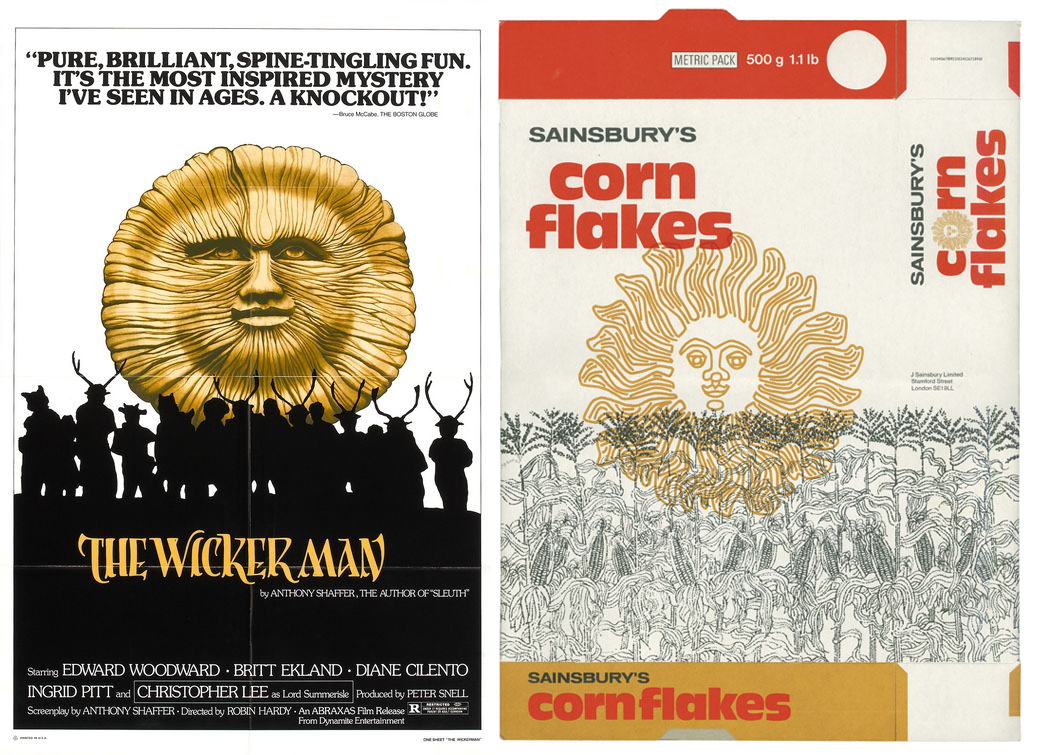
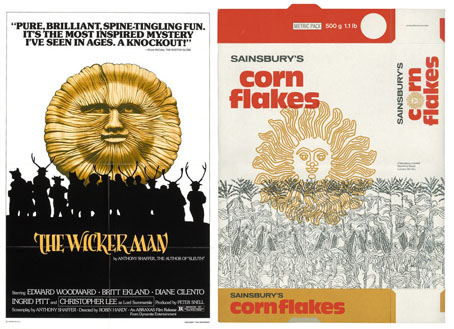
Johnny Trunk of Trunk Records reissued the soundtrack to The Wicker Man in 1997. Mr Trunk’s latest delve into the cultural past is Own Label: Sainsbury’s Design Studio, a book from Fuel examining the supermarket chain’s packaging design of the 1960s and 1970s. Creative Review shows some examples while I have to note the uncanny similarity between one of the posters for The Wicker Man and an old Sainsbury’s corn flakes box. Now we see that the Old Weird Britain wasn’t only hiding in the fields and the folk songs but was also lurking on the supermarket shelves.
Related: a new DVD set from the BFI, Here’s a Health to the Barley Mow: A Century of Folk Customs and Ancient Rural Games. And let’s not forget the ley lines of Milton Keynes, and a new edition of Ritual by David Pinner, said to be the novel which inspired The Wicker Man.
• “He wrote me…” Sans Soleil (1983), Chris Marker’s beguiling accumulation of memories, dreams and reflections, is recalled in a Quietus piece entitled Things that Quicken the Heart. Not the first time on DVD as it says there (Nouveaux Pictures released it with La Jetée in 2003) but it’s good to know it’s being reissued.
• Marker’s film references Tarkovsky’s Stalker a couple of times, most notably in the comment, “On that day there will be emus in the Zone.” Geoff Dyer has what he describes as “a very detailed study” of Stalker out next year.
I don’t like those commentators who keep on saying that London will never be the same again. London is always the same again. I remember those comments were made very loudly after the [July 2005] terrorist attacks – “London will never be the same again, London has lost its innocence” – it was all nonsense. London was exactly the same again the following day. Rioting has always been a London tradition. It has been since the early Middle Ages. There’s hardly a spate of years that goes by without violent rioting of one kind or another. They happen so frequently that they are almost part of London’s texture. The difference is that in the past the violence was more ferocious, and the penalties were more ferocious – in most cases, death.
Peter Ackroyd, reminding us that the Four Horsemen of the Apocalypse don’t wear hoodies and ride bikes.
• Wolf Fifth: “rare vinyl records from the golden era of avant garde and experimental music”. And in FLAC as well, not crappy mp3; I want to hear all those scratches uncompressed, dammit!
• Another great mix at FACT, this time compiled by snd who throw together Morton Feldman, Siberian shamen, Einstürzende Neubauten, Dome, Oval and many others.
• Colin Marshall asks “how weird is Australia?” in an appraisal of Nicolas Roeg’s Walkabout.
• A Comprehensive Solution to the Tokyo Umbrella Problem.
• More poster art from Hapshash and the Coloured Coat.
• Morbid Excess, a series of drawings by May Lim.
• Conrad Schnitzler (1937–2011) by Geeta Dayal.
• Willow’s Song (1973) by Paul Giovanni & Magnet | The Willow Song (1989) by The Mock Turtles | Wicker Man Song (1994) by Nature and Organisation.
Maps and legends

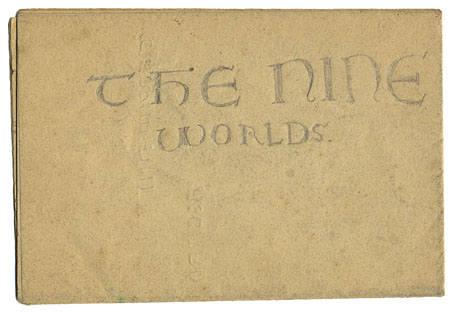
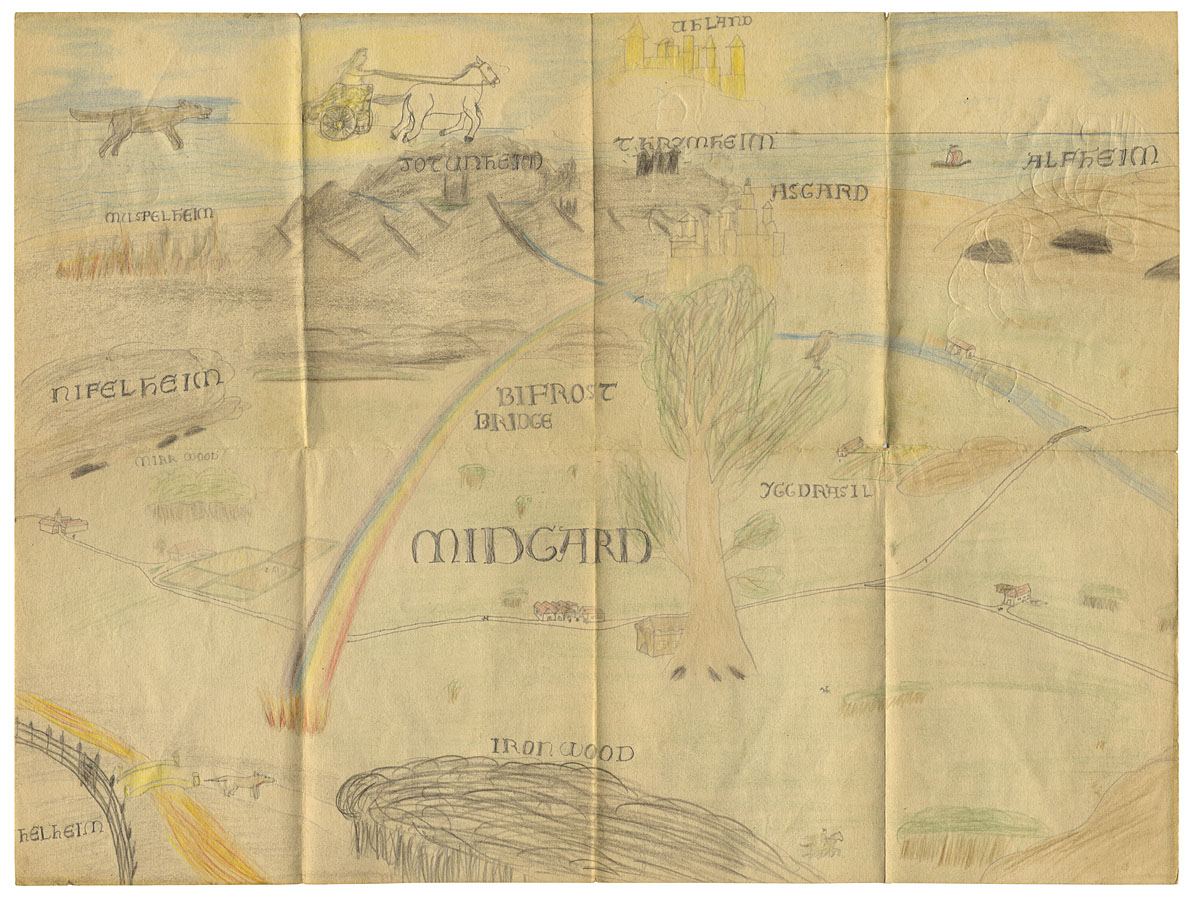
Following the mention yesterday of my facsimile John Speed map I set about searching for the map in question since it’s managed to survive all these years. For the moment I haven’t been able to find it but going through a portfolio of old drawings I finally found this item, a map or chart or the Nine Worlds of Norse mythology which I drew when I was 11 years old. Various family traumas mean a lot of my early artwork hasn’t survived so this drawing is the earliest piece of my work that I own. (Click below for a bigger view.)

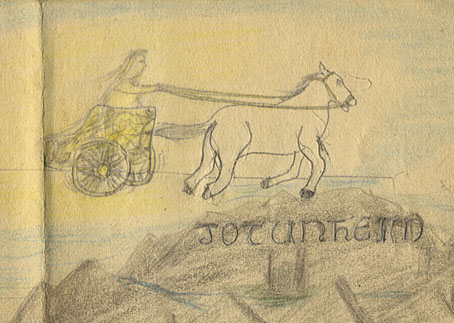
Sol in her Sun Chariot. The horse evidently looked better after a second attempt.
I can be specific about my age since I remember drawing this in 1973 shortly after moving to secondary school. The paper is the horrible stuff that was standard issue at that place, rough and terrible for pencil work. I’d been given a new set of coloured pencils so took advantage with this to use just about every colour in the box.
Compass roses
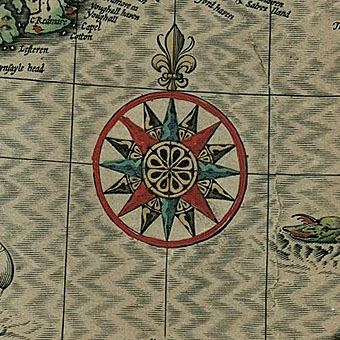
Compass rose by John Speed (1610).
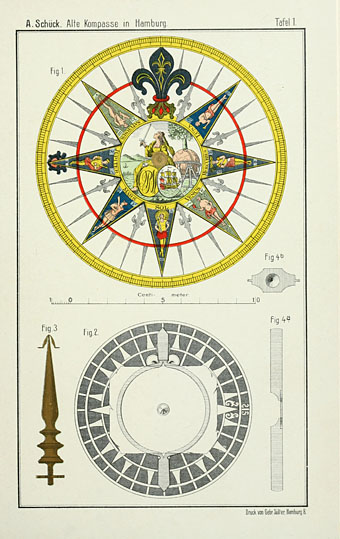
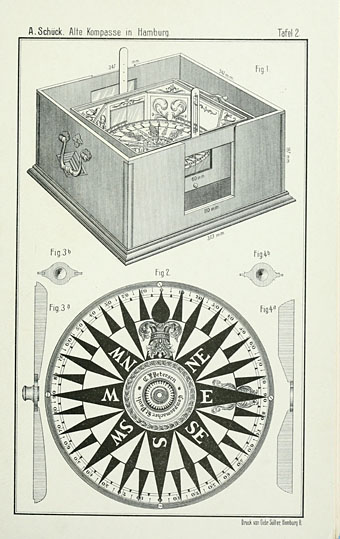
Be still, my beating heart… Every so often this graphic designer has been known to complain that there isn’t a decent resource for those cartographic details known as compass roses. Well today I hit the motherlode with the discovery of Alte Schiffskompasse und Kompassteile im Besitz Hamburger Staatsanstalten (1910) by Albert Schück at the Internet Archive. Schück’s book is a small study of the evolution of the compass card from crude diagram to the elaborate creations seen here, bedizened with astrological figures or divided into degrees. The plates are exactly the kind of thing I’ve been after for years, not that I need them for any particular purpose but—given that I fetishise these things—it’s good to have them to hand.
Part of the obsession can be traced to the compass rose on John Speed’s map of Great Britain and Ireland (above). My teenage bedroom walls included among their pictures a facsimile of Speed’s map printed on some peculiar plasticised paper which (as I recall) was supposed to make it look an antique print. When drawing maps of my own I’d usually copy Speed’s compass rose, and familiarity with the device meant that I started searching them out whenever I saw another old map. Also on the bedroom wall was Pauline Baynes’ map of Middle Earth which includes a compass rose of its own.

BibliOdyssey posted a nice selection of Speed maps recently, all of them hand-coloured (my reproduction was black-and-white). Speed’s compass rose for the Isle of Man makes the island appear to be the centre of the world. Also at the Internet Archive is a similar study to the Schück, The Rose of the Winds: The origin and development of the Compass-Card (1913) by Silvanus P Thompson. This is more useful if your interest is in the actual history of the cards since the diagrams are a lot less extravagant. Among other things Thompson refers to Schück’s volume in a note about the origin of the fleur-de-lys figure as a compass fixture. “Rose of the Winds” refers to the very earliest compass devices in which directions were marked not with North, South, East and West but with whatever the local names were for the winds at sea.