Greek games

ganymede.jpg

Ganymede from an Attic red-figure bell-krater, ca. 500–490 BC.

And ye Megarians, at Nisæa dwelling,
Expert at rowing, mariners excelling,
Be happy ever! for with honours due
Th’ Athenian Diocles, to friendship true
Ye celebrate. With the first blush of spring
The youth surround his tomb: there who shall bring
The sweetest kiss, whose lip is purest found,
Back to his mother goes with garlands crowned.
Nice touch the arbiter must have indeed,
And must, methinks, the blue-eyed Ganymede
Invoke with many prayers—a mouth to own
True to the touch of lips, as Lydian stone
To proof of gold—which test will instant show
The pure or base, as money changers know.

Theocritus, Idyll XII, translated by Edward Carpenter.

One Ancient Greek tradition yet to be revived by the International Olympic Committee is the Diocleia, an annual contest held in the Dorian city of Megara. William Smith’s A Dictionary of Greek and Roman Antiquities (1882) gives a brief explanation:

DIOCLEIA, a festival celebrated by the Megarians in honour of an ancient Athenian hero, Diocles, around whose grave young men assembled on the occasion, and amused themselves with gymnastic and other contests. We read that he who gave the sweetest kiss obtained the prize, consisting of a garland of flowers. (Theocrit. Idyll. xii. 27, &c.) The Scholiast on Theocritus (l. c.) relates the origin of this festival as follows – Diocles, an Athenian exile, fled to Megara, where he found a youth with whom he fell in love. In some battle, while protecting the object of his love with his shield, he was slain. The Megarians honoured the gallant lover with a tomb, raised him to the rank of a hero, and in commemoration of his faithful attachment, instituted the festival of the Diocleia.

So the Diocleia was primarily a same-sex kissing contest, a detail that 19th century accounts do their best to skirt around, as they tended to do when faced with the unavoidable yet unacceptable sexual proclivities of the Ancient World. Here’s another account from a typewritten thesis by Ernest Leslie Highbarger, Chapters in the History and Civilization of Ancient Megara (1923):

Diocles
In his honor public games, the Diocleia, were celebrated. These were as important at Megara as were the Pythia and Eleusinia elsewhere. According to Megarian belief, Diocles was a Megarian ruler of Eleusis. But the Alexandrine tradition claimed that he was an Athenian who had fled to Megara for some cause and had become a hero after dying in defense of a boy friend. […] These Diocleia were held at the beginning of spring. The prize is said to have been a crown of flowers and was presented to the boy who gave the sweetest kiss. Boeckh and Reinganum, however, maintain that we must not limit such a contest to kissing but must extend it to contests in general such as the ones in which Diocles was victorious. But if we are to judge by the elegies of Theognis, boy-love was as common at Megara as in other parts of Greece and the osculatory contest at the games may have constituted no insignificant part.

Edward Carpenter, on the other hand, being a pioneering activist for gay rights, regarded these festivals as one of the many valuable precedents that might be used to argue a defence for same-sex relations:

Further [Bethe] suggests that the competition which yearly took place among the youths at the tomb of the great hero and lover, Diocles, in Megara – and which is known to us through Theocritus (Idyll xii.) – had a similar origin; and represented the survival of actual betrothals which once were celebrated there, as at a holy place. There is certainly something very grand about this whole conception and manifestation of the Uranian love among the Dorians. The wonderful stories – treasured in the hearts of the Greek peoples for centuries – of heroic bravery and mutual devotion inspired by it; the high seriousness with which it was cultivated both as a political safeguard and as a means of the education of youth, the religious sanction and dedication to the gods, and withal the absolute recognition of its human and passional origin, cannot fail to make us feel that here was a great people with a unique message for the world. Certainly we shall never in modern times understand this love until we realise this quality of it and its immense capabilities.

Intermediate Types among Primitive Folk (1914)

Dorian: Yes, the word is the origin of Dorian Gray’s first name, and Oscar Wilde was fully aware of its referring to proscribed passions. He was sufficiently well-acquainted with Greek poetry to pen a poem of his own to Theocritus so would have been very familiar with the Idylls and their paean to the Diocleia.

Previously on { feuilleton }
Achilles by Barry JC Purves

Charles Ricketts’ Salomé

ricketts1.jpg

Here is my scheme. I proposed a black floor – upon which Salomé’s white feet would show; this statement was meant to capture Wilde. The sky was to be a rich turquoise blue, and across by the perpendicular fall of strips of gilt matting, which should not touch the ground, and so form a sort of aerial tent above the terrace. Did Wilde actually suggest the division of the actors into separate masses of colour, today the idea seems mine! His was the scheme, however, that the Jews should be in yellow, the Romans were to be in purple, the soldiers in bronze green, and John in white. Over the dresses of Salomé, the discussions were endless: should she be black “like the night”? Silver, “like the moon”? Or – here the suggestion is Wilde’s – “green like a curious poisonous lizard”? I desired that the moonlight should fall upon the ground, the source not being seen; Wilde himself hugged the idea of some “strange dim pattern in the sky”.

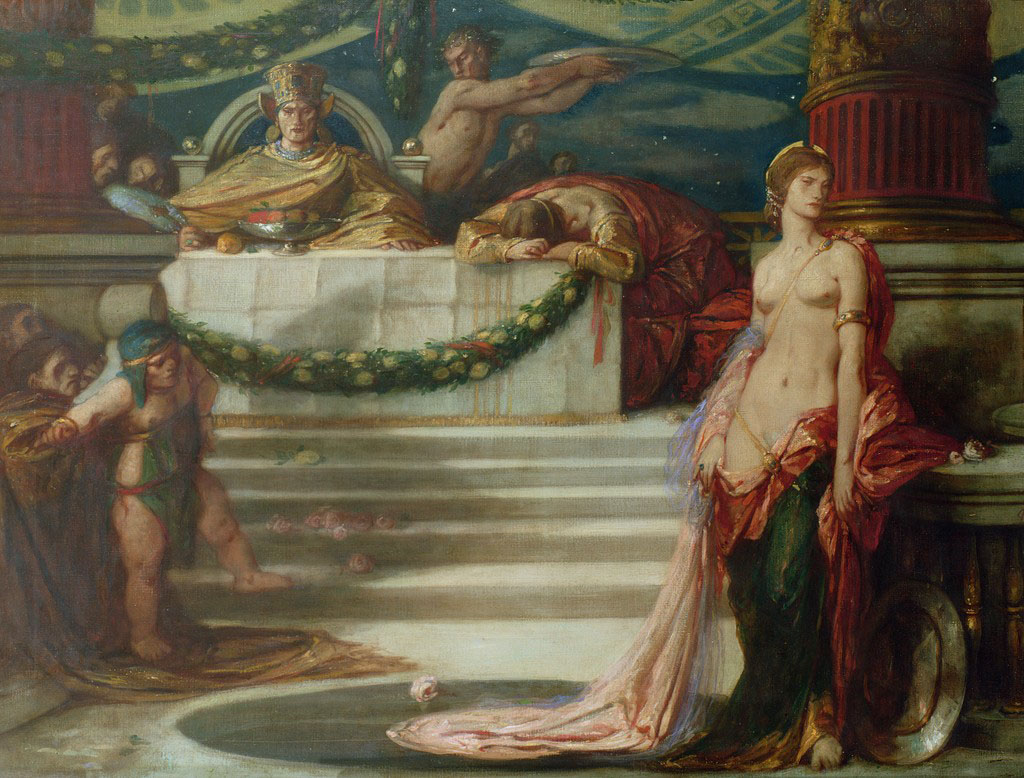
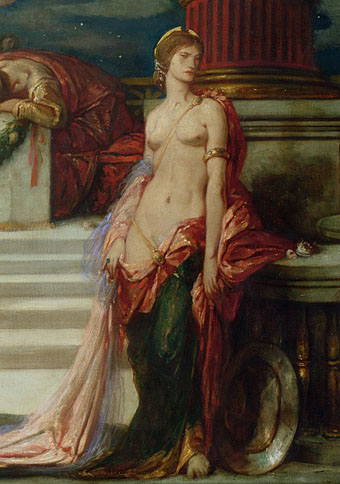
Thus artist, designer, publisher and writer Charles Ricketts (1866–1931), describing in later years his proposal for what would have been the first staging of Oscar Wilde’s Salomé in London. The scheme never materialised since the play was banned but Ricketts did create costume and stage designs for subsequent productions elsewhere, including performances in Japan in 1920. The V&A has Ricketts’ sketch of the stage for a private production in 1906 by the Literary Theatre Society, London. (The ban on Biblical themes in theatre kept the play from public performance in London until 1931.) In the Tate archives there’s what may be one of Ricketts’ costume designs from the Japanese production. Ricketts’ painting of Salomé dates from 1925, and for such a lurid and passionate subject seems rather passionless and inert. This isn’t so surprising, he was always a better designer and graphic artist than a painter; his lifelong partner, Charles Shannon, was the one who excelled with oils.

And speaking of Ricketts and Shannon, searching around turned up this recent blog devoted to the pair which contains much detail about their celebrated book designs.

ricketts2.jpg

Elsewhere on { feuilleton }
The Salomé archive

Previously on { feuilleton }
Charles Ricketts’ Hero and Leander

Albert Robida’s Vieux Paris

vieux1.jpg

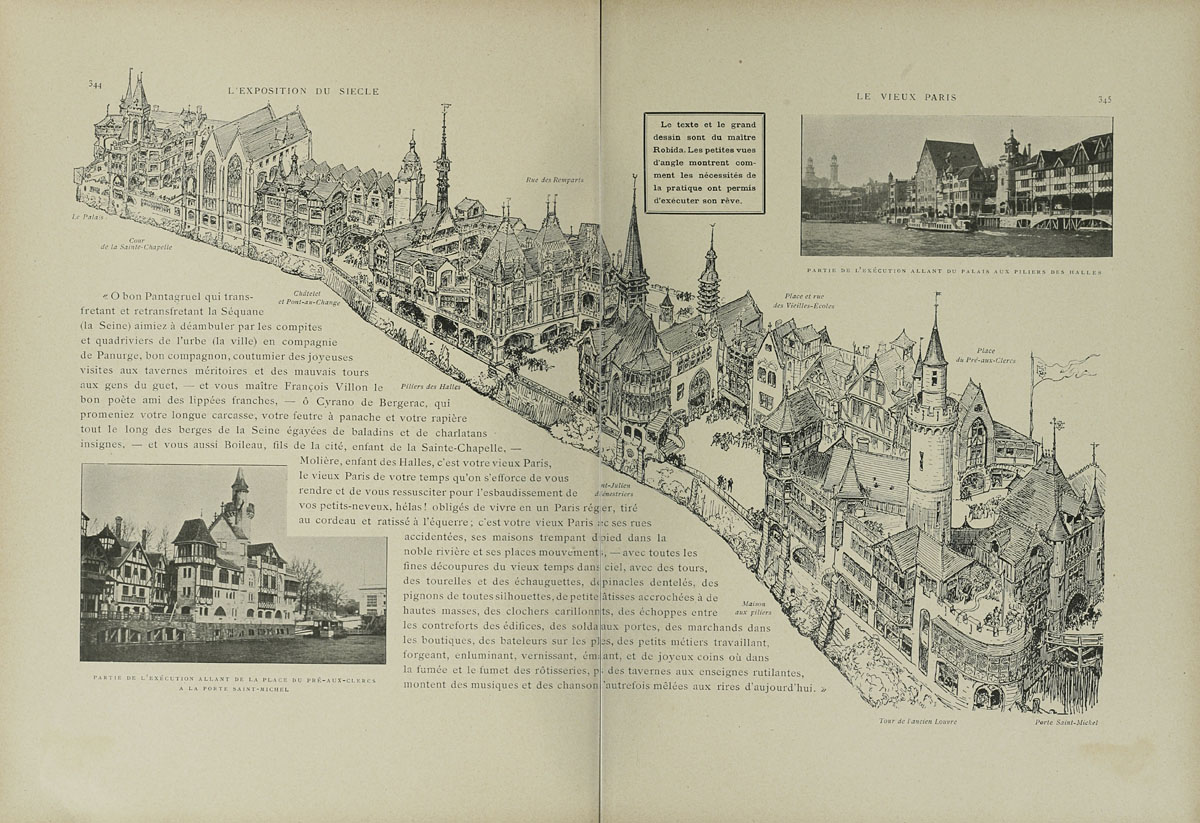
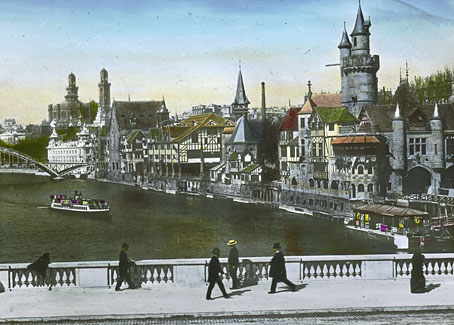
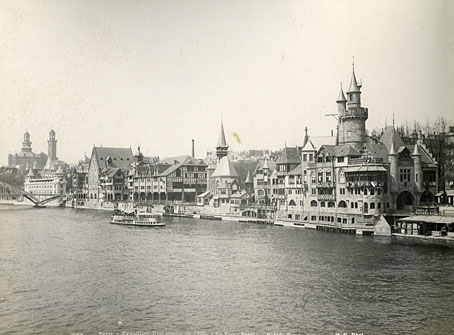
After several posts about Albert Robida it seems more-or-less mandatory to write something about his spectacular creation for the Paris Exposition Universelle of 1900. “Vieux Paris” was an elaborate theme park-style attraction that sought to recreate some of the lost buildings of medieval Paris on the right bank of the Seine, a short distance from the Trocadero. (The international pavilions were situated on the opposite bank.) Robida is remembered today for his science fiction but he was given this job as a result of books such as Paris de siècle en siècle; le coeur de Paris, splendeurs et souvenirs (1896) which explored life in the historic city. Vieux Paris was planned by the artist, with the buildings being created by a team of architects under the direction of Léon Benouville. As with modern theme parks, teams of actors and other staff were costumed in order to convey the requisite period flavour. The birds-eye drawing is the best view I’ve seen of the construction, the pages being from Albert Quantin’s L’Exposition du siècle.

vieux2.jpg

From the Brooklyn Museum’s Flickr set.

vieux3.jpg

Photo by Michel Berthaud at Luna Commons.

Previously on { feuilleton }
The End of Books, 1894
Le Vingtième Siècle by Albert Robida
La Vie Électrique by Albert Robida
The Lumière Brothers at the Exposition Universelle
Le Grand Globe Céleste, 1900
Tony Grubhofer’s Exposition Universelle sketches
The Cambodian Pavilion, Paris, 1900
Le Manoir a l’Envers
Suchard at the Exposition Universelle
Esquisses Décoratives by René Binet
Le Palais de l’Optique, 1900
Exposition Universelle films
Exposition jewellery
Exposition Universelle catalogue
Exposition Universelle publications
Exposition cornucopia
Return to the Exposition Universelle
The Palais Lumineux
Louis Bonnier’s exposition dreams
Exposition Universelle, 1900

The End of Books, 1894

robidabooks01.jpg

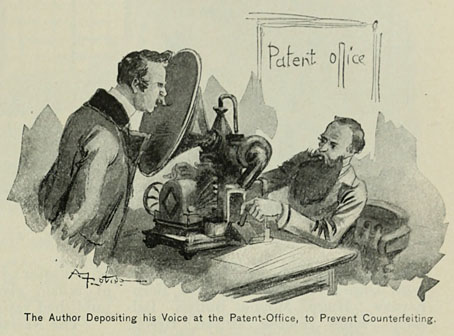
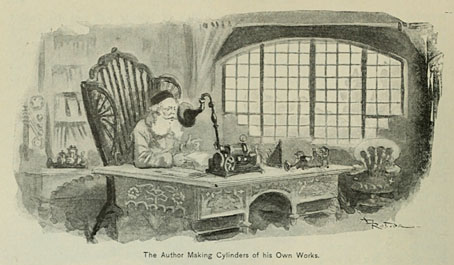
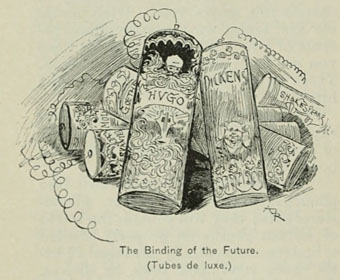
More illustrations from Albert Robida, and a riposte to anyone thinking that the idea of the end of books is a recent thing. This article by bibliophile Octave Uzanne appeared in Volume 16 of Scribner’s Magazine (July–December 1894). The piece opens with a description of various scientists and artists at a Royal Society evening making predictions about life in the future. Among other proposals there’s that old saw of science fiction, the meal of condensed nutrients which would supposedly put an end to world hunger. Uzanne’s account of the future of the book involves authors speaking their works into recording devices. Despite Robida’s somewhat comic extrapolations Uzanne seemed to have been semi-serious; even if he wasn’t he made a good job of predicting audio books, and (after a fashion) television: those wanting illustrations would have images projected by one of Edison’s Kinetoscopes.

There will be registering cylinders as light as celluloid penholders, capable of containing five or six hundred words and working up on very tenuous axles, and occupying not more than five square inches; all the vibrations of the voice will be reproduced in them; we shall attain to perfection in this apparatus as surely as we have obtained precision in the smallest and most ornamental watches.

As to the electricity, that will often be found in the individual himself. Each will work his pocket apparatus by a fluent current ingeniously set in action; the whole system may be kept in a simple opera-glass case, and suspended by a strap from the shoulder.

As for the book, or let us rather say, for by that time books “will have lived,” as for the novel, or the storyograph, the author will become his own publisher. To avoid imitations and counterfeits he will be obliged, first of all, to go to the Patent-Office, there to deposit his voice, and register its lowest and highest notes, giving all the counter-hearings necessary for the recognition of any imitation of his deposit. The Government will realize great profits by these patents.

The full article may be read here.

robidabooks02.jpg

robidabooks03.jpg

Continue reading “The End of Books, 1894”

Le Vingtième Siècle by Albert Robida

robidasiecle01.jpg

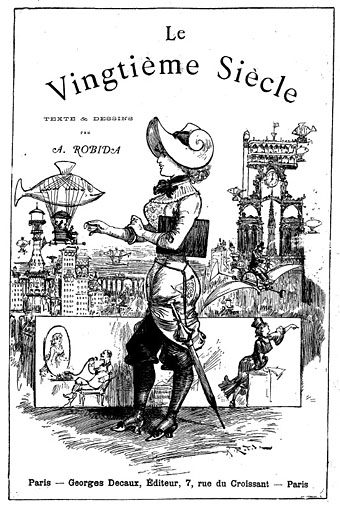
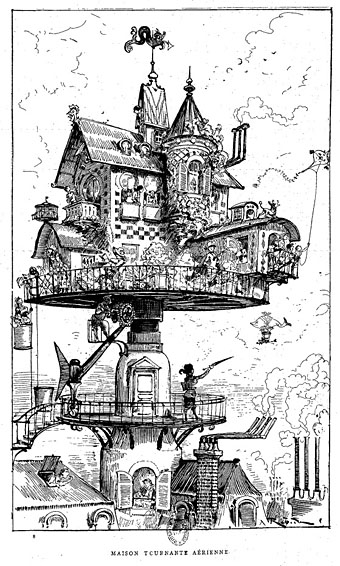
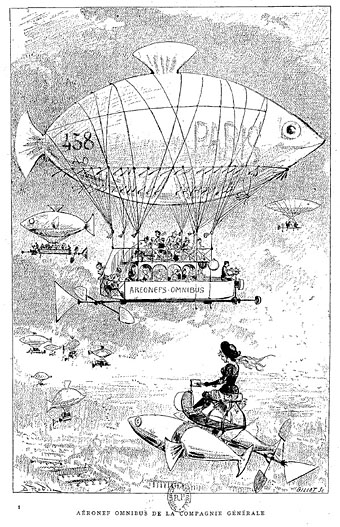
More 19th-century futurism from French illustrator and author Albert Robida. Le Vingtième Siècle was published in 1883, and is a far more comical look at life in the 20th century than La Vie Électrique, showing a future where most of the airships are shaped like enormous fish. This is a copiously illustrated volume of over 500 pages so the selection is again limited. These examples are taken from a copy at Gallica but some of the larger drawings can be seen in higher quality at this Flickr set.

robidasiecle02.jpg

robidasiecle03.jpg

Continue reading “Le Vingtième Siècle by Albert Robida”