Gore Vidal, 1925–2012

vidal.jpg

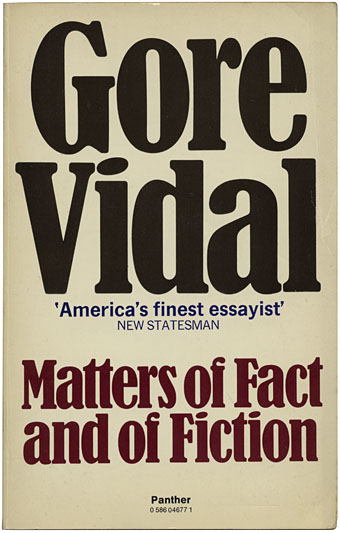
You could spend all day picking out choice quotes. So much is still pertinent.

From ‘Women’s Liberation: Feminism and Its Discontents’:

Those who have been treated cruelly will treat others cruelly. This seems to be a fact of our condition. The Patriarchs have every reason to be fearful of woman’s revenge should she achieve equality. He is also faced with the nightmare (for him) of being used as a sexual object or, worse, being ignored (the menacing cloud in the middle distance is presently no larger than a vibrator). He is fighting back on every front.

Take pornography. Though female nudes have been usually acceptable in our Puritan culture, until recently the male nude was unacceptable to the Patriarchs. After all, the male—any male—is a stand-in for God, and God wears a suit at all times, or at least jockey shorts. Now, thanks to randy Lilith, the male can be shown entirely nude but, say the American censors, never with an erection. The holy of holies, the totem of our race, the symbol of the Patriarchs’ victory over the Great Mother, must be respected. Also, as psychologists point out, though women are not as prone to stimulus through looking at pictures as men (is this innate or the result of conditioning?), they are more excited by pictures of the male erect than of the male at ease. And excitement of course is bad for them, gives them ideas, makes them insatiable; even the ancient Greeks, though freer in sexual matters than we, took marriage seriously. As a result, only unmarried girls could watch naked young men play because young girls ought to be able to look over a field which married women had better not know about.

Today we are witnessing the breakup of patterns thousands of years old. The patriarchal response is predictable: if man on top of woman has been the pattern for all our known history, it must be right. This of course was the same argument he made when the institution of slavery was challenged. After all, slavery was quite as old an institution as marriage. With the rejection of the idea of ownership of one person by another at the time of our Civil War, Women’s Lib truly began. If you could not own a black man, you could not own a woman either. So the war began. Needless to say, the forces of reaction are very much in the saddle (in every sense), and women must fight for their equality in a system which wants to keep them in manageable family groups. buying consumer goods. raising future consumers, until the end of time—or the world’s raw resources, which is rather closer at hand.

The New York Review of Books, July 22, 1971

From ‘Pink Triangle and Yellow Star’:

Although our mental therapists and writers for the better journals usually agree that those who prefer same-sex sex are not exactly criminals […] or sinful or, officially, sick in the head, they must be, somehow, evil or inadequate or dangerous. The Roman Empire fell, didn’t it? because of the fags?

Our therapists, journalists, and clergy are seldom very learned. They seem not to realize that most military societies on the rise tend to encourage same-sex activities for reasons that should be obvious to anyone who has not grown up ass-backward, as most Americans have. In the centuries of Rome’s great military and political success, there was no differentiation between same-sexers and other-sexers; there was also a lot of crossing back and forth of the sort that those Americans who do enjoy inhabiting category-gay or category-straight find hard to deal with. Of the first twelve Roman emperors, only one was exclusively heterosexual. Since these twelve men were pretty tough cookies, rigorously trained as warriors, perhaps our sexual categories and stereotypes are—can it really be?—false. It was not until the sixth century of the empire that same-sex sex was proscribed by church and state. By then, of course, the barbarians were within the gates and the glory had fled.

Today, American evangelical Christians are busy trying to impose on the population at large their superstitions about sex and the sexes and the creation of the world. Given enough turbulence in the land, these natural fascists can be counted on to assist some sort of authoritarian—but never, never totalitarian—political movement. Divines from Santa Clara to Falls Church are particularly fearful of what they describe as the gay liberation movement’s attempt to gain “special rights and privileges” when all that same-sexers want is to be included, which they are not by law and custom, within the framework of the Fourteenth Amendment.

The Nation, November 14, 1981

Previously on { feuilleton }
Gore Vidal on American tolerance

Steinlen’s cats revisited

steinlen01.jpg

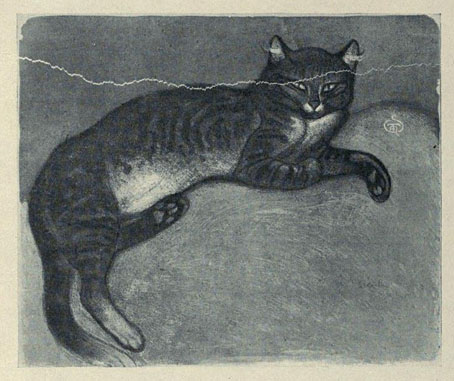
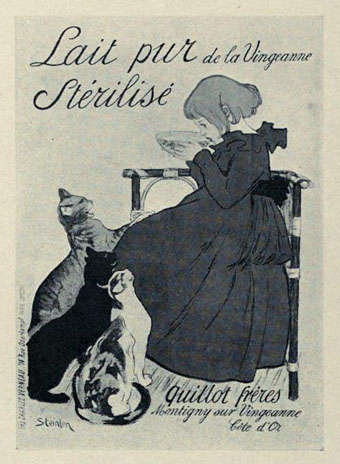
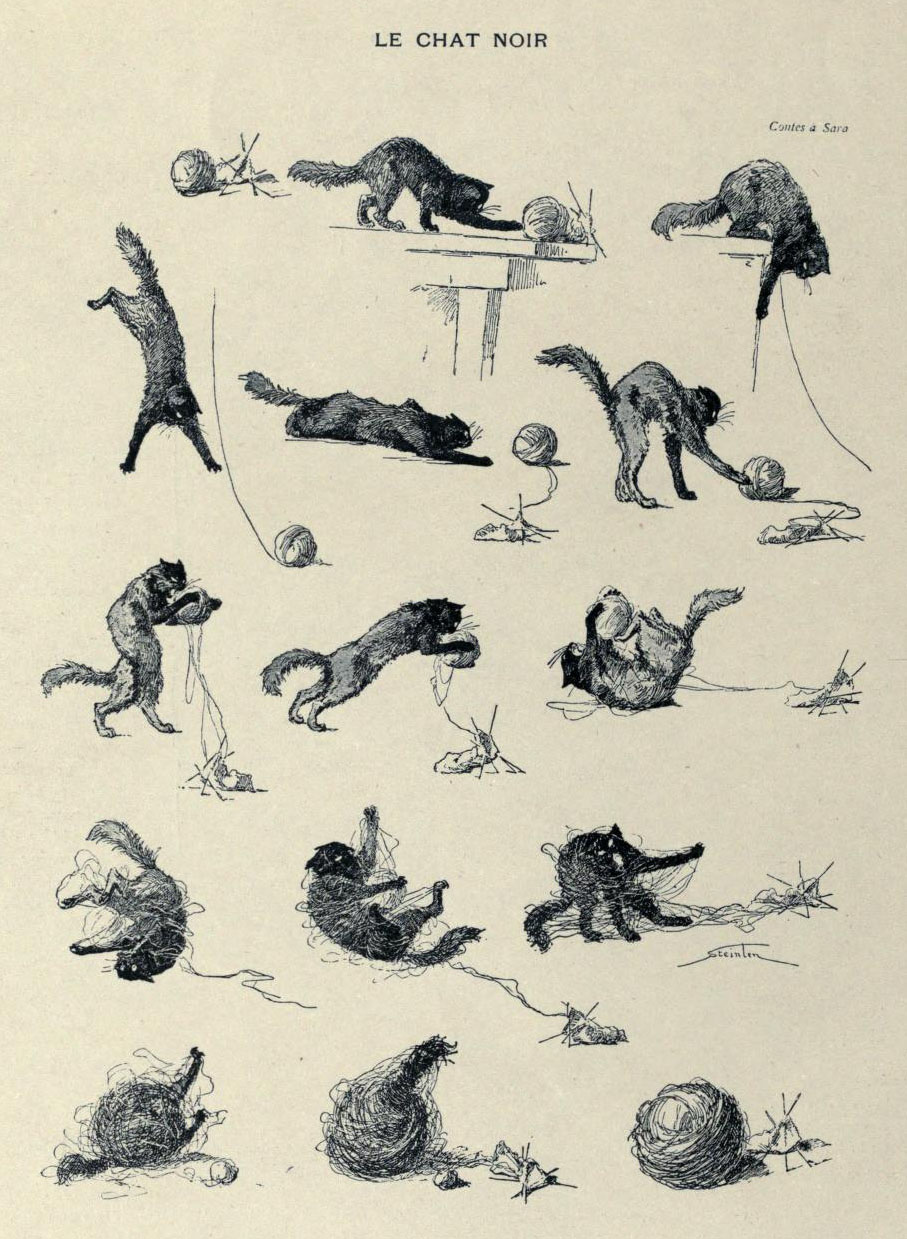
Chris Marker’s feline obsession was oft-remarked: cats feature regularly in his films, and in later years he’d often send a picture of a cat to anyone requesting a portrait photo. The Immemory CD-ROM features his cartoon avatar/companion/alter-ego Guillaume, a character who later manifested in three dimensions in Marker’s corner of Second Life.

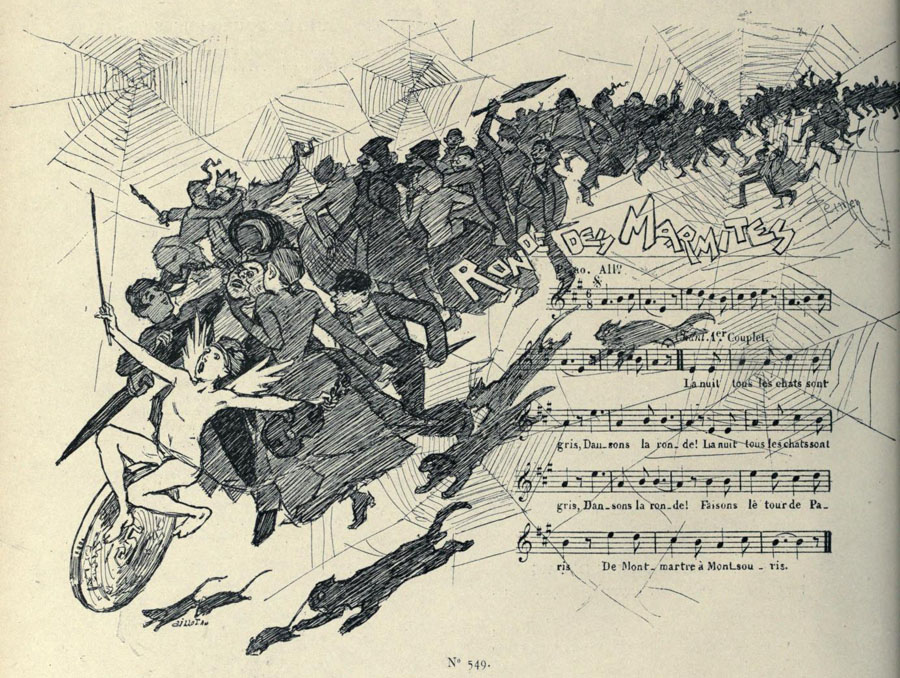
All of which had me thinking about another Parisian cat obsessive, artist Théophile Alexandre Steinlen (1859–1923). I’ve written about Steinlen’s cats before, one of which, his Chat Noir poster of 1896, is now a permanent fixture in the tourist shops of the city. Parisians are probably sick of the sight of that particular animal although I imagine Marker would have liked Steinlen’s other cats which range from fine art studies to cartoony sketches. All the examples here are from L’oeuvre gravé et lithographié de Steinlen, a catalogue of the artist’s print work from 1913. The song Ronde Des Marmites concerns the grey cats of Montmartre. At the end of the post there’s an other nod to Monsieur Marker (and Edward Lear) with a trio of Steinlen owls.

steinlen02.jpg

steinlen03.jpg

steinlen04.jpg

Continue reading “Steinlen’s cats revisited”

Chris Marker, 1921–2012

chrismarker.jpg

“A recurrent rumour says that Chris Marker and the cat Guillaume-en-Egypt sank with the Titanic.” Photo credited to Wim Wenders.

In our moments of megalomaniacal reverie, we tend to see our memory as a kind of history book: we have won and lost battles, discovered empires and abandoned them. At the very least we are the characters of an epic novel (“Quel roman que ma vie!” said Napoleon). A more modest and perhaps more fruitful approach might be to consider the fragments of memory in terms of geography. In every life we would find continents, islands, deserts, swamps, overpopulated territories and terrae incognitae. We could draw the map of such a memory and extract images from it with greater ease (and truthfulness) than from tales and legends. That the subject of this memory should be a photographer and a filmmaker does not mean that his memory is essentially more interesting than that of the next man (or the next woman), but only that he has left traces with which one can work, contours to draw up his maps.

Chris Marker, introductory notes to Immemory (2002)

Memory is the key word: it’s at the heart of Chris Marker’s most well-known films, his science fiction short La Jetée (1962), and the feature-length film-essay Sans Soleil. Both those films reference Hitchcock’s Vertigo, a film concerned with layered memories, both real and invented. Memory also comprises the subject of Marker’s most ambitious work from his later years, the CD-ROM Immemory, a unique creation which few will have experienced since it appeared after the great wave of ROM-mania in the 1990s, and was also Mac-only at a time (2002) when Macs were even more of a minority concern than they are today. My own copy is now unusable since it only runs on the outmoded OS 9 system (later copies were upgraded to OS X), leaving me with nothing but memories of Immemory and a box which sports a still from Vertigo among its cover images. The loss is regrettable but somehow fitting, and there’s a lesson here about impermanence for all you boys and girls planning bright new iPad apps. La Jetée is the film that receives the most attention, made on a budget that even when adjusted forward wouldn’t have covered the catering costs on Inception, it was one of JG Ballard’s favourites, and the source (of course) for Terry Gilliam’s Twelve Monkeys. But it’s to Sans Soleil that I always return, a place where the complex interleaving of documentary footage and fictional—or is it?—narration proves endlessly rewarding.

marker.jpg

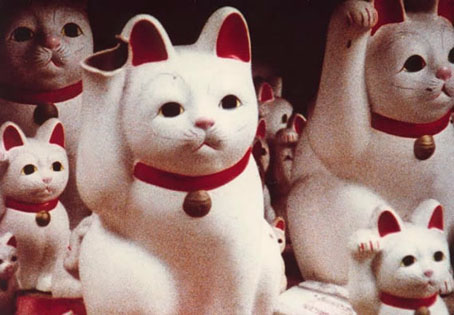
The Beckoning Cats from Sans Soleil (1983).

Chrismarker.org: an essential resource
Chris Marker’s YouTube channel
Chris Marker interviewed by Samuel Douhaire and Annick Rivoire in 2003
The New Yorker: In Memoriam: Chris Marker by Richard Brody
Guardian obituary by Ronald Bergan
Telegraph obituary
Things That Quicken The Heart: Chris Marker’s Sans Soleil by David Moats
The Humanists: Chris Marker’s Sans Soleil by Colin Marshall
Brian Dillon on La Jetée

Previously on { feuilleton }
Junkopia
Penguin Labyrinths and the Thief’s Journal
Monsieur Chat
Sans Soleil

m_chat.jpg

The Catherine Wheel by Twyla Tharp

catherinewheel.jpg

The music links this weekend were all related to my favourite Talking Heads period, 1979–1982, which not only encompasses the release of the band’s Fear Of Music and Remain In Light albums but also saw the individual group members produce some great solo records. I’d been playing one of these, the first Tom Tom Club album, all week while the sun was out. Now the temperature has dropped again, and we’re back to this summer’s default setting of perma-rain, the music doesn’t feel quite so appropriate. In 1981 while Tina Weymouth and Chris Frantz were exercising their funk muscles David Byrne was recording My Life In The Bush Of Ghosts with Brian Eno. The score Byrne produced immediately prior to this for the Twyla Tharp Dance Company often sounds like My Life… avant la lettre, with similar musicians (Eno included), sounds and rhythms. This is one reason I favour Songs From The Broadway Production Of “The Catherine Wheel” over Byrne’s subsequent solo albums.

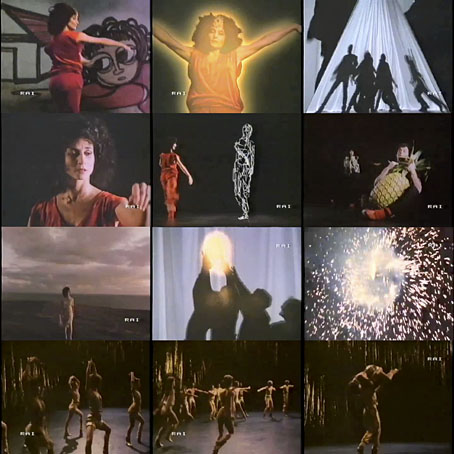
The Catherine Wheel was a seventy-two minute dance film choreographed and directed by Twyla Tharp. The film was part-produced by the BBC and as far as I’m aware was only ever broadcast the once in Britain in 1983. Byrne’s score runs continuously as on the CD and cassette versions, the vinyl release being a re-sequenced editing of the tracks favouring the handful of songs. In dance terms the film was very innovative for the time, employing some subtle video effects and a couple of sequences where a duet is danced with a wire-frame CGI figure. A long end sequence, The Golden Section, predates The Catherine Wheel, and was apparently the origin of the project. Since I hadn’t seen any of this in nearly thirty years my search for Tom Tom Club videos at the weekend made me wonder whether YouTube had any Catherine Wheel clips, only to find that the entire film can be viewed here in a recording from Italian TV. (That copy was removed, link now goes to another one.) I’m so familiar with Byrne’s album it’s been fascinating seeing this again, especially since I only saw it on a small black-and-white TV originally and recalled very little of the performance. All the music works well enough on its own but seems completed when heard in this context, especially during The Golden Section. The film is also available on DVD from Kultur so this is another item for the shopping list.

Previously on { feuilleton }
Moonlight in Glory
My Life in the Bush of Ghosts

Weekend links 119

peterderome.jpg

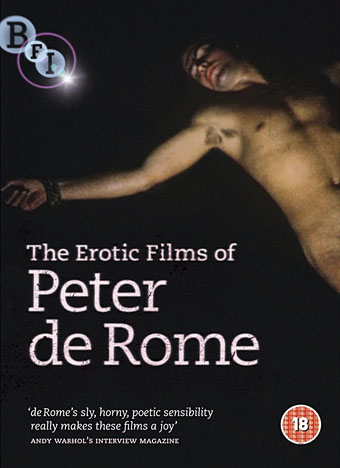
The BFI’s recent DVD release of Peter de Rome’s gay porn films has been mentioned here a couple of times already but I only bought a copy this week. It’s a remarkable release for a number of reasons, not least for showing how much attitudes towards pornography in Britain have changed in recent years. De Rome’s films are explicit enough to ensure that in the 1970s and 1980s anyone caught selling them in the UK might have been imprisoned. That you can now buy them uncut from a high street shop on a disc packaged with the usual care by the British Film Institute means another small part of our iniquitous past has gone for good. Among the extras there’s a documentary with the 88-year-old director discussing his work. This week he talked to BUTT magazine who also have one of his shorter films from the DVD, Hot Pants, on their site.

• “Reading this book, it is hard not to feel that the largest mental health problem – the really crazy thing – is society’s attitude to drugs in general and LSD in particular…” Phil Baker reviews Albion Dreaming: A Popular History of LSD in Britain by Andy Roberts.

• “Loved by aristocrats and immortalized in literature, Denham Fouts remains virtually unknown in his own hometown.” Richard Wall on The World’s Most Expensive Male Prostitute.

The very etiology of rabies is mythic: once the bite heals and the virus has traveled to the brain, “the wound will usually return, as if by magic, with some odd sensation occurring at the site.” Then there’s the fact that no definitive diagnosis can be made without taking a biopsy of the sick animal’s brain, leaving only one gory solution: decapitation.

Rabies is horror’s muse. In almost all iterations of the genre, those we most trust suddenly turn strange: a boyfriend morphs into a wolf at midnight, a fiancé turns out to be harboring a mad first wife in the attic, a friend is bit by a zombie and goes berserk.

Alice Gregory reviews Rabid: A Cultural History of the World’s Most Diabolical Virus by Bill Wasik and Monica Murphy.

• The Horror of Philosophy: Erik Davis talks to Eugene Thacker about Lovecraft, medieval mysticism, and thinking the world-without-us.

Eagle Scouts Returning Our Badges: A Tumblr for those protesting the current anti-gay stance of the Boy Scouts of America.

• His Father’s Best Translator: Lila Azam Zanganeh on the late Dmitri Nabokov.

Les Liaisons dangereuses: illustrations by Alastair (Hans Henning Voigt).

• Andrea Scrima looks at Robert Walser’s Der Spaziergang (The Walk).

10 Great Places to Meet Lesbians If You Have a Time Machine.

• Jesse Bering in Scientific American asks “Is Your Child Gay?

As Above, So Below (1981) by Tom Tom Club | Genius Of Love (1981) by Tom Tom Club | Mea Culpa (1981) by Brian Eno & David Byrne.