Two new covers

rockhill.jpg

My latest cover designs have arrived in time for Spook Month, although the first of these suits the season more by association than its appearance. Jim Rockhill’s A Mind Turned in Upon Itself is a study of the work of J. Sheridan Le Fanu, Ireland’s leading writer of ghost stories and Gothic fiction. This is another design for Swan River Press which adheres to the publisher’s preferred format of a dustjacket that wraps a small hardback with textured and illustrated boards. The brief was fairly straightforward, to present a rare photograph of Le Fanu in a suitably attractive manner. My initial idea was to create a frame that would reflect to some degree various aspects of Le Fanu’s fiction, but it quickly became apparent that the portrait photo was too tall and narrow to sit easily inside a frame that matched the ratio of the book. A better option was to look for a frame which could fit the shape of the book while also filling in the space around the photo.

dore.jpg

A page from The Workshop: a Monthly Journal Devoted to Progress of the Useful Arts.

When Le Fanu was writing in the mid-19th century book design had become very lavish, with a proliferation of presentation volumes gold-blocked and embossed on their covers and spines. The Heztel editions of Jules Verne are prime examples, as are the many editions of Gustave Doré’s books. My cover is an adaptation of a German edition of Doré’s Bible which had an unusual panel in the centre that happened to be a good size and shape to accommodate the Le Fanu photo, although I still had to extend the design a little. My version also includes a pair of small Le Fanu monograms embedded in the frame.

outline.jpg

For the board illustration I followed the form of an earlier Swan River book with an Irish theme, The Far Tower, whose boards I covered with an engraving collage. The end result, which looks like a single illustration, is a composite of two smaller illustrations from a book of views of Ireland, together with a quantity of foliage which frames the design and joins the pictures together.

ppc.jpg

The second cover is for a book I’m working on at the moment, Lovecraft’s Brood, a sequel to Tachyon’s well-received Lovecraft’s Monsters. I was very pleased to be asked to work on this one, the earlier book is a favourite of mine from among the books I’ve done for Tachyon, and Ellen Datlow is an expert at compiling well-chosen story collections. There’s not much I can say about the cover which follows the form of the previous book. As with Lovecraft’s Monsters, the framed face will also appear as one of the interior illustrations. You’ll have to wait a while to see the results of this, however. Watch this space.

brood-cover.jpg

Meanwhile, I’ve neglected to mention another Tachyon book whose interiors I’ve designed which is available now. The Essential Horror of Joe R. Lansdale is a great introduction to the work of a master of horror fiction whose stories manage to be grim and witty in equal measure. Very grim at times; visceral horror is Lansdale’s forte. The collection includes his best-known story, Bubba Ho-Tep, and features cover art by another Swan River Press cover artist, Dave McKean.

Previously on { feuilleton }
Lovecraft’s Monsters

In the Mad Mountains

madcover.jpg

Cover design by Elizabeth Story. Cover art by Mike Mignola.

The subtitle tells you everything you need to know about this new collection of Joe R. Lansdale stories from Tachyon. I designed the interior of the book, less floridly than some of my previous designs for Tachyon, and a little more abstractly than I’d usually do for a title such as this. All of the stories have been published before, and since I’d illustrated one of them (for Lovecraft’s Monsters) I had vague hopes of incorporating my earlier illustration while providing new ones for the rest of the stories. This proved impossible, however; I was working on the layout while still finishing the design for The Bumper Book of Magic so didn’t have the time to do seven more drawings. I’ll post the illustration here anyway.

bleeding.jpg

The Bleeding Shadow is a great story, a low-rent detective tale set in the 1920s in which the predicament from The Music of Erich Zann—violinist has to keep playing his instrument in order to keep something terrible at bay—is recast with shellac 78s and a blues guitarist. Among the other pieces there’s a story that manages to successfully contrive a meeting between Huckleberry Finn, Brer Rabbit and the Cthulhu Mythos; and the final story which gives the collection its name, wherein the setting of Lovecraft’s Antarctic epic becomes a Sargasso-like landscape of shipwrecks, lost planes and horrors great and small. I especially enjoyed The Crawling Sky, a story of the Old Weird West featuring a Solomon Kane-like itinerant preacher, the Reverend Jebidiah Mercer. Lansdale’s grotesque humour is to the fore in this one. I’d like to see the Reverend given a collection of his own someday.

mad1.jpg

mad2.jpg

mad3.jpg

Elsewhere on { feuilleton }
The Lovecraft archive

Previously on { feuilleton }
Things Get Ugly
Lovecraft’s Monsters

The Corset and the Jellyfish

bantock.jpg

Cover design by Brian DeVoot and Elizabeth Story.

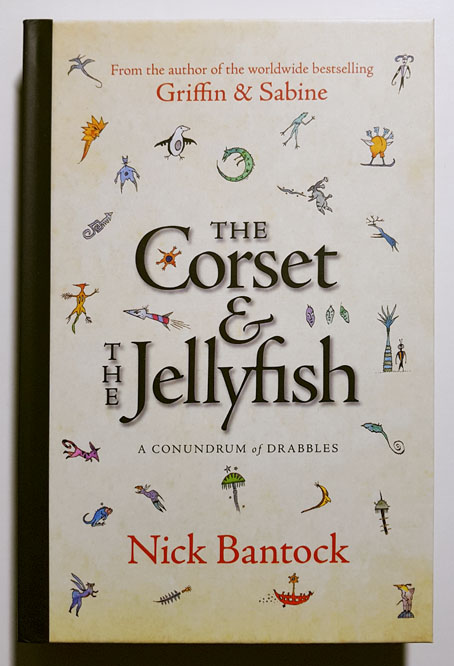
In the post this week, the latest book from Tachyon, a collection of Oulipo-inflected Surrealism from Nick Bantock:

Little is known of the fascinating manuscript that Nick Bantock has come to possess. It was discovered in an attic in North London, stuffed into a battered cardboard box, and unceremoniously delivered directly to Nick’s doorstep. Inside the package lay one hundred evocatively absurd stories, one hundred humorous drawings of strangely familiar, quirkish glyphs, plus a cryptically poetic note signed only as “HH.” (Possibly the well-known, eccentric billionaire, Hamilton Hasp?)

In these stories—each consisting of precisely 100 words—strange creatures slip through alleyways, and eerie streets swallow people whole. Taken altogether, they may constitute a puzzle that no one has been able to solve thus far. Could there even be one missing story?

I didn’t design this one but I was happy to see a preview copy which I described as “A tapestry of exquisite miniatures”. Each of Bantock’s illustrations is printed in colour, which I think is a first for the publisher. Given the time of year, The Corset and the Jellyfish is an ideal gift for any visitors to Calvino’s invisible cities.

The Legend of Charlie Fish

charliefish.jpg

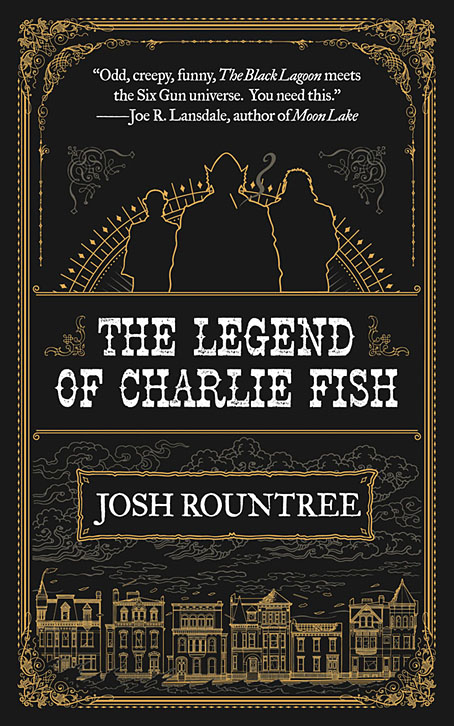
I’ve had several new book covers waiting in the wings for the past few months. The most recent of these, the cover for The Legend of Charlie Fish by Josh Rountree, was made public earlier this week so I can reveal it here.

In this debut, neo-gothic Western novel, an unlikely found family flees to Galveston, Texas, and a psychic young girl bonds with an enigmatic gill-man. While two bounty hunters are determined to profit by the spectacle Charlie Fish, the Great Storm—the worst natural disaster in US history—is on its way.

The brief for this one was to create something similar to the covers I designed for Mike Shevdon’s Courts of the Fayre series. Having already been asked to imitate the look of that series for a Marianne Williamson cover I was a little reluctant to do so again, but the final version of this one feels sufficiently different from the others to stand apart. One advantage of the graphic treatment was being able to use silhouettes to hint at the nature of the “enigmatic gill-man” without being too specific. When the appearance of characters is more alluded to than described you have to take care that your artwork isn’t too literal.

The Legend of Charlie Fish will be published by Tachyon in July 2023.

Peculiar Shocks

bodyshocks02.jpg

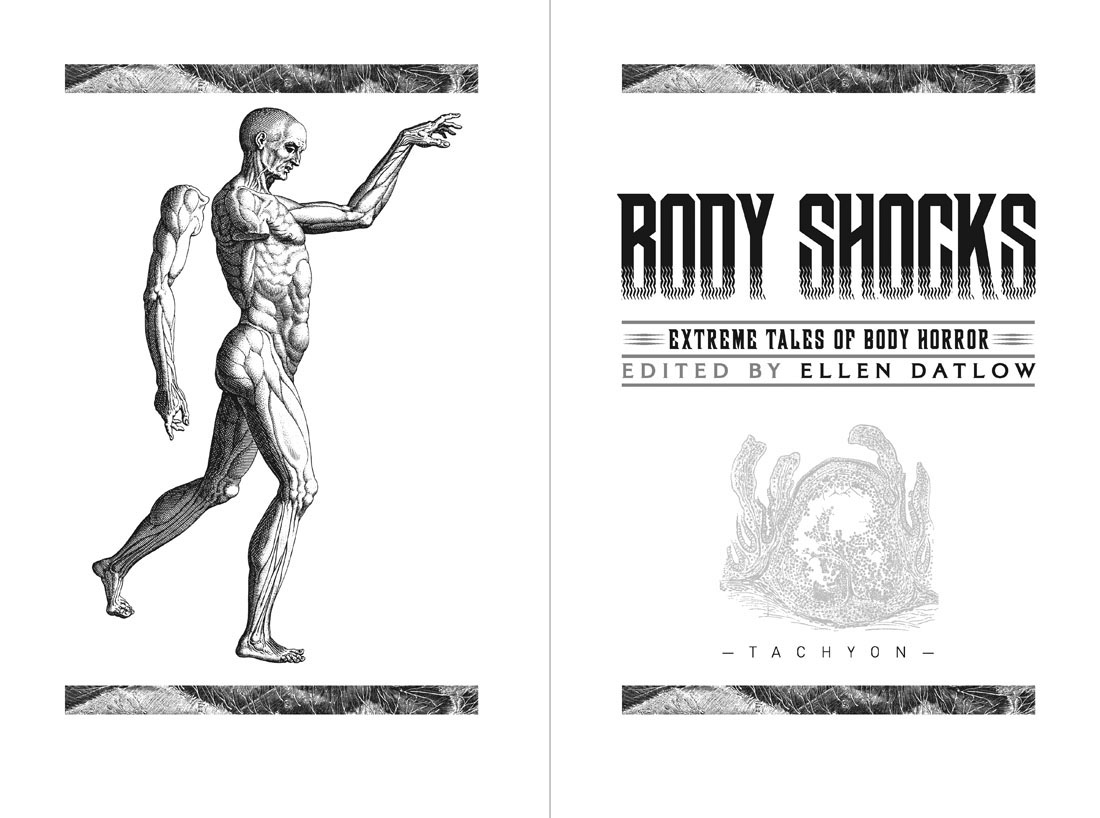
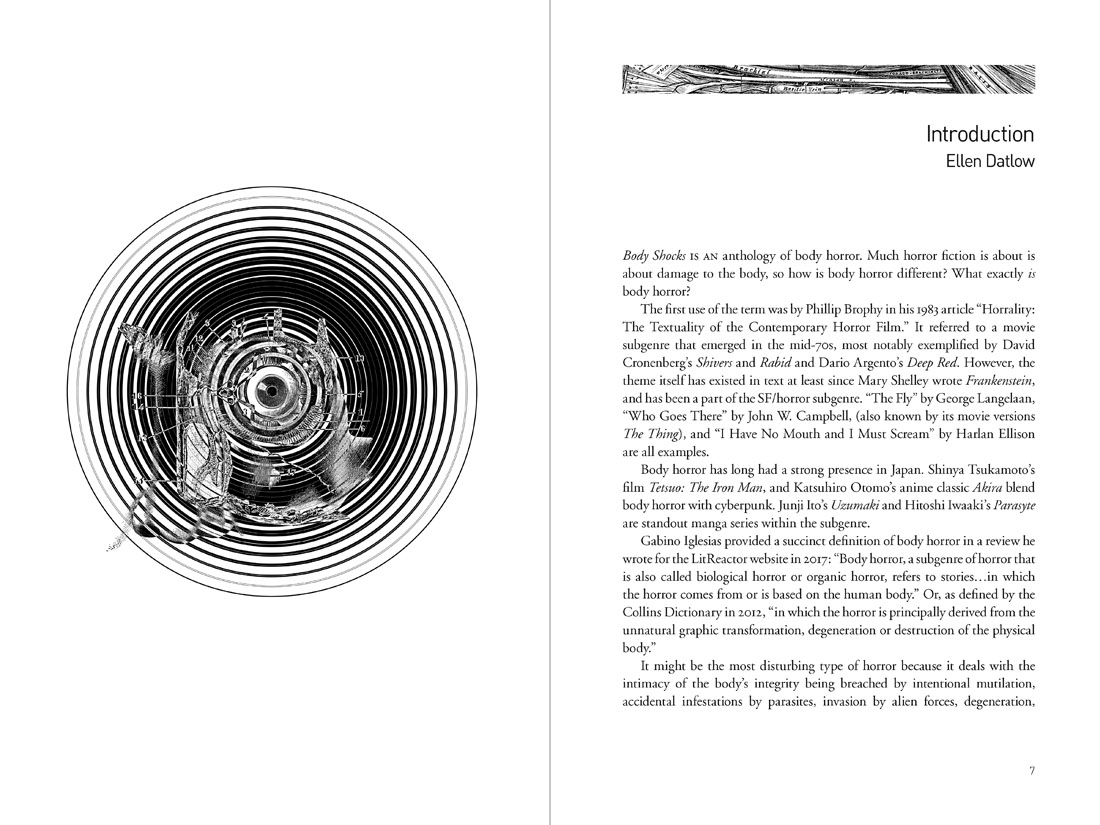
My cover design for Body Shocks, the body-horror story collection edited by Ellen Datlow, appeared here back in March. Now that the book is out from Tachyon I can show some of the interior design. In the earlier post I mentioned cover drafts that featured anatomical illustrations, none of which worked as well as the eyeball collage that became the final cover. The rejected pieces were better suited to the interior which combines engraved illustrations with the kind of sans-serif typography you might find on modern medical labels.

bodyshocks03.jpg

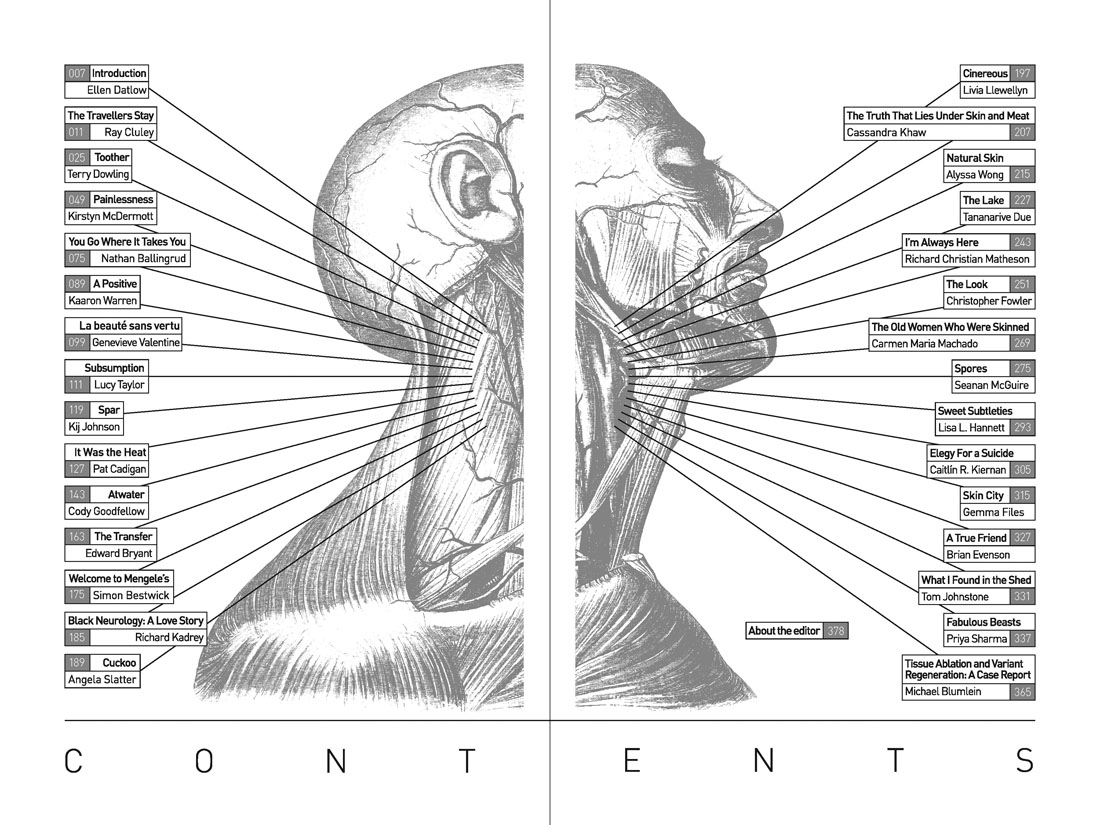
The diagram of veins that fills out the contents spread looks like an illustration from a 19th-century edition of Gray’s Anatomy but it’s actually an illustration from a book about massage whose title I don’t seem to have made a note of. Gray’s is a thorough volume, being a complete guide to the human body, but the illustrations aren’t as large or as detailed as those you can find elsewhere. The header bands used to indicate the beginning of each story are from Gray’s, however, while many of the stories end with full-page plates from The Anatomy of Humane Bodies by William Cowper. These are mostly engravings of autopsies which I processed by inverting the images then overlaying them with parallel lines. You can still tell the pictures are medical illustrations but they’re not as obtrusive as they would be if they’d been left untreated.

bodyshocks04.jpg

Continue reading “Peculiar Shocks”