Stanisław Lem, 1996

lem1.jpg

The Polish writer has been in my thoughts for the past week, now that I’ve finally got round to reading Solaris while also having watched The Congress, Ari Folman’s adaptation of Lem’s The Futurological Congress. Reading Solaris was an interesting experience when the story is so familiar from the Tarkovsky adaptation, which I’ve watched numerous times, and the Soderbergh adaptation, which has risen in my estimation in recent years. The novel was fascinating for all the detail about the mysterious planet which the films omit, while also being somewhat old-fashioned considering it was published in 1961. Lem was apparently dismissive of Anglophone science fiction but by the 1950s the treatment of futuristic technology by British and American writers was increasingly sophisticated, even if the psychology and characterisation in their stories still lagged behind literature in general. Lem’s future timeline is like something out of the 1940s, where humanity can travel to distant star systems yet the spacecraft are the cigar-shaped rockets familiar from the covers of pulp magazines. In the station orbiting Solaris the trio of scientists have endless scientific discussions, the video screens are small and monochrome, and there’s even a mention of something being powered by valves.

lem2.jpg

Solaris may be Lem’s most popular novel but it doesn’t warrant much discussion in this Polish TV documentary after Lem has mentioned his exasperated arguments with Andrei Tarkovsky when the film was being planned. Tomasz Kaminski’s profile runs through Lem’s life mostly via its subject’s reminiscences, although there is occasional comment from Lem’s friends and colleagues in the Polish literary world. The film doesn’t offer a great deal of context either but it does provide a portrait of a prickly character who I’ve never seen speaking at length before. I found it useful to rewatch the Quay Brothers’ biographical film after this one, a shorter piece which fills in a few gaps in Lem’s history while also showing the degree to which his early life was dictated by the upheavals of the Nazi occupation and the Communist era.

There are currently two versions of Kaminski’s film at YouTube, only one of which has English subtitles, and very crude ones at that. Better subtitles may be found at Opensubs but to use those you’ll have to download the video first. 4k Video Downloader Plus is my tool of choice.

Previously on { feuilleton }
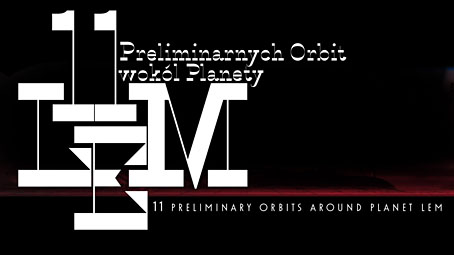
11 Preliminary Orbits Around Planet Lem by the Brothers Quay
Maska: Stanisław Lem and the Brothers Quay
Ikarie XB 1
Golem, 2012

11 Preliminary Orbits Around Planet Lem by the Brothers Quay

lem.jpg

Here come the Quays again with another short documentary for the Polish Cultural Institute. This was posted only a few days ago to acknowledge the centenary of the birth of writer Stanisław Lem. It’s only the briefest run through Lem’s career as a writer of science fiction but it does include a sequence that lists the films adapted from his work which is a useful reminder of all the ones I’ve yet to see. And the piece ends with an extract from Maska, the Quays’ own adaptation of a Lem short story, and a favourite of mine among their recent films. (Thanks to Tomas for the tip!)

Elsewhere on { feuilleton }
The Quay Brothers archive

Weekend links 586

ertz.jpg

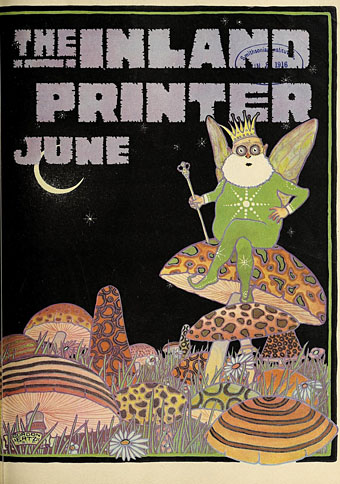
Cover by Gordon Ertz for The Inland Printer, June 1916.

• “I worry that enthusiasm is being mistaken for a moral virtue, and negative criticism for a character flaw.” Dorian Lynskey on the dying art of the hatchet job. Also a reminder (not that we require it) that the word “fan” in this context has always been an abbreviation of “fanatic”.

• Culture.pl explores the work of Stanisław Lem, the science-fiction writer “whose works, abilities and quirky sense of humor convinced Philip K. Dick that he was too brilliant to exist and must have actually been a committee of people”.

• The electronic music of Paul Schütze receives a reappraisal on Phantom Limb in November with a compilation album, The Second Law.

Aliya Whiteley on Amanita Muscaria, the hallucinogenic mushroom seen in hundreds of fairy-tale illustrations.

• Stuart Firestein talks to Roger Payne about changing the world’s attitude to whales by recording their songs.

• Jennifer Lucy Allan talks to Sam Underwood about his unique Acoustic Modular Synth.

Jóna G. Kolbrúnardóttir sings Odi Et Amo from Englabörn by Jóhann Jóhannsson.

• A forthcoming release on Dark Entries: Back Up: Mexican Tecno Pop 1980–1989.

• Luc Sante looks at Jim Jarmusch’s collages.

John Grant‘s favourite albums.

• RIP Michael Chapman.

• The Divination Of The Bowhead Whale (1978) by David Toop & Max Eastley | Keflavik: The Whale Dance (1980) by Richard Pinhas | Ballet For A Blue Whale (1983) by Adrian Belew

Weekend links 460

treister.jpg

Black Hole (1987) by Suzanne Treister.

• “Most people who are considered heroes are always to be found messing about in someone else’s affairs, and I don’t think that’s very heroic.” Robert Altman talking in 1974 to Jan Dawson about The Long Goodbye.

• “Tea is calming, but alerting at the same time.” Natasha Gilbert on the science of tea’s mood-altering magic.

• Alien spaceship, Hammer horror? Philip Hoare on the pulsating visions of Harry Clarke.

“…world cinema, particularly European cinema…hasn’t shied away from sex and, in fact, has often found ways of using sex to tell a story. Movies like The Duke of Burgundy or Sauvage or BPM gracefully integrate eroticism into the narrative—even when the sex itself is far from graceful. Even the American films that have focused on sex tend to do it with a leer and luridness, regarding sex with a certain narrative fetishism, as opposed to matter-of-factly.”

Rich Juzwiak talking to Catherine Shoard about the current state of sex in the cinema

• Chernobyl again: photographs by David McMillan from inside the exclusion zone.

Lasting Marks: the 16 men put on trial for sadomasochism in Thatcher’s Britain.

• Before Tarkovsky: Michael Brooke on the Russian TV adaptation of Solaris.

• Mix of the week: XLR8R Podcast 588 by Rouge Mécanique.

• Dustin Krcatovich on The Strange World of Mark Stewart.

• Your Surrealist literature starter kit by Emily Temple.

John Peel’s Archive Things (1970)

5fathom: Things rich and strange

Hole In The Sky (1975) by Black Sabbath | Thru The Black Hole (1979) by Metabolist | Black Hole (1993) by Total Eclipse

Weekend links 447

exercise.jpg

Physical Training for Business Men (1917).

• At Expanding Mind: Erik Davis concludes his discussion with religious scholar Diana Pasulka about anomalous cognition, 2001 monoliths, disclosure, future truths, absurd Christianity, and her book American Cosmic.

• This year the LRB wouldn’t let non-subscribers read Alan Bennett’s 2018 diary but they have a recording of Bennett reading entries here.

• “Glen thought it was very good PR for us to be heavily involved in the druids.” Tom Pinnock talks to the Third Ear Band.

• Rebecca Fasman on the forgotten legacy of gay photographer George Platt Lynes.

• Laura Leavitt on John Cleves Symmes Jr.‘s obsession with a hollow Earth.

• David Parkinson recommends 12 essential Laurel and Hardy films.

• Paul Grimstad on the beautiful mind-bending of Stanisław Lem.

• Mix of the week: Secret Thirteen Mix 277 by Sigillum S.

• The endlessly photogenic Chrysler Building.

Energy Flow by Ryuichi Sakamoto.

195 Gigapixel Shanghai

Solaris: Ocean (1972) by Edward Artemyev | The Sea Named Solaris (1977) by Isao Tomita | Simulacra II (2011) by Ben Frost & Daníel Bjarnason