The Gourmet by Kazuo Ishiguro

gourmet1.jpg

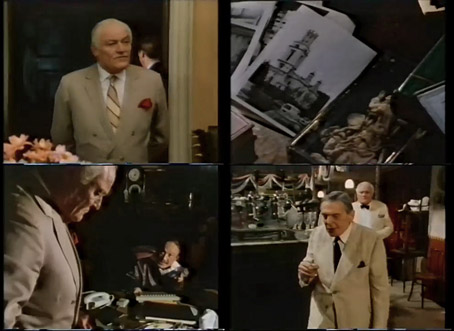
The Gourmet (1986), an original television drama written by Kazuo Ishiguro and directed by Michael Whyte, has long been in the top ten of TV films I was hoping would turn up on YouTube, and here it is at last. With a running time of under 50 minutes this is shorter than one-off dramas tend to be but its plus points are considerable, the first of which is its being an early yet neglected work by the Nobel Prize-winning author. The gourmet of the title is Manley Kingston, played by the inimitable Charles Gray in one of his few leading roles. Gray inhabits the part of the preoccupied and obsessed Kingston so well the character might have been created with him in mind; he’s even more imperious and commanding here than he was as Mycroft Holmes in the Granada TV Sherlock Holmes adaptations being made around the same time.
gourmet2.jpg

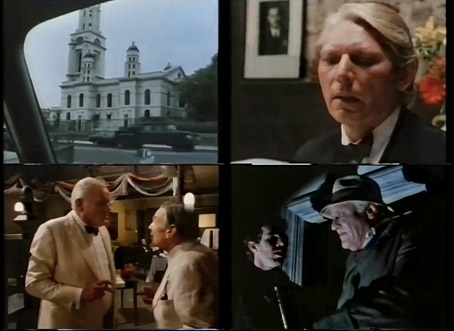
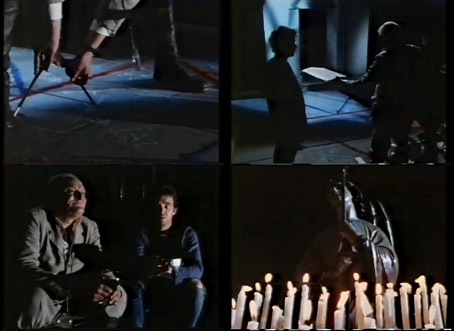
Ishiguro’s script presents us with a world of competitive international gourmets whose palettes are so jaded that their search for new tastes propels them to increasingly outré extremes, up to and including the consumption of human flesh. In a lesser drama this might be the shocking end revelation but the long-pig scene is a brief and wordless reminiscence on the way to Kingston’s ultimate gustatory experience, the devouring of a ghost. The film is almost worth watching solely for the moment when Gray enunciates the words “Not of this Earth?!” after being informed of the spectral meal by one of his gourmet associates. Another associate, played by David Rappaport (in an upper-class role for once, albeit with a dubbed voice), provides Kingston with the directions to a church where a suitable phantom may be found. The building isn’t identified but Hawksmoor aficionados will recognise it as St. George in the East, an apt location not only for the sinister quality the Hawksmoor churches acquired in the wake of Peter Ackroyd’s celebrated novel, but also for the building’s smaller towers which are always described as resembling pepper pots. I used to think the Hawksmoor church was a coincidental choice of location but Ackroyd’s novel had been discussed and partly dramatised on The South Bank Show the year before The Gourmet was made; the actor who played the architect’s hapless assistant in the dramatisation was Mick Ford, the same actor who appears in The Gourmet as a homeless man enjoined by Kingston to assist him in his ghost-catching ritual.
gourmet3.jpg

Despite its grotesque elements, The Gourmet isn’t an overt work of horror, which no doubt explains why the film is never mentioned in lists of neglected TV dramas. Watching it again I was less interested in the genre elements than the interplay between Kingston’s abstracted fervour and the human beings he ignores while pursuing his quarry. The latter encompasses the fellow gourmets who regard him as a world authority, his wife (who he doesn’t kiss when he leaves the house), his chauffeur (whose name he never remembers), and the derelicts who are also led to the church by hunger, queuing for a bowl of soup and a bunk in the crypt. Seen today, the gulf of inequality, and the self-indulgence of Kingston’s pursuit for the rarest of foods while people around him are starving, may be taken as a critique of Thatcherism as well as a foretaste of the future. The scenes outside the church show the East End of London as it was before its ongoing and unending redevelopment, when a new breed of rapacious appetites would arrive to sweep the homeless from those desirable riverside properties. The real ghost-eaters, the devourers of London’s history, have been consuming the capital ever since. (Thanks to Amelia for alerting me to this!)

Previously on { feuilleton }
Terror and Magnificence

A view over Yuggoth

yuggoth2.jpg

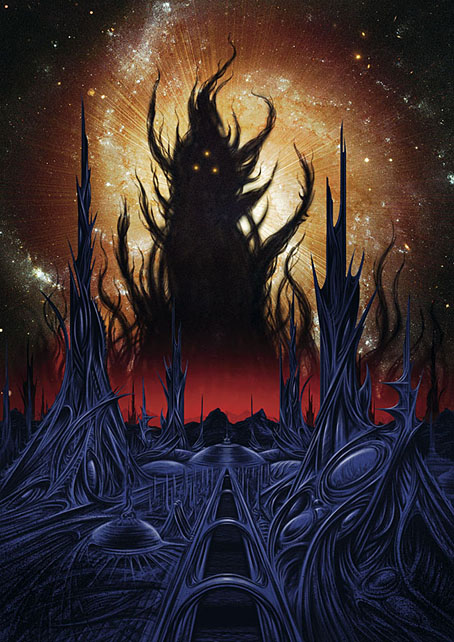
I mentioned in the post about the Sherlock Holmes illustrations that the next book from Editorial Alma featuring my work would be another Lovecraft collection. One of the illustrations in the new volume was of the planet Yuggoth, a world known to human beings as Pluto. In Lovecraft’s mythos Yuggoth has long been an outpost of advanced alien civilisations, particularly the fungoid crustaceans of The Whisperer in Darkness and the splendidly-titled sonnet sequence Fungi from Yuggoth. I’d broached this subject a couple of times in the past, first with a panel in my Haunter of the Dark comic strip (the Shining Trapezohedron is described as being brought to Earth from Yuggoth) then with a photocopy collage of Haeckel organisms for the first Starry Wisdom collection.

Yuggoth is one of several alien outposts in Lovecraft’s fiction, allied in its remoteness from humans with the underwater city of R’lyeh and the Antarctic city in At the Mountains of Madness. All these locations suggest exotic architecture so they’ve long been some of my favourite features in Lovecraft’s work, hence this new piece which I couldn’t resist doing after completing work on the Alma book. Since I acquired a Wacom tablet four years ago I’ve become so used to using it for line drawing that working with it now feels as natural as working with pens and inks. But digital painting was something I still didn’t feel happy with. This is mainly because the brush options in Photoshop are limitless, and one thing I’ve never liked with art materials is too much choice. When I was working with physical media I used to use a minimum of pens and brushes so what I really wanted from Photoshop was a single brush that would do what I wanted without having to swap tools all the time when working. This view of Yuggoth is the result of having finally settled (by chance, as it happened) on a brush that does everything I want without getting in the way. The drawing was completely improvised so as a composition it has some flaws; it could also have been developed a lot more to bring out highlights and details. But as an experimental piece it worked out well and also didn’t take too very long to do. When I have the time I’ll be doing more with this new brush.

Elsewhere on { feuilleton }
The Lovecraft archive

Illustrating Sherlock Holmes

beeton.jpg

Beeton’s Christmas Annual, 1887.

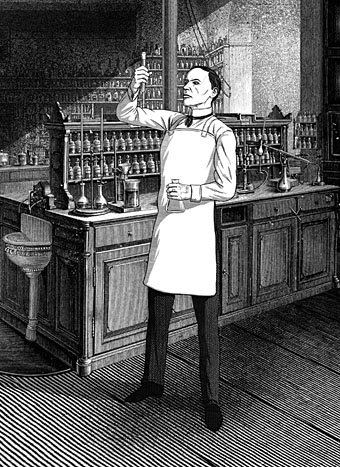
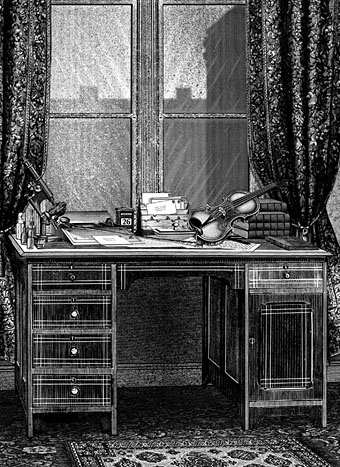
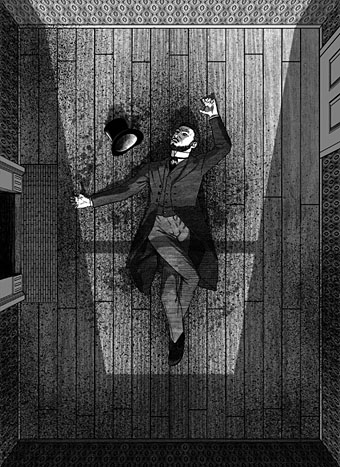
The latest in the series of illustrated editions I’ve been working on for Spanish publisher Editorial Alma is a single-volume collection of two short Sherlock Holmes novels, A Study in Scarlet and The Sign of Four. Work on this book began immediately after I’d finished Dracula so maintaining the Victorian theme was easy enough, although the commission as a whole was an awkward one. The main problem was having barely enough time to create 20 new illustrations while I was finishing work on the huge Jim Cawthorn book. But even with enough time this would have been a difficult brief. I regard Sidney Paget‘s original Holmes illustrations as the definitive ones so trying to offer people a fresh take on the world’s greatest detective is difficult. (And, as with Dracula, there’s further competition from the innumerable screen adaptations.) Then there are the stories themselves which are often more cerebral than visual, offering little for an illustrator beyond successive views of rooms, streets, houses and so on. Even Paget has trouble with this aspect of the stories, with many of his illustrations showing the various characters standing or sitting in rooms. If I’d had more time I might have tried a lateral take on the content—two of the illustrations in Dracula avoided the people-in-rooms problem by showing collections of objects on tables—but I didn’t have the time…

paget.jpg

Watson and Holmes by Sidney Paget. From The Adventure of Silver Blaze, The Strand Magazine, December 1892.

As things turned out, the least satisfying of the novels from a story perspective, A Study in Scarlet, was easier to illustrate because much of the second half takes place in the United States. This was the first Holmes novel, and it doesn’t work as well as the others for precisely this reason, the narrative attention is removed from Holmes, Watson and London, but the change of scene is a benefit for an artist. The second novel, The Sign of Four, is a better story but was compromised in this edition because the publisher only wanted every other chapter illustrated. For this reason Holmes and Watson are elusive presences in their own books although given the problems outlined above this may be for the best.

There’s still one more volume to emerge from my recent round of work for Alma, a collection of four Lovecraft stories, three of which I hadn’t illustrated before. More about this in a month or so. In the meantime, the full run of Holmes pictures follows below, while all may be seen at a larger size here.

A Study in Scarlet

holmes01.jpg

holmes02.jpg

holmes03.jpg

Continue reading “Illustrating Sherlock Holmes”

The Smoke

smoke01.jpg

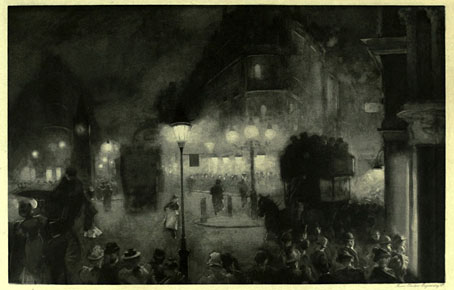
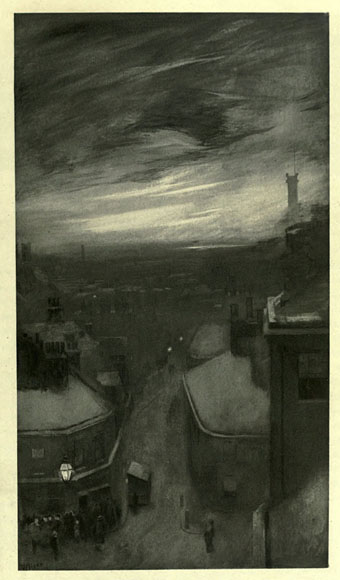
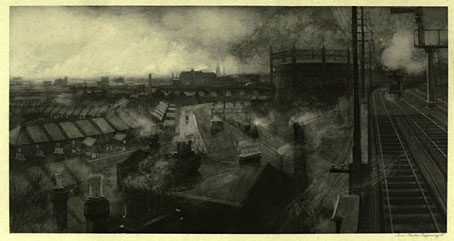
London in 1898 was the most populous city in the world, a metropolis of “four million souls” as Arthur Conan Doyle continually reminds us in the Sherlock Holmes stories. The stereotypical representation of London in the 19th century is of a city wreathed in fog but the reality was closer to the dense smogs that plague Chinese cities today. The four million souls heated themselves by burning wood and coal, and the resulting smoke (and a fair amount of steam, no doubt) combined with the British climate to create the noxious, tinted “fogs” that fill the streets of Victorian fiction.

smoke02.jpg

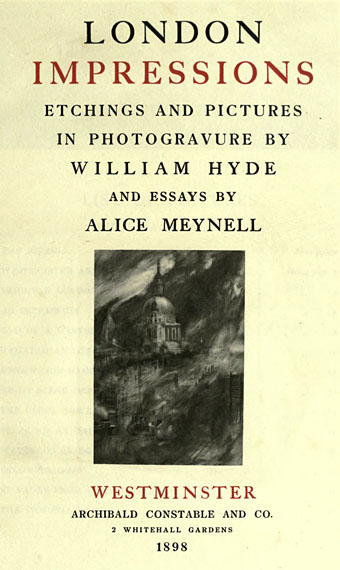
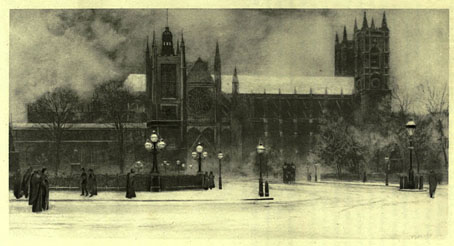
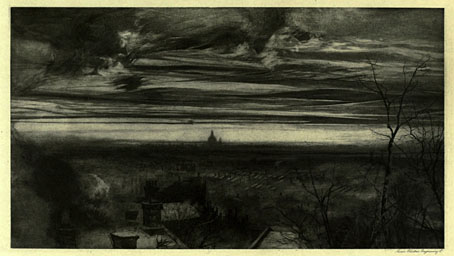
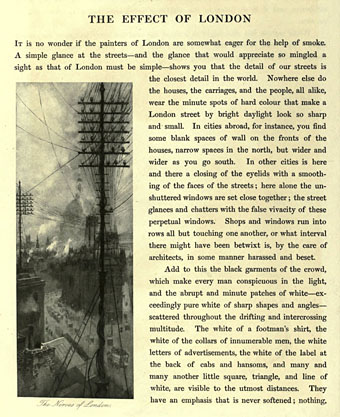
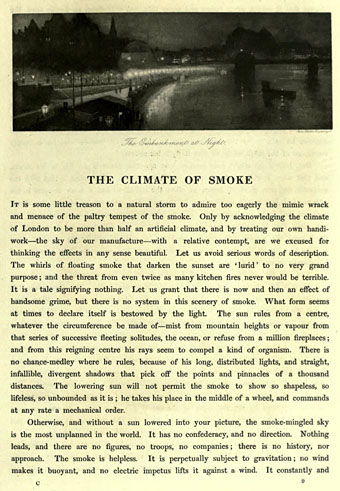
Whatever the health hazards, the vaporous atmosphere had its champions in artists such as Claude Monet and James Whistler, both of whom relished the way the smoky air softened the silhouettes of the city. William Hyde may be added to the list for this superb series of etchings showing London at its most tenebrous, another chance discovery at the Internet Archive. London Impressions is an ambivalent celebration of the capital as a city of shadows, smoke and fog, the essays by Alice Meynell ruefully admitting that while the industrial cities of the north may rival London for their polluted atmosphere, their smaller size means that blue sky is never far away, something the Londoner of 1898 couldn’t take for granted. This is a marvellous book, and one I’d love to own if it wasn’t so rare; there’s a copy on eBay at the moment for $1,640. At least we can read it (and download the pages) here.

smoke03.jpg

smoke04.jpg

smoke05.jpg

smoke06.jpg

smoke07.jpg

smoke08.jpg

Continue reading “The Smoke”

Weekend links 394

coin.jpg

Britain’s Royal Mint acknowledges this year’s bicentenary of the publication of Frankenstein with a commemorative £2 coin.

• A trailer for The Green Fog, a film by Guy Maddin, Evan Johnson and Galen Johnson, which uses clips from over 200 films set in and around San Francisco to create a collage companion to (and critique of) Alfred Hitchcock’s Vertigo. John DeFore reviewed the film for The Hollywood Reporter.

• Downloadable sound files and utilities for the Fairlight Computer Musical Instrument. Should you require it, the file containing the orchestra stab that was a feature of so much pop music in the 1980s is ORCH5. (Click on the “Library/Disk” listing then click “Extract” to download the samples.)

• Radio at the Internet Archive: the BBC adaptations of Mervyn Peake’s Titus Groan and Gormenghast (both adapted by Brian Sibley in 1984); and 554 Sherlock Holmes radio shows.

• Mixes of the week: XLR8R Podcast 523 by Scanner, RA Podcast 605 by Chris SSG, and Secret Thirteen Mix 241 by Jaroska.

• At Discogs: a list of “Experiments, gimmick and concept albums, bands and labels“.

Patrick Cowley The Ultimate Master Megamix

• At Dennis Cooper’s: Karen Black Day.

Events In Dense Fog (1978) by Brian Eno | Fog Animal (2005) by Deaf Center | In The Fog I (2011) by Tim Hecker