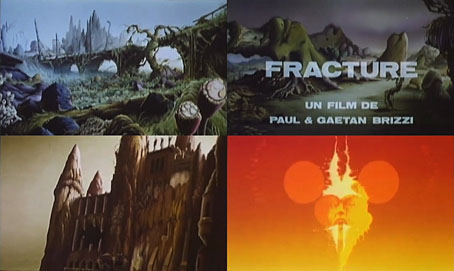
Fracture by Paul and Gaëtan Brizzi

fracture1.jpg

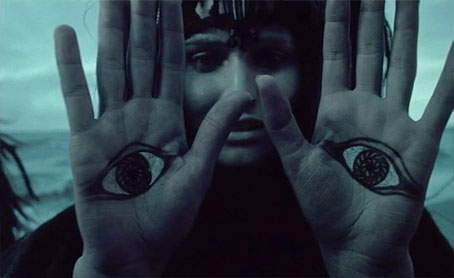
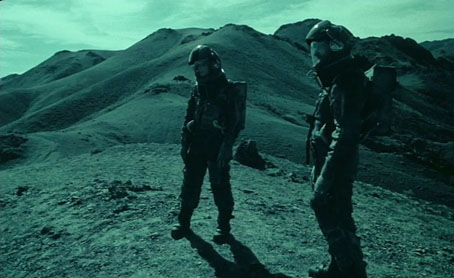
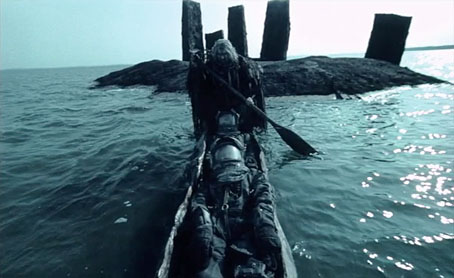
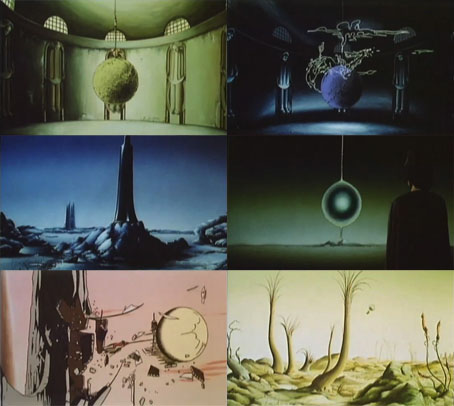
Fracture (1977) is a short animated film from France by the Brizzi Brothers (Paul and Gaëtan), a duo better known for their work on feature-length animated films such as Asterix versus Caesar (1985), and a number of films for Disney. Fracture is their earliest work, and isn’t remotely Disney-like, delivering an SF/fantasy scenario of alien inexplicabilities that makes it an animated counterpart of the comic strips that were running in Métal Hurlant (and its US counterpart, Heavy Metal) in the late 1970s. (The Brizzi Brothers’ most recent works have been comic books so I’d be surprised if Fracture didn’t have comics influence.)
fracture2.jpg

Comics and animation have a considerable advantage over film and TV in being able to avoid the commercial imperatives that explain away mysteries and make the alien too familiar. Animation doesn’t exploit this advantage as often as it might so examples such as Fracture are all the more rare and valuable. The Brizzi Brothers’ film may not be as thoroughly strange and inexplicable as Piotr Kamler’s masterpiece, Chronopolis (1983), but it has its moments. As a bonus, the soundtrack is lifted from albums by Tangerine Dream and Edgar Froese which have been monopolising my waking hours for the past two weeks.

Previously on { feuilleton }
The Captive, a film by René Laloux
Continu-discontinu 2010, a film by Piotr Kamler
L’Araignéléphant
Le labyrinthe and Coeur de secours
Chronopolis by Piotr Kamler

The edge of coherence: On the Silver Globe

otsg1.jpg

Science-fiction cinema has always suffered in comparison to its written counterparts; sets and special effects have to work hard to create believable worlds or futures, while the need to recoup enormous costs has often meant that film scenarios aren’t much better than those being written in the early days of the pulp magazines. Simplistic adventure stories yield bigger audiences and greater revenues. Computer technology has helped the effects problem but production expenses ensure that inventive or unusual SF films are scarce and invariably low-budget works. Anything too ambitious or challenging is unlikely to be funded.

otsg2.jpg

On the Silver Globe is an unfinished science-fiction film by Andrzej Żuławski that even in its incomplete state is that very rare thing: a film with a fantastic premise that doesn’t appear to have been staged for an audience at all. The film is long—over two-and-a-half hours—and much of it so disregards the conventions of commercial cinema that the immediate reaction is amazement that it exists in any form. Żuławski has a cult reputation outside his native Poland for Possession (1981), a unique horror film made when he was living in exile in Paris. On the Silver Globe was one of the reasons for his leaving the country; after two years of work in several countries, and with the film almost finished, the production was shut down in 1977 by a new vice-minister of cultural affairs who perceived a metaphoric subtext directed against the Polish authorities. The existing footage was supposed to have been destroyed but Żuławski and his production team hid the film and costumes hoping one day to shoot the missing scenes. After ten years of waiting it was decided to present the film as it was with the missing scenes filled by shots of Polish streets and countryside. A voiceover by the director describes the missing content.

otsg3.jpg

Continue reading “The edge of coherence: On the Silver Globe”

Continu-discontinu 2010, a film by Piotr Kamler

continu.jpg

A recent film by Piotr Kamler that’s not on the DVD collection from aaa, Continu-discontinu 2010 is a short animation that’s a lot more abstract than Kamler’s earlier works although you might detect the director’s hand in the motion of some of its wandering particles. In place of the electronic scores that soundtrack many of his films there’s a recording of a viol piece composed by Marin Marais.

Previously on { feuilleton }
L’Araignéléphant
Le labyrinthe and Coeur de secours
Chronopolis by Piotr Kamler

Maska: Stanisław Lem and the Brothers Quay

maska1.jpg

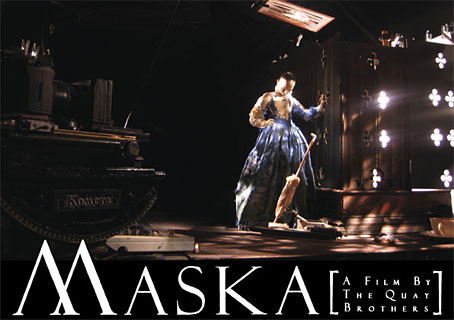
Did I mention the Brothers Quay? This is a mesmerising piece, and another short film to add to the growing number of Quay works yet to be collected on DVD. Maska (2010) is a 23-minute digital animation based on Stanisław Lem’s short story, The Mask (1976), which the producers have recently made available on YouTube. It was perhaps inevitable that if the Quays were going to venture into science fiction they’d use an Eastern European source. Lem’s story concerns a sophisticated technological society which is nonetheless still a monarchy. The narrator is an artificial woman who the aristocracy have created for a special mission; her human exterior conceals a robot interior, but this is no Maria from Metropolis. Midway through the story the robot breaks free of its human shell and is revealed to be a mantis-like creature.

maska2.jpg

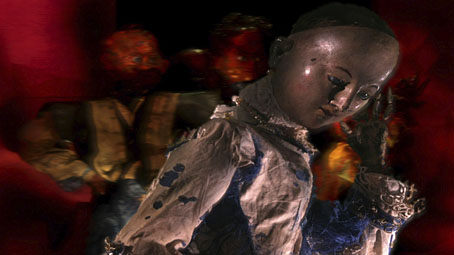
The Quays’ corpus has tended to avoid genres of any kind so it’s fascinating seeing how they wrangle both sf and horror into a mise-en-scène which is remote from their decaying European scenarios but which, in its details, is completely familiar: puppet characters, flickering light, shifting focus, everything immersed in shadow. Maska also departs from form by having a spoken narration which offers some rudiments of explanation. The habitual atmosphere of unease is still present, however, and pushed to outright horror in places, assisted by extracts from Penderecki’s nerve-jangling De Natura Sonoris No. 1.

maska3.jpg

As with Piotr Kamler’s Chronopolis, this is a good reminder of how science fiction can be presented in a less obvious manner by animation, offering a view into a world that doesn’t have to be explained down to the last detail. Some of the best written SF, and some comic-strip SF (usually the Continental titles), delivers a strangeness that’s completely absent from most filmed science fiction. Vast budgets demand simple-minded narratives with mass appeal so it’s left to animation and low-budget films to venture into areas that would be off-limits elsewhere. Maska is an impressive film, one of the best Quay shorts I’ve seen for some time. Watch it here.

Elsewhere on { feuilleton }
The Quay Brothers archive

L’Araignéléphant

kamler.jpg

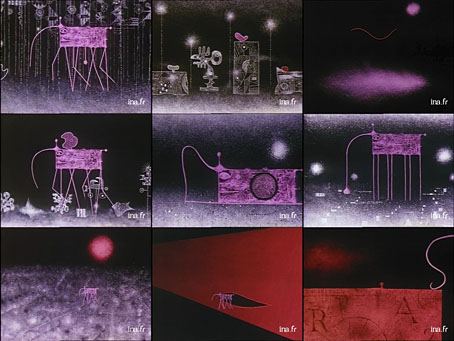
L’Araignéléphant (1967) is another of the strange animations made by Piotr Kamler in the 1960s and 1970s, this one being a 9-minute piece concerning the travails of “the spiderelephant”. As with Kamler’s Le labyrinthe, the music is by the French electroacoustic composer Bernard Parmegiani whose death was announced this week, hence the link. Parmegiani had a varied career which included scores for a number of other films (among them a Jan Lenica short, A, which I’ve not been able to find), and more commercial music than people at his serious end of the composition scale usually produce.

Ubuweb has a selection of Parmegiani’s longer compositions, one of which, Pop’eclectic (1969–1973), chops up pop and classical recordings (spot the Small Faces!) in a manner which would become commonplace a decade or so later with the advent of sampling. The Kamler films, meanwhile, are all available on a single DVD where the narration for L’Araignéléphant—which doesn’t explain very much—is subtitled.

Previously on { feuilleton }
Psyché Rock
Le labyrinthe and Coeur de secours
Chronopolis by Piotr Kamler