La femme qui se poudre

bokanowski1.jpg

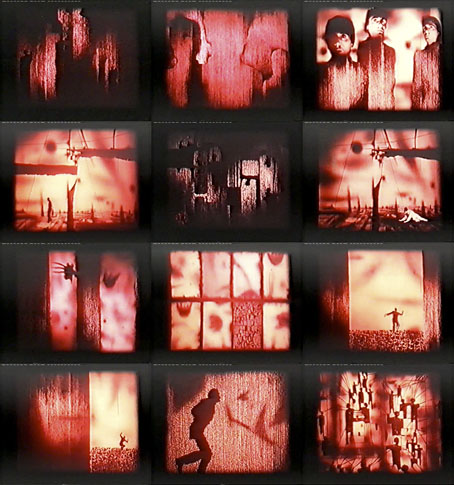
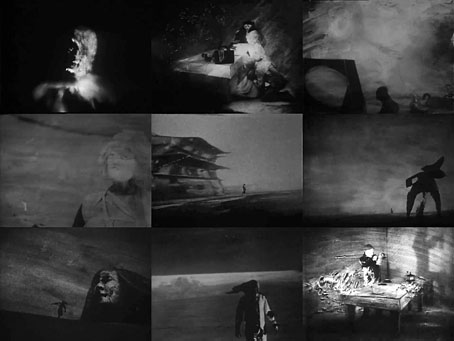
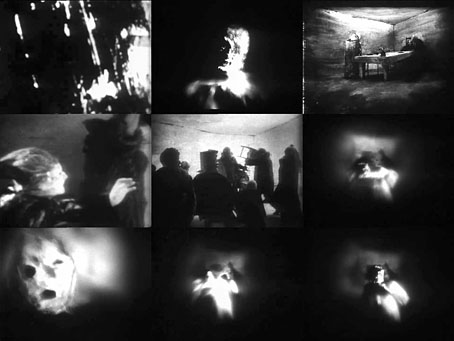
The DVD collection of films by Piotr Kamler turned up last week so I’ve been alternating viewing of that with shorts by Patrick Bokanowski. The latter is less an animator than a filmmaker who uses animation or film effects to achieve his aims, together with masks and very stylised performances. Bokanowski’s early film La femme qui se poudre (The Woman Who Powders Herself, 1972) runs for 15 minutes, and is as remarkable in its own way as his feature-length L’Ange (1982). La femme qui se poudre has the same masked figures engaged in activities which often lack easy interpretation; in both films the atmosphere can shift from absurdity to the edge of horror and back again. For me what’s most remarkable about this particular short is the way it anticipates both Eraserhead and the early films of the Brothers Quay yet still seems little known. The Quays are on record as admiring L’Ange but I’ve yet to see any sign that David Lynch knew of this film in the 1970s. I’d be wary of assuming that Lynch was imitating Bokanowski, artists are quite capable of finding themselves working in similar areas independently.
bokanowski2.jpg

Films of this nature always benefit from well-matched soundtracks: Piotr Kamler uses recordings by different electronic composers; Eraserhead had Fats Waller and the rumblings and hissings of Alan Splet; the Quays have unique compositions by Lech Jankowski. La femme qui se poudre and L’Ange have outstanding soundtracks by Michèle Bokanowski, the director’s wife and an accomplished avant-garde composer. Her work is as deserving of further attention as that of her husband. DVDs of L’Ange and a collection of Patrick Bokanowski’s short films may be purchased here.

Previously on { feuilleton }
Le labyrinthe and Coeur de secours
Chronopolis by Piotr Kamler
Brothers Quay scarcities
Patrick Bokanowski again
L’Ange by Patrick Bokanowski

Le labyrinthe and Coeur de secours

kamler1.jpg

Le labyrinthe (1969).

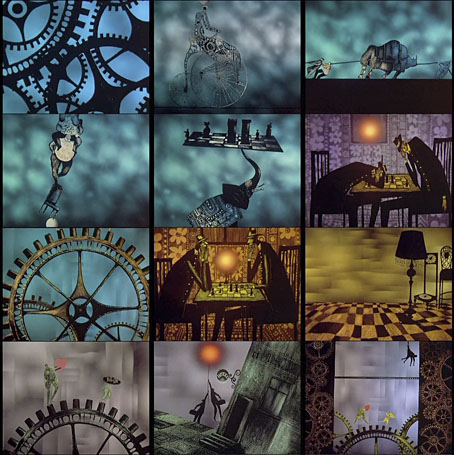
Among the new arrivals at Ubuweb there’s the very welcome addition of more animated films by Polish director Piotr Kamler. Kamler’s incredible Chronopolis (1982) was posted there late last year, a longer work than these shorter films which are nonetheless fascinating in themselves. For a start they show the range of Kamler’s animation which differs radically from film to film. Le labyrinthe is the kind of thing SF artist Richard Powers might have made had he been offered an animation commission: a human figure paces through increasingly threatening corridors and empty spaces until the winged creatures that haunt the zone bear down on him. Coeur de secours is more a sequence of events than anything that might be easily summarised; I’d seen this one years ago on Channel 4 but didn’t remember a thing about it. Chronopolis was notable for its electronic score by Luc Ferrari, and both the earlier films have similar soundtracks created by Bernard Parmegiani and Francois Bayle respectively. All these films, Chronopolis included, are collected on a recent DVD which I’ll definitely be buying. Kamler’s work, like that of Patrick Bokanowski and the Quay Brothers, goes places that films with much larger budgets can never reach.

kamler2.jpg

Coeur de secours (1973).

Previously on { feuilleton }
Chronopolis by Piotr Kamler

Chronopolis by Piotr Kamler

chronopolis3.jpg

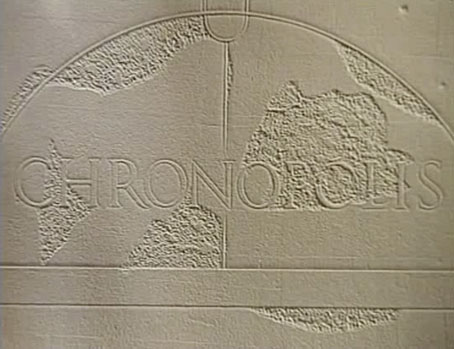
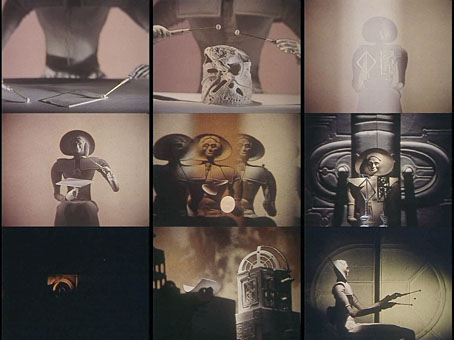
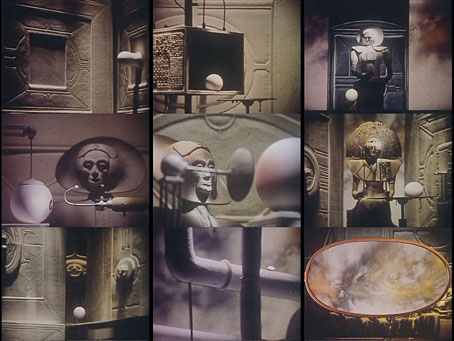
Another gem at Ubuweb, and nothing to do with JG Ballard’s SF story of the same name, Piotr Kamler’s Chronopolis (1983) is a 50-minute animated science fiction film, albeit science fiction of a much more abstract variety than one usually finds in cinema. I’m generally exasperated by the way film and TV SF does little more than play Cowboys & Indians in space so it’s refreshing to see something that’s unashamedly strange and doesn’t feel the need to explain itself. There is apparently a version of this with some English narration for those benighted American audiences everyone feels a need to pander to but the Ubuweb version is wordless, and if you can’t read French then you won’t understand the few lines of text prologue at the opening.

chronopolis1.jpg

Accompanying Kamler’s beautifully crafted and quite inexplicable scenes there’s an electronic score by composer Luc Ferrari, mostly analogue timbres whose origin is as mysterious as the events taking place on-screen. Kamler’s statuesque figures remind me of the gods and aliens that Moebius and co. were drawing in Métal Hurlant during the 1970s. Chronopolis was a French production begun in 1977 so it’s possible that French comics were an influence. Moebius himself worked on another animated SF film during this period, René Laloux’s Time Masters (1982). Chronopolis is closer in tone to the weirdness of Laloux’s earlier Fantastic Planet (1973), and all the better for it.

chronopolis2.jpg

Previously on { feuilleton }
Les Jeux des Anges by Walerian Borowczyk
Les Temps Morts by René Laloux