Wilfried Sätty and the Cosmic Bicycle

satty1.jpg

Listen, Sleep, Dream (1967), a poster by Wilfried Sätty.

Continuing the San Francisco theme, twenty years ago today I was visiting the city myself. Jay Babcock, Richard Pleuger and I had driven up there from Los Angeles to research some of the history of Wilfried Sätty (1939–1982), master collagist, psychedelic poster artist, record cover designer and book illustrator. We spent 24 hours driving around the Bay area: up to Petaluma, where we met Sätty’s friend and artistic collaborator, David Singer, a fine collage artist in his own right; then to Berkeley to talk to Walter Medeiros, custodian of the Sätty estate and one of the leading scholars of the psychedelic poster scene; finally to North Beach, where we found the house in Powell Street where Sätty was living and working in the 1960s and 70s.

satty2.jpg

Sätty and an unknown woman in the artist’s basement pad/studio at Powell Street, a place he referred to as “the North Beach U-boat”. This was from a magazine feature that I photographed at David Singer’s house. I forget the source, it may have been from a 1972 TIME article about San Francisco artists.

The trip was a dizzying experience, but fascinating for what it revealed about Sätty and his work. From David Singer we learned, among other things, that the name “Sätty” had been chosen as a pseudonym by the former Wilfried Podriech for its echo of Ancient Egypt; the pronunciation, when you pay attention to the umlaut, conjures the word “Seti”. Walter Medeiros showed us stacks of original Sätty artwork, including all the collages intended for the artist’s final book, Visions of Frisco, a visionary history of the city which was published in 2007. Medeiros later emailed me a few additional notes which I have filed somewhere, correcting my guesswork in the piece I’d written about Sätty for Strange Attractor Journal earlier in 2005. At the time the only information I had to hand was the scant biographical information in Sätty’s books, the interview that he gave to Man, Myth and Magic in 1970, and a few web pages devoted to the artist which someone had put together in the late 1990s then never updated.

satty3.jpg

The house at 2143 Powell Street as it was in 2005. Those trees have grown considerably in the past 20 years.

All of which had me looking last week to see whether Sätty had a more substantial web presence today. Happily, he does, with this dedicated site maintained by Ryan Medeiros, Walter’s son. I’m saddened to read that Walter Medeiros is no longer with us but it’s gratifying to discover his family continuing his efforts to preserve Sätty’s legacy. Sätty is often reduced to a minor figure in the history of San Francisco poster art but he was more than this: a book creator as well as an illustrator, and a collage artist who extended Max Ernst’s engraving collage into new dimensions, using printing presses to multiply and overprint his assemblages.

satty4.jpg

Sätty’s first book, The Cosmic Bicycle, was published in 1971 by Straight Arrow Books, the publishing imprint of Rolling Stone magazine. This is a collection of collages, a few of them in colour, in which the compositions have a distinctly Surrealist quality. Sätty’s subsequent work downplayed the wild juxtapositions in favour of greater compositional control. His subsequent collection, Time Zone (1973), is a wordless “novel” in the manner of Max Ernst’s collage books.

satty5.jpg

The Cosmic Bicycle is also the title of a 4-minute animated film which brings to life some of Sätty’s pictures from the book. I linked to a copy of this years ago but that link is now defunct so here it is again, an odd little film which runs the artwork through a solarisation process then moves pieces of them around to the accompaniment of an electronic score. (As usual with Vimeo today, you have to log in to see it.) The film was directed by Les Goldman, an animation producer who was mentioned here recently in relation to The Hangman (1964), a short film he made with Paul Julian. Goldman’s own film seems almost amateurish in comparison but the music is by Moog pioneers Paul Beaver and Bernie Krause, credited here as Parasound Inc. Beaver and Krause’s Gandharva album features one of Sätty’s finest cover designs, with title lettering by David Singer. The film score isn’t the duo’s finest by any means—I’d even describe it as rather annoying—but it’s good to see their Sätty connection reinforced.

Previously on { feuilleton }
The original Gandharva
The Occult Explosion
Wilfried Sätty album covers
Nature Boy: Jesper Ryom and Wilfried Sätty
Wilfried Sätty: Artist of the occult
Illustrating Poe #4: Wilfried Sätty
Switched-On… hits and misses

so01.jpg

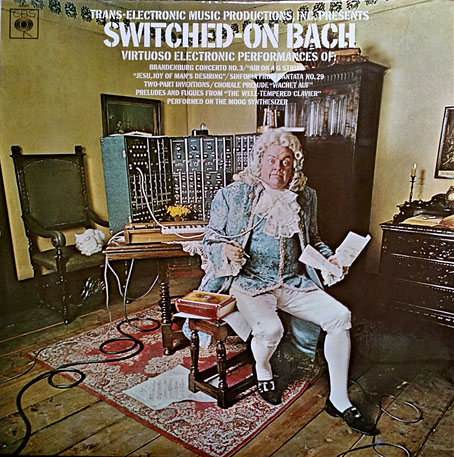
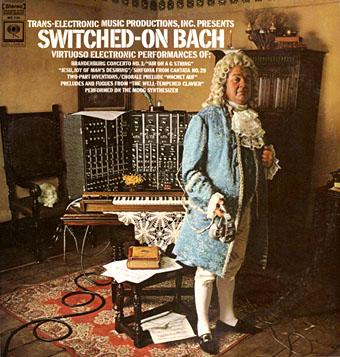
The first pressing of Switched-On Bach with a cover showing a Bach-alike confounded/dismayed by the sounds issuing from the machine behind him. The cover was soon swapped for the one below.

After mentioning the proliferation of Switched-On… synthesizer albums in the previous post, curiosity impelled me to see how many of these things were out there. A lot more than I expected is the answer, almost enough to make this cul-de-sac of novelty exploitation into a sub-genre of its own. As mentioned earlier, it was the huge success of Switched-On Bach (1968) by Wendy Carlos that began the trend. The album had a rare crossover appeal so that it could be sold to classical listeners as well as to a younger audience interested in electronic sounds, those for whom the words “switched on” echoed the druggy/erotic intersection of “turned on”. Carlos had an advantage over other musicians thanks to a long association with Robert Moog which meant she had a head start in exploring the recording potential of the new Moog synthesizer and innovations like Moog’s touch-sensitive keyboard. In 1968 few people could afford a Moog system; those who could usually needed to hire technicians like Paul Beaver and Bernie Krause to help them operate the thing. For a brief while it was enough to simply use the instrument to make strange noises, hence Mick Jagger’s droning score for Kenneth Anger’s Invocation of my Demon Brother (1969), and George Harrison’s preposterous Electronic Sound (1969), 44 minutes of very amateurish Moog-doodling. Switched-On Bach sounds a little primitive today—it sounds primitive next to its follow-up albums, The Well-Tempered Synthesizer (1969) and Switched-On Bach II (1973)—but Carlos and collaborators Rachel Elkind and Benjamin Folkman spent much more time refining their recording techniques than the knob-twiddling horde who rushed to capitalise on their success.

so02.jpg

The rules of the Switched-On… idiom are as follows: a title that begins with the words “Switched-On”, obviously, although there’s a subset of the form in which an album may have a different title while a subtitle mentions something about “switched-on recordings”; the music must be cover versions of familiar songs or compositions, originality here is surplus to requirements; and it’s not essential but the cover art often alludes in some way to synthesizer technology and/or “the future”, with the latter represented by Space Age typefaces such as Amelia, Computer, Countdown or Data 70. I’ve not heard many of these albums, and I’m fairly certain that I don’t want to hear most of them, but I’ve heard enough Carlos cash-ins to know that the cover designs are often the best thing about them. The remastered CDs that Wendy Carlos released in the 1990s feature additional tracks that give some idea of the amount of work involved in the creation of each album. The early cash-ins, by contrast, tend to avoid time-consuming multi-track composition in favour of using a synthesizer as though it’s merely an expensive keyboard. The success of these albums musically may be gauged by the lack of reissues. They may be of interest to the so-bad-it’s-good “Incredibly Strange Music” crowd but I prefer to spend my time listening to other things. Beware.

so03.jpg

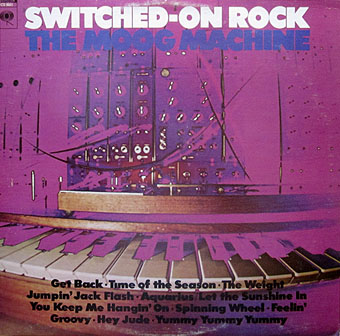
Switched-On Rock (1969) by The Moog Machine.

so04.jpg

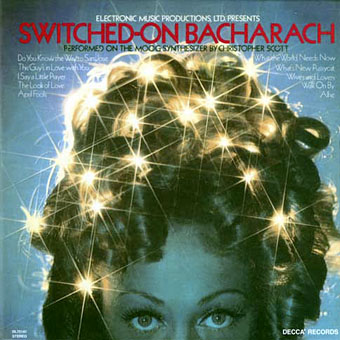
Switched-On Bacharach (1969) by Christopher Scott.

so05.jpg

Switched-Off Bach (1969) by Various Artists.

CBS exploits the success of the electronic album by packaging a collection of earlier non-electronic recordings.

Continue reading “Switched-On… hits and misses”

Electronic Music Review

emr01.jpg

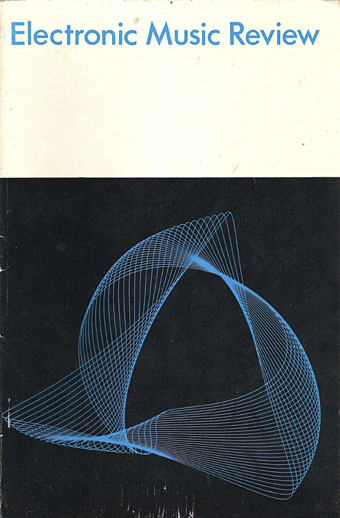
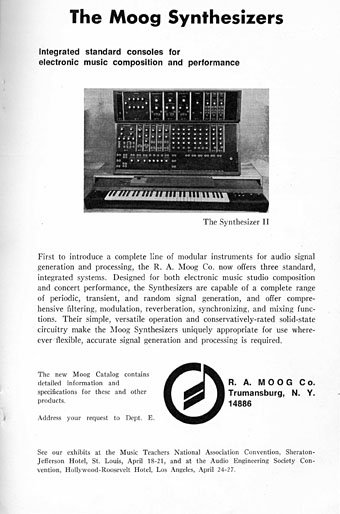
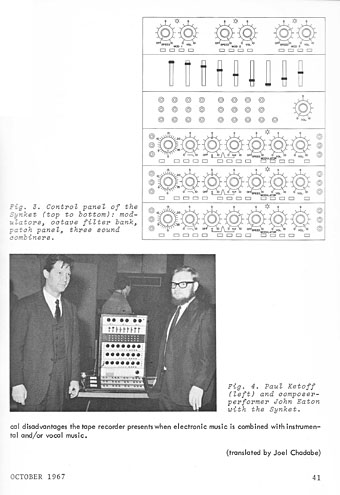
A new addition at the Ubuweb archives that’s catnip for anyone interested in the history of electronic music. Electronic Music Review was Reynold Weidenaar & Robert Moog’s short-lived journal devoted to the world of electronic music at a time when the field was rapidly growing away from the academic, “serious” side of musical composition and being taken up by the pop world.

All seven issues are present, running from January 1967 to July 1968. Pages of VCF circuit diagrams aren’t so interesting unless you’re an electronic engineer but the magazines also feature unique articles from composers who are now very well known, including Luciano Berio, Frederic Rzewski, Tod Dockstader, Henri Pousseur, Alvin Lucier and Jon Appleton. Despite the many women working in the field they evidently didn’t go looking for any to write for them. Granted, Wendy Carlos is among the contributors but in the late 60s she was still using the name Walter. In the later issues, Dockstader, Carlos and others review the recent electronic music releases. It’s especially fascinating to see an early reaction to albums such as Morton Subotnik’s Silver Apples of the Moon, and the debut from The United States of America, a cult favourite of mine for many years.

emr02.jpg

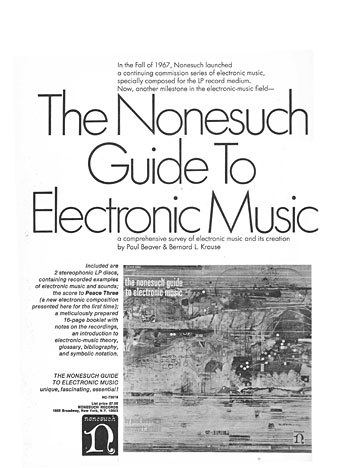
Scattered throughout the issues are ads for the latest studio gear and new album releases. One of these, The Nonesuch Guide to Electronic Music, was compiled by Paul Beaver and Bernard Krause. The latter is still recording, and happens to be interviewed in the current issue of Arthur Magazine.

emr03.jpg

emr04.jpg

Continue reading “Electronic Music Review”