Weekend links 289

hermes.jpg

Fathomless Sounding (1932) by Gertrude Hermes.

• Over at Greydogtales (“weird fiction, weird art and even weirder lurchers”) I talk about art, design, the writing of this blog, and I also reveal more about my ongoing Axiom project. The latter currently stands at two novels, a couple of half-finished stories and a few pieces of artwork. I may be unveiling some of the art in the new year so watch this space.

• Howard Brookner’s Burroughs: The Movie (1983), a definitive film portrait of William Burroughs, is released at last on DVD/Blu-ray. US-only for the moment but further releases elsewhere are promised. The director’s nephew, Aaron Brookner, has a documentary about his uncle released next year.

• “…beautifully articulated bawdiness, perverse pleasures and a radical, though nondidactic, political view.” Melissa Anderson reviews Boyd McDonald’s Cruising the Movies: A Sexual Guide to Oldies.

The crisis, as Ellis and Silk tell it, is the wildly speculative nature of modern physics theories, which they say reflects a dangerous departure from the scientific method. Many of today’s theorists — chief among them the proponents of string theory and the multiverse hypothesis — appear convinced of their ideas on the grounds that they are beautiful or logically compelling, despite the impossibility of testing them. Ellis and Silk accused these theorists of “moving the goalposts” of science and blurring the line between physics and pseudoscience. “The imprimatur of science should be awarded only to a theory that is testable,” Ellis and Silk wrote, thereby disqualifying most of the leading theories of the past 40 years. “Only then can we defend science from attack.”

Natalie Wolchover on A Fight for the Soul of Science

• Mixes of the week: A mix by Front & Follow, and The Ivy-Strangled Path Vol. XIV by David Colohan.

• “Psychedelics can’t be tested using conventional clinical trials,” says Nicolas Langlitz.

• At Dangerous Minds: Ralph Steadman illustrates Ray Bradbury’s Fahrenheit 451.

• Why does Moby-Dick (sometimes) have a hyphen? Erin Blakemore investigates.

• My thanks again to Dennis Cooper for including this blog on his year-end list.

• Cian Traynor was given 20 minutes to ask Ennio Morricone some questions.

Lolita at 60: Ten writers reconsider Nabokov’s novel, page by page.

• At Ballardian: High-Rise: Wheatley vs Cronenberg.

Poison Ivy: The Queen of Psychobilly Punk

The Cinema of Hotels: a list

Solo intimacy DIY

Moby Dick (1970) by Led Zeppelin | William Burroughs Don’t Play Guitar (1996) by Islamic Diggers | Physical (2001) by Goldfrapp
Weekend links 114

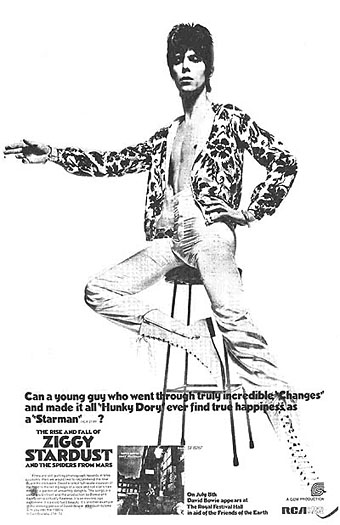
bowie.jpg

David Bowie’s cigaretted fingers and bulging silver crotch point the way to the future. This summer sees the fortieth anniversary of the Ziggy Stardust album’s release. The Melody Maker ad above can be found with a wealth of other Ziggy-related material at the very thorough Ziggy Stardust Companion site. For me the definitive artefact isn’t the album itself but DA Pennebaker’s film of the final concert from the 1973 tour; the songs really come alive and Bowie’s performance is overwhelmingly electric. Related: Cracked Actor, the BBC documentary from 1975 about Bowie’s post-Ziggy life on and off the stage.

• The week in books: Amanda Katz described the remarkable history of a single copy of The War of the Worlds by HG Wells then asked “Will Your Children Inherit Your E-Books?” | Bosnian novelist Aleksandar Hemon in The Browser’s FiveBooks interview put Blood Meridian on his list. | “Call me the greatest American novel”: Christopher Buckley on Moby-Dick. | The Brit Lit Map.

• For another anniversary, the Alan Turing centenary, there’s The Strange Life and Death of Dr Turing (part two here) and Breaking the Code (1996), Derek Jacobi playing the tragic genius in a biographical drama.

Commissioner of Sewers (1991) a William Burroughs documentary by Klaus Maeck in which the author reads some of his work and endures a Q&A session with surprising equanimity.

• Music, flesh and fantasy: When Mati Klarwein’s hyperactive paintings stole the psychedelic show.

• Move Over Casio: Teenage Engineering’s OP-1 Portable Synth Looks Cool, Does Everything.

• A retrospective of art by Madge Gill (1882–1961) at The Nunnery, London.

• “Art is unavoidably work”: Terre Thaemlitz interviewed.

• A trailer for Document: Keiji Haino.

WB Yeats, Magus

Pathétique 1 (1994) by Fushitsusha | Pathétique 2 (1994) by Fushitsusha.

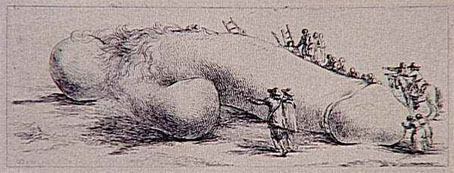
Le Phallus phénoménal

denon.jpg

Le Phallus phénoménal (1793–1794).

This blurred and discoloured picture arrives following a discussion with Paul Rumsey in the comments for an earlier post about engravings of monstrous whales. The pictures there were by engraver Hieronymus Cock whose surname gives us an additional resonance when discussing Moby Dick and sperm whales. The picture I posted of Jan Saenredam’s stranded whale showed the dead creature’s considerable penis (another engraving does the same) which led Paul to alert me to Dominique Vivant’s mischievous play on these pictures, where the artist exchanges the whale for a Brobdingnagian phallus. Or perhaps it’s merely a Gulliverian phallus and those people are Lilliputians… Whatever the case, I then mentioned to Paul JG Ballard’s story ‘The Drowned Giant’ from Ballard’s Terminal Beach collection which concerns the body of an enormous human found washed on a beach and subject to similar scrutiny by townspeople as in the stranded whale pictures. The body is eventually dissected and sold off. Paul reminded me of the end of the piece where Ballard writes:

As for the immense pizzle, this ends its days in the freak museum of a circus which travels up and down the north-west. This monumental apparatus, stunning in its proportions and sometime potency, occupies a complete booth to itself. The irony is that it is wrongly identified as that of a whale…

…which brings us full circle. Perhaps fittingly, Ballard’s story was published in Playboy magazine in 1965 under the title ‘Souvenir’.

As for Dominique Vivant (1747–1825), aka the Baron de Denon, his prestigious career besides engraving included, among other things, the directorship of the Louvre. We’re told he also wrote an erotic novel, Point de lendemain, and produced a selection of pornographic etchings, of which Le Phallus phénoménal would seem to be a part. Let no one accuse the French of being prudes; the picture above is from a site where you can order framed prints should you have a sudden urge to hang a phenomenal phallus on your wall.

Elsewhere on { feuilleton }
The etching and engraving archive

Previously on { feuilleton }
Of the Monstrous Pictures of Whales
Jan Saenredam’s whale
The Whale again
Rockwell Kent’s Moby Dick
Phallic bibelots
Phallic worship
The art of ejaculation

Of the Monstrous Pictures of Whales

whale1.jpg

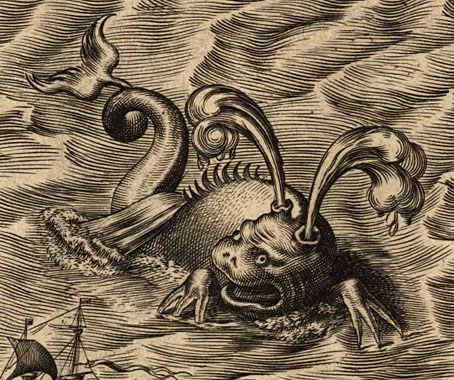
When Herman Melville complains in chapter 55 of Moby Dick about erroneous representations of whales, this is the kind of thing he had in mind. Among those he takes to task, however, I don’t recall any of them having two blow-holes like the creature above.

whale2.jpg

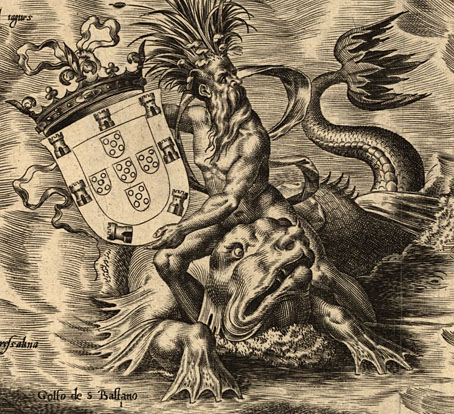
The coat of arms of Portugal.

These fanciful beasts are the work of (no sniggering, please) Hieronymus Cock (1510–1570), an Antwerp engraver, and they populate the seas as part of his marvellous map of America created with the assistance of Spanish cartographer Diego Gutiérrez.

Gutiérrez’s magnificent 1562 map of America was not intended to be a scientifically or navigationally exacting document, although it was of large scale and remained the largest map of America for a century. It was, rather, a ceremonial map, a diplomatic map, as identified by the coats of arms proclaiming possession. Through the map, Spain proclaimed to the nations of Western Europe its American territory, clearly outlining its sphere of control, not by degrees, but with the appearance of a very broad line for the Tropic of Cancer clearly drawn on the map.

The map is described in detail here while another part of the Library of Congress Map Collections site has an incredible high-resolution copy which is a delight to pore over. This is a really big image (10492 x 11908 pixels) but the huge size is just what I love to see. You can not only zoom into the myriad details—cannibals cooking a human feast in Brazil—but also admire the precision of the cross-hatching. Less than forty years separate these generic creatures from Jan Saenredam’s far more accurate rendering of a beached sperm whale.

whale3.jpg

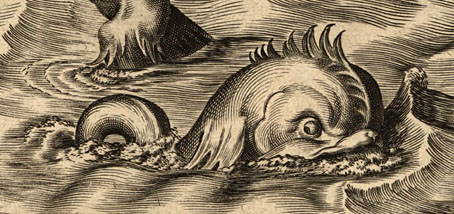
A dolphin (Melville classed dolphins and porpoises as small whales).

Elsewhere on { feuilleton }
The etching and engraving archive

Previously on { feuilleton }
Jan Saenredam’s whale
The Whale again
Rockwell Kent’s Moby Dick

Jan Saenredam’s whale

saenredam.jpg

Still reading Moby Dick at a leisurely pace. After finishing Melville’s chapters on the representations of whales I thought I’d see if the pictures he most prefers are online anywhere. A vain search, as it turns out, but I did discover this splendid depiction, Stranded Sperm Whale, by Dutch artist Jan Saenredam (1565–1607).

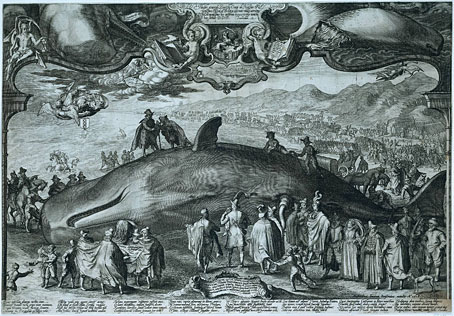
On 19 December 1601, a sperm whale washed up near Beverwijk. Crowds of people came to see the sight. Among them Jan Saenredam, who made this print. He has depicted himself drawing on the left.

The description continues at the Rijksmuseum site from which this copy originates. Mr Peacay of BibliOdyssey has a very large copy on his Flickr pages which shows more of the fine detail. Melville is highly critical of poor depictions of whales but I suspect he would have liked this one. As well as the local colour and allegorical border elements, Saenredam faithfully renders his dead whale, even leaving space for the drooping scape of cetacean penis. In a similar, if more mundane manner, there’s this engraving by Jacob Matham.

Elsewhere on { feuilleton }
The etching and engraving archive

Previously on { feuilleton }
The Whale again
Rockwell Kent’s Moby Dick