H.P.L.

hpl.jpg

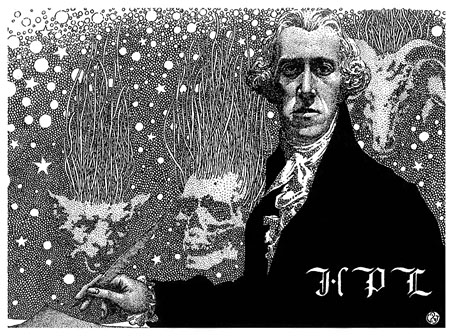
It’s that man again. Presenting the latest reworked page from the ongoing reconstruction/improvement of my Haunter of the Dark book. The picture will illustrate “Abdul Alhazred”, the final section of Alan Moore’s text for The Great Old Ones in which HP Lovecraft is positioned at Malkuth, the “Kingdom” in Alan’s eldritch Kabbalah. This makes Lovecraft himself the receptive vessel of the energies descending from the spheres above, while paradoxically being the source of those energies. Or some of them at least… The Great Old Ones is a Mythos Kabbalah which features Dagon, Hastur, Tsathoggua and Yig as well as Cthulhu and the rest. Alan doesn’t subscribe to Kenneth Grant’s baseless theory that Lovecraft really was a receptacle for transmissions from interdimensional entities, but the incorporation of the writer into his own pantheon isn’t unprecedented. Abdul Alhazred was a childhood persona of Lovecraft’s before he assigned the name to the author of Al Azif, or the Necronomicon; further personas may be found in Through the Gates of the Silver Key (“Ward Phillips”), Robert Bloch’s The Suicide in the Study (“Luveh-Keraph, priest of Bast”), and other fictions.
hpl.jpg

HPL (1937) by Virgil Finlay.

Whether this literary sport warrants the apparently limitless production of Lovecraftian art featuring the man himself, usually sprouting or festooned with tentacles, is a debatable matter. Virgil Finlay began the fantastic portrait trend in 1937 with his memorial depiction of the author writing with a quill pen while dressed in 18th-century garb. The earliest example that I can think of showing Lovecraft paired with the ubiquitous tentacles was the Moebius cover for Lettres d’Arkham in 1975, although there may well be other drawings prior to this. I’ve often wondered what Lovecraft would have made of the deluge of publications and images derived from his work, especially those that place him inside the products of his imagination.

moebius.jpg

Cover art by Moebius, 1975.

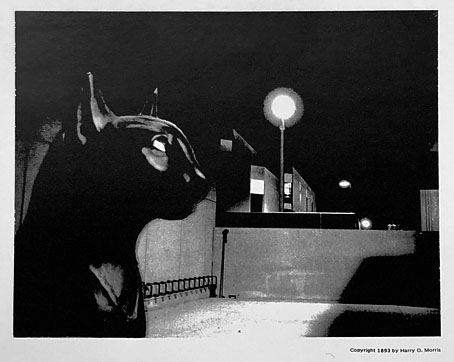
And speaking of which… I was at a loss at first with how to approach a new Lovecraft portrait, all I knew was that one was necessary. The original Malkuth picture from 1999 is another poor Photoshop job which has nevertheless been reused elsewhere on a few occasions, even appearing in 2007 on the cover of an issue of FATE magazine. For the new version I started with the portrait itself, using white lines on black to copy the same portrait photograph that formed the centre of the older picture. This was then duplicated and flipped horizontally to create a kind of Janus head which gives the portrait a suitably weird quality without wreathing it in tentacles. The mirrored head harks back to a sequence of treated photos by JK Potter which I first saw in the Heavy Metal Lovecraft special in 1979. Potter had used the same portrait photo to create effects that were somewhat compromised by poor reproduction, leading me to be believe that I’d created something slightly different to the first panel in his sequence. While researching this post I turned up an earlier version of the artwork which appeared on the back of the first issue of a US fanzine, Fantasy Mongers, also in 1979. The clearer reproduction revealed that the first head in Potter’s sequence is almost identical to my own. Ah well…

jkpotter.jpg

Photo art by JK Potter from the back cover of Fantasy Mongers #1, 1979.

The rest of the picture was improvised around this central image. Having drawn the portrait in white-on-black I decided to use a similar technique for the other elements. The Cthulhoid pillars are based on those in my Red-Night Rites painting from 1997, one of which appeared in the 1999 picture. The smaller figure on the right is from one of the photos that Wilfred Talman took while wandering the streets of New York with Lovecraft and Frank Belknap Long. This also appeared in the 1999 picture but for the new version I’ve emphasised what appears to be a book that Lovecraft is carrying in his right hand. Searching around for a complementary figure that might represent Abdul Alhazred turned up a 19th-century photo of a character who not only looked the part but is also standing in a manner similar to the Talman Lovecraft. If you look closely he’s also carrying a book, an addition of my own which turns him into the author of Al Azif. The polyhedra supporting the pair aren’t as arbitrary as they may seem. The spheres serve a dual purpose, preventing the figures from floating in space (or standing in water) while also relating to the Sephiroth of Malkuth which is identified with the Earth in the Kabbalistic scheme of planetary associations.

The next reworked picture will be Tsathoggua which is being polished rather than completely overhauled. I’m hoping I might have this done by the end of the month but I’m still chipping away at The Dunwich Horror while doing all this, as well as working on things which pay the bills. (I’ve just finished designing and illustrating another book.) Further progress will be announced in due course.

Elsewhere on { feuilleton }
The Lovecraft archive

Previously on { feuilleton }
The Return of the Crawling Chaos
Lettering Lovecraft
Weird ekphrasis and the Dunwich Horrors
Kadath and Yog-Sothoth
Another view over Yuggoth

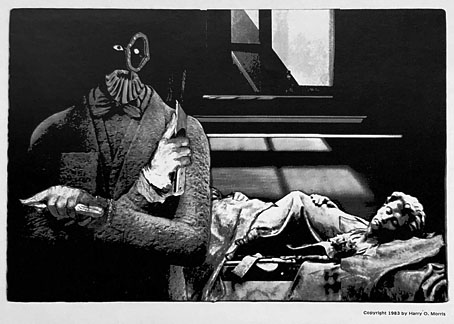
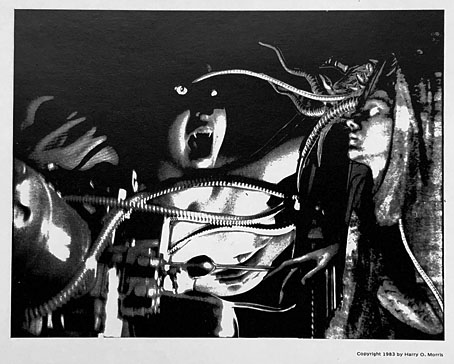
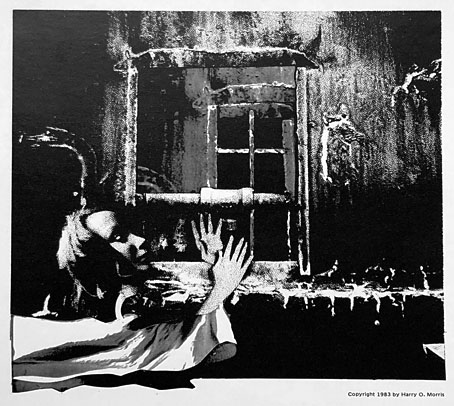
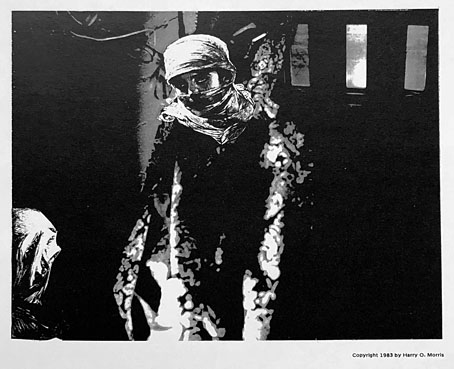
Harry O. Morris’s Maldoror

morris01.jpg

Lautréamont’s delirious prose poem/novel/proto-Surrealist dream-text is sufficiently wild and free-ranging to inspire many visual interpretations. One of the peculiarities of the book is that all these interpretations are valid to some degree, although some still suit the general tone better than others. Quite a few of the well-known Surrealist artists had a crack at illustrating Les Chants de Maldoror but artists who don’t illustrate on a regular basis have a tendency to gesture vaguely at the given text while offering yet more of their own concerns.

morris02.jpg

Expert collage artist Harry O. Morris does a better job than Dalí, Magritte and co. in his depictions of Lautréamont’s mutable scenarios. Maldoror is very much a collaged text, a product of its author’s enthusiastic plagiarism, which suggests that if the book has to be illustrated at all then collage is the technique to use. Morris’s interpretation was published in 1983 as Scenes from Lautréamont’s Maldoror, a portfolio of 10 plates. A note from the artist on this page acknowledges the influence of photo-montagist JK Potter, Morris being better known for his collages of engraved illustrations and other pictorial matter.

morris03.jpg

morris04.jpg

morris05.jpg

Continue reading “Harry O. Morris’s Maldoror”

A view over Yuggoth

yuggoth2.jpg

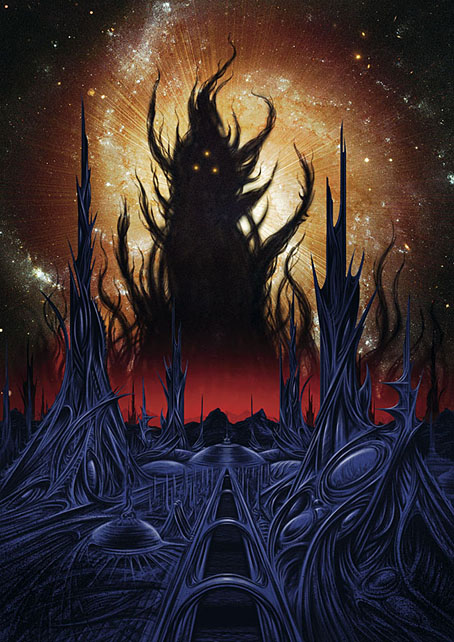
I mentioned in the post about the Sherlock Holmes illustrations that the next book from Editorial Alma featuring my work would be another Lovecraft collection. One of the illustrations in the new volume was of the planet Yuggoth, a world known to human beings as Pluto. In Lovecraft’s mythos Yuggoth has long been an outpost of advanced alien civilisations, particularly the fungoid crustaceans of The Whisperer in Darkness and the splendidly-titled sonnet sequence Fungi from Yuggoth. I’d broached this subject a couple of times in the past, first with a panel in my Haunter of the Dark comic strip (the Shining Trapezohedron is described as being brought to Earth from Yuggoth) then with a photocopy collage of Haeckel organisms for the first Starry Wisdom collection.

Yuggoth is one of several alien outposts in Lovecraft’s fiction, allied in its remoteness from humans with the underwater city of R’lyeh and the Antarctic city in At the Mountains of Madness. All these locations suggest exotic architecture so they’ve long been some of my favourite features in Lovecraft’s work, hence this new piece which I couldn’t resist doing after completing work on the Alma book. Since I acquired a Wacom tablet four years ago I’ve become so used to using it for line drawing that working with it now feels as natural as working with pens and inks. But digital painting was something I still didn’t feel happy with. This is mainly because the brush options in Photoshop are limitless, and one thing I’ve never liked with art materials is too much choice. When I was working with physical media I used to use a minimum of pens and brushes so what I really wanted from Photoshop was a single brush that would do what I wanted without having to swap tools all the time when working. This view of Yuggoth is the result of having finally settled (by chance, as it happened) on a brush that does everything I want without getting in the way. The drawing was completely improvised so as a composition it has some flaws; it could also have been developed a lot more to bring out highlights and details. But as an experimental piece it worked out well and also didn’t take too very long to do. When I have the time I’ll be doing more with this new brush.

Elsewhere on { feuilleton }
The Lovecraft archive

The Thing on the Doorstep

thing1.jpg

Workwise, this year has been a major one for interior illustration. So far I’ve completed about 80 illustrations for different titles, and I’m still not finished. The majority of the work has been for a Spanish publisher, Editorial Alma, based in Barcelona. Earlier this year they launched a line of reprints of classic works of fiction, each of which is illustrated. To date I’ve worked on three of the titles, the first of which, Narraciones extraordinarias by Edgar Allan Poe, will feature in a later post.

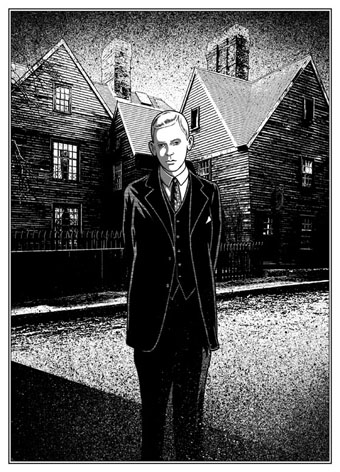
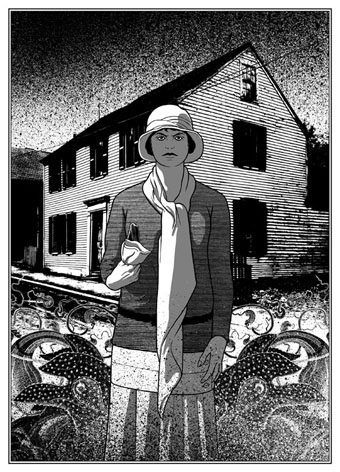
The second title, La llamada de Cthulhu by HP Lovecraft, is a small collection comprising the rather odd pairing of The Call of Cthulhu with The Thing on the Doorstep, two very different stories that you wouldn’t usually expect to see together. I provided six illustrations, three for Cthulhu which are slightly reworked pages from my comic-strip adaptation of the story, and three new ones for The Thing on the Doorstep. This is a story I’d never considered illustrating before when so much of its horror is psychological. It does, however, feature two characters who (by Lovecraft’s standards) are well-defined: the ineffectual Edward Pickman Derby and his sinister future wife, Asenath Waite. So that’s what you see here: portraits of the two main characters plus a view of the climactic scene that gives the story its title. Ideally, I would have liked to have done a fourth picture showing Derby’s surprise awakening at a nightmarish ritual but the deadlines on these books have been tight and there simply wasn’t time.

thing2.jpg

For those interested in this title, the only purchase link I have is an Amazon one. All the books are hardbacks (without dustjackets) complete with decorated endpapers—I provided a tentacle pattern for this one—and a bookmark ribbon. Deadlines aside, it’s been a very pleasant experience working for Alma. The next two books are the big ones so watch this space.

thing3.jpg

Elsewhere on { feuilleton }
The Lovecraft archive

Leather Cthulhu unleashed

cthulhu1.jpg

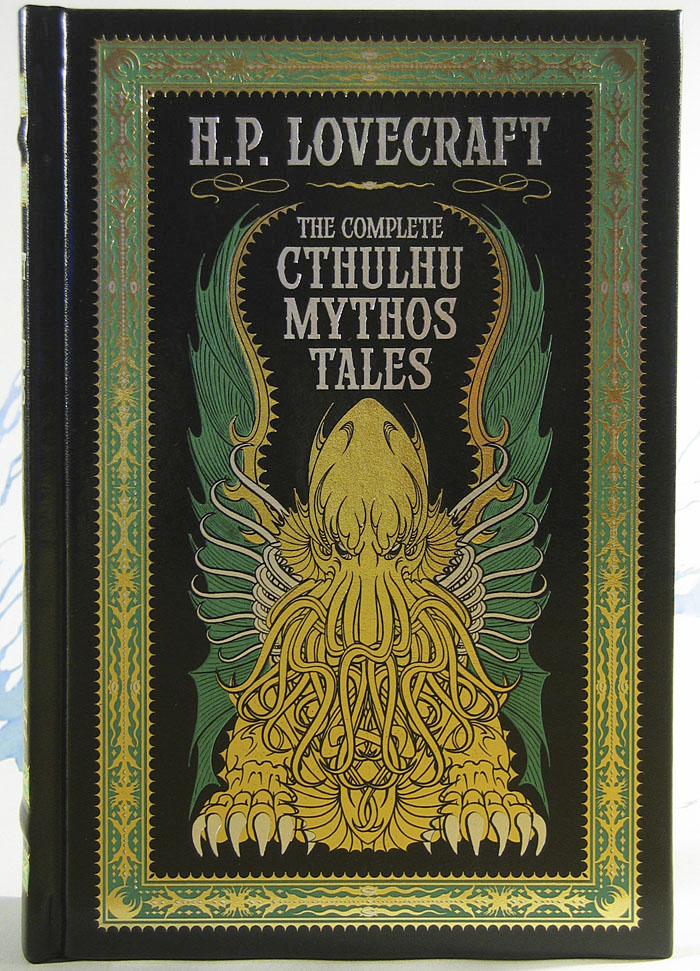
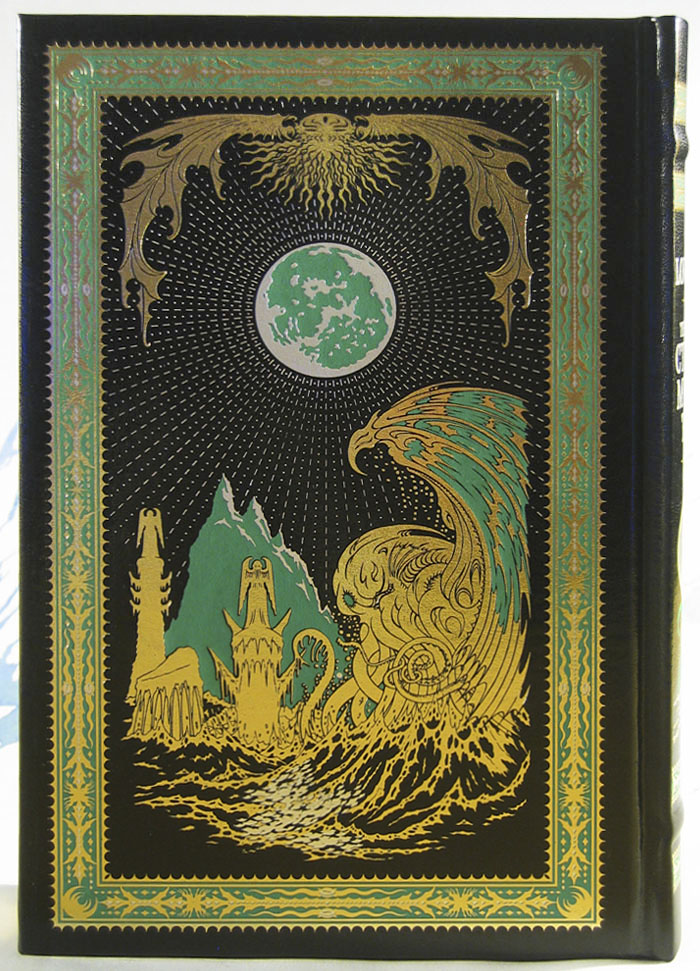
The beautiful leatherbound Complete Cthulhu Mythos Tales is officially published this Friday but the books are in Barnes & Noble stores already, and my complimentary copies arrived this week. Photos don’t do justice to the volumes in this series of classic reprints, you really need to hold one to see how well made they are. The leather is smooth and flawlessly printed—I was worried that I might have pushed the limits with some of the details in my cover design but every line and edge is where it should be. The pages of this particular volume are edged with gold, an effect applied to some of the books I’ve designed for Savoy but an uncommon thing in today’s book world.

cthulhu2.jpg

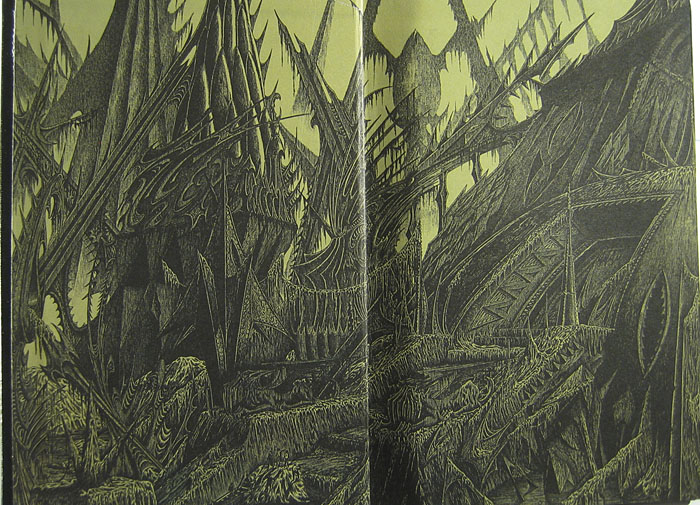
As I mentioned earlier, this edition also features endpapers showing details of my R’lyeh spread from The Call of Cthulhu, plus a poster of my Cthulhu Rising piece from 2004. Which leads to an important note for purchasers: the temporary glue that fixes the poster to the back endpapers, and the ad sheet (see below) to the back cover was stronger than intended so care needs to be taken when detaching these items from the book. I’ve been told that a warning about this will be added to the next batch of books, and the glue (which is that clear stuff used to fix things to magazine covers) will also be changed.

A couple more photos and a list of contents follow below. I’ve worked on a lot of books over the years but this one is up there with the very best; Lovecraft’s finest fiction in a single gorgeous volume, and all for $20.

cthulhu3.jpg

Continue reading “Leather Cthulhu unleashed”