Weekend links 817

paolozzi.jpg

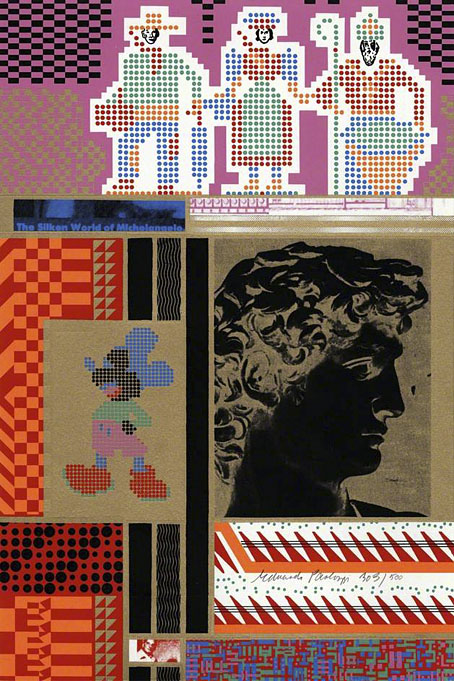
The Silken World of Michelangelo (1967) by Eduardo Paolozzi.

• “By the late 19th century, representing time as a line was not just widespread—it was natural. Like today, it would have been hard to imagine how else we could represent time. And this affected how people understood the world.” Emily Thomas on the evolution of our thinking about the nature of time.

• At Green Arrow Radio: Bill Laswell and the Cosmic Trip, in which the indefatigable performer/producer talks about his career and Cosmic Trip, a new album by saxophonist Sam Morrison.

• At Public Domain Review: Snail Homes, Bog Bodies, and Mechanical Flies: Robert Testard’s Illustrations for Les secretz de l’histoire naturelle (ca. 1485).

• Among the new titles at Standard Ebooks, the home of free, high-quality, public-domain texts: Continental Op Stories by Dashiell Hammett.

• The winter catalogue of lots for the After Dark: Gay Art and Culture online auction. Homoerotic art, photos, historic porn, etc.

• New music: The Third Mind. A Sonic Tribute to the Dreamachine by Various Artists.

• Mix of the week: DreamScenes – February 2026 at Ambientblog.

A Conversation with Tarotplane by AJ Kaufmann.

• RIP Bud Cort.

Timewhys (1971) by Tonto’s Expanding Head Band | Time Be Time (1990) by Ginger Baker | Time Scale (2009) by Belbury Poly

Weekend links 811

reiniger.jpg

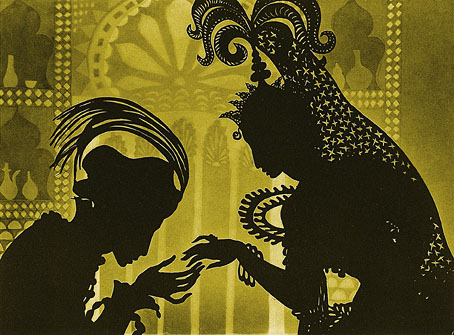
A still from The Adventures of Prince Achmed (1926), a feature-length animated film by Lotte Reiniger.

Hélice 39 is a speculative-fiction journal (in Spanish) whose current issue includes an article by Marcelo Sanchez: “What did Borges think of Lovecraft?”

• Among the new titles at Standard Ebooks, the home of free, high-quality, public-domain texts: The Maltese Falcon by Dashiell Hammett.

• Old music: Hydrophony For Dagon by Max Eastley & Michael Prime; The Adventures Of Prince Achmed by Morricone Youth.

Public Domain Review lists some of the writers whose works will enter the public domain this year.

• “Modern Japanese Printmakers celebrates vibrant mid-20th-century innovation“.

• At Nautilus: “Here’s what’s happening in the brain when you’re improvising.”

• At the BFI: Pamela Hutchinson selects 10 great films of 1926.

• New music: The Future Is Now by Pietro Zollo.

• At Dennis Cooper’s: Phil Solomon Day.

• 2026 is the Year of the Fire Horse.

Runaway Horses (“poetry written with a splash of blood”) (1985) by Philip Glass | Unicorns Were Horses (1996) by New Kingdom | Red Horse (2002) by Jack Rose

Omnibus: A Portrait of Raymond Chandler

chandler1.jpg

The full title of this BBC documentary is Down These Mean Streets a Man Must Go: A Portrait of Raymond Chandler. The film was broadcast in 1969, ten years after Chandler’s death, and has been on iPlayer recently to judge by the logo in the corner, but it’s not one I’d seen before. It would have been ideal viewing a couple of years ago during my attempt to watch all the films listed in The Big Noir Book. While working my way through the film list I was also reading some of Dashiell Hammett’s novels (The Maltese Falcon is excellent; The Dain Curse is terrible) and all of Raymond Chandler’s novels. Or almost all…I didn’t read Poodle Springs, his final book, left unfinished then completed by other hands. I enjoyed the Philip Marlowe novels so much I was tempted to start them all over again after I’d reached the end of Playback. Added to the enjoyment was the opportunity to see how much the books were mauled when they passed through the Hollywood mill. The BBC documentary opens with a clip from The Big Sleep which has always been the best of the adaptations (it can be difficult getting Humphrey Bogart out of your head when you’re reading Philip Marlowe’s narration) but even this one alters the story while downplaying the sexual content (homosexuality and pornography in the novel), something that all the films of the 40s do their best to avoid.

chandler2.jpg

A Portrait of Raymond Chandler was written by John Foster and Fred Burnley who present the writer via his own words in a sequence of dramatised interviews and enactments of scenes from the novels. There’s also a brief interview with JB Priestley, an intriguing thing in itself as I’d no idea that Priestley knew Chandler. The enactments don’t work very well—all the very small and very English rooms look nothing like Los Angeles architecture—but Edward Judd makes a decent attempt to apply his hard-boiled manner to the detective role without any Bogart impersonations. Judd appeared throughout the 60s in a succession of science-fiction films, and the film works best when he’s reading from the novels. Omnibus used him for the voiceovers a few years later in another portrait of a writer, Fear and Loathing in Gonzovision, a film about Hunter S. Thompson. The Chandler documentary appeared just ahead of the wave of renewed Hollywood interest in the Marlowe books that broke in the 1970s. Among the film clips there’s a short scene from the soon-to-be-released Marlowe, an updated adaptation of The Little Sister which isn’t one of the best Marlowe films but it has some nice interior shots of the Bradbury Building, and you get to see Bruce Lee demolish James Garner’s office with his feet and fists.

Previously on { feuilleton }
The Big Noir Book, or 300 films and counting…

The Big Noir Book, or 300 films and counting…

noir4.jpg

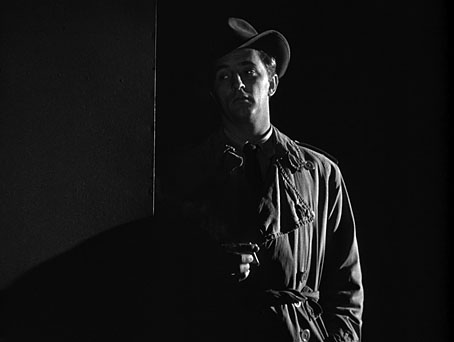
Robert Mitchum in Out of the Past (1947). Photography by Nicholas Musuraca.

“His voice was the elaborately casual voice of the tough guy in pictures. Pictures have made them all like that.” —Raymond Chandler, The Big Sleep

1: The Big Project
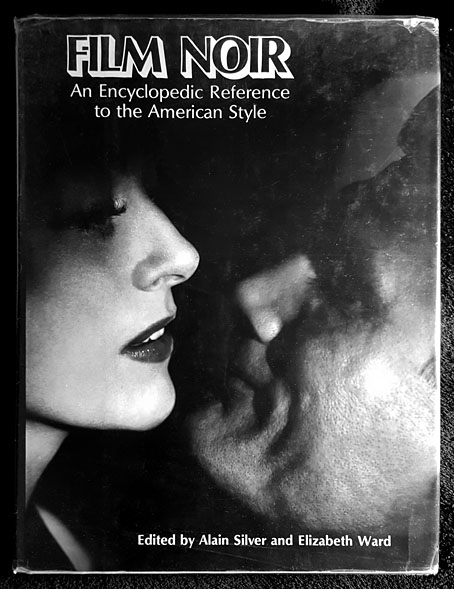
This is a big post about a big subject: the film noir of the 1940s and 1950s, also the “neo-noir” revival of the following decades. The project in question was my attempt to watch all the films listed in a comprehensive study of the form, Film Noir: An Encyclopedic Reference to the American Style, which was published in 1979. There are many books about film noir but this one, which I often refer to as The Big Noir Book, is hard to beat, a heavyweight guide in which editors Alain Silver and Elizabeth Ward construct a definition of the genre, chart its history, and compile indices for the key creators: actors, writers, directors and cinematographers. The core of the book is a detailed list of 300 films (see below), with production credits for each entry, a précis of each story and a short critical essay.

“Big” is an apposite term; many of these films involve big characters, big passions, big crimes and big predicaments, the latter invariably matters of life or death. The word “big” turns up in a number of noir titles, thanks no doubt to Raymond Chandler’s first Philip Marlowe novel, The Big Sleep. Howard Hawks’ adaptation of the Chandler book is one of the defining films of the genre, one that was very successful despite the plot being rendered incoherent by bowdlerisation and competing screenwriters. The studios spent the next few years offering picture-goers The Big Clock (1948), The Big Night (1951), The Big Heat (1953), The Big Combo (1955) and The Big Knife (1955). Also The Big Carnival (1951), an alternate “big” title for Ace in the Hole.
noir6.jpg

The big book. On the cover: Joan Crawford and Jack Palance in Sudden Fear (1952).

I can’t be the only person to have encountered Silver & Ward’s list then thought about trying to watch everything on it. But unless you’re an academic or a film reviewer this would have been difficult until very recently, if not impossible when many of the titles are obscure B-pictures that you wouldn’t usually find on TV. The idea first arose in the 1980s when a friend bought a copy of the noir book shortly after I’d been reading Robert P. Kolker’s Cinema of Loneliness, a substantial analysis of five American directors which, in its first edition, includes some discussion of the noir influence on the films of the 1970s. Three of the films that Kolker examines are examples of neo-noir that make the Silver & Ward list: The Long Goodbye, Taxi Driver and Night Moves. Kolker also acknowledges Stanley Kubrick’s grounding in the noir idiom. Kubrick’s Killer’s Kiss and The Killing are both on the list, while the film that followed these, Paths of Glory, features hardboiled dialogue by Jim Thompson, and a cast filled with noir actors. My growing interest in the genre happened to coincide with the arrival on British television of Channel 4, a TV station which spent its early years filling the afternoons and late evenings with re-runs of old films. Silver & Ward’s book had the effect of making me pay closer attention to films I might otherwise have ignored or only watched if there was nothing else on. The book also contextualised these films in a way that’s never required with other genres. This period was an introduction to noir as it really is, as opposed to the clichés which still surround the genre today.
noir3.jpg

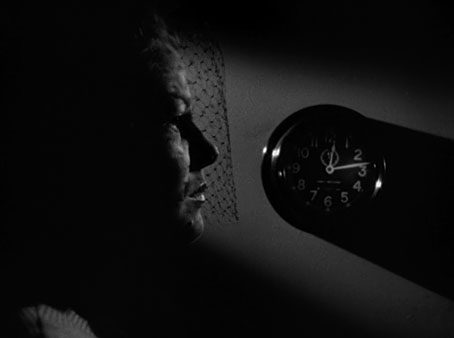
Claire Trevor in Raw Deal (1948). Photography by John Alton.

2: The Big Definition
Everyone knows the noir clichés: private eyes, duplicitous dames, lethal hoods, nightclub singers, sardonic voiceovers, light slanting through venetian blinds, the American metropolis, rain-washed nocturnal streets, big cars, big hats, trench coats, guns, cops, more cops, etc, etc.

Hollywood films of the 1940s do, of course, feature all of these things many times over, but the genre definition offered by Silver & Ward is as much about a pessimistic world-view as it is about the aesthetics of life in the American city. The “noir” quality that French critics of the 1950s identified in post-war American cinema was a visual attribute before it was anything else, a realisation that many of the recent Hollywood films were saturated with angled shadows and endless night. But the black (or, more properly, dark) character of these films is as much a set of circumstances as it is a visual style, one where the wheel of fate is often the most important element driving the story. The visual style can contribute a great deal to the storytelling and the overall mood but noir circumstance can exist, as it does in Leave Her to Heaven, in bright Technicolor sunlight miles away from any city. Fate may manifest as blind chance—mistaken identity, someone in the wrong place at the wrong time—or a deterministic inevitability that leads a protagonist to their destruction. A doom-laden finale was frequently imposed by Hollywood’s Production Code which insisted that crime can never be shown to pay, but the Code’s moral stricture is only obtrusive in the films about criminals. Many noir situations concern ordinary people whose attempts to live decent lives are thwarted by bad decisions or unfortunate circumstance. Despite Hollywood’s reputation for happy endings a negative resolution is a noir staple, as is an atmosphere of desperation, entrapment and paranoia; a Pyrrhic victory is often as good as it gets. Meanwhile, the shadow of war hangs over all the films of the 1940s. Many of the wartime pictures refer in passing to events in Europe, while the post-war films are often informed by the recent ordeals of returned veterans. There’s even a sub-class of noir involving veterans with damaged brains whose amnesias or violent mood swings lead them into trouble.

The noir stereotype of the private eye is well-founded when Silver & Ward mark the beginning of the genre with Humphrey Bogart’s appearance as Sam Spade in The Maltese Falcon. Many films about private eyes followed Bogart but not all of them are truly noir, while the genre itself is flexible enough to depart from the detective formula. Film noir doesn’t have to involve cities at all: a number of the films on Silver & Ward’s list are entirely set in small towns or remote rural areas. The genre doesn’t have to be set in the USA either: there are London noirs, South American noirs, Caribbean noirs, European noirs and Far East noirs. The films aren’t always black-and-white or filled with shadows: several of the noirs from the 1950s are in colour, as are all the ones from the 1970s.

Continue reading “The Big Noir Book, or 300 films and counting…”

Weekend links 645

macgeorge.jpg

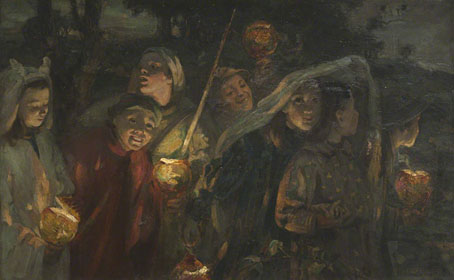
Halloween (no date) by William Stewart MacGeorge.

• Couldn’t Care Less: Cormac McCarthy in a 75-minute conversation (!) with David Krakauer at the Santa Fe Institute, filmed in 2017 and recently posted to YouTube. Not a literary discussion, this one is all about science, philosophy, mathematics, architecture and the operations of the unconscious mind. McCarthy’s essay about the origins of language, The Kekulé Problem, may be read here.

• At Wormwoodiana: Douglas A. Anderson finds a 1932 reprint of an HP Lovecraft story, The Music of Erich Zann, in London newspaper The Evening Standard. The story had appeared a few months prior to this in a Gollancz book, Modern Tales of Horror which reprinted a US collection edited by Dashiell Hammett. The newspaper printing includes an illustration by Philip Mendoza.

• New Hollywood Vs Mutant Cinema: The flipside of US cinema, 1960s–80s. Joe Banks talks to Kelly Roberts, Michael Grasso and Richard McKenna about their new book, We Are the Mutants: The Battle for Hollywood from Rosemary’s Baby to Lethal Weapon.

• At Bandcamp: Rich Aucoin explains the army of synths on his new quadruple album. The battalion includes the bespoke modular setup known as T.O.N.T.O., a rig that few people get to play with.

• New/old music: Malebox, an EP of Patrick Cowley rarities coming soon from Dark Entries.

• Mix of the week: Samhain Séance 11: endleofon by The Ephemeral Man.

• The surreal photographs of Ralph Eugene Meatyard.

• “NASA team begins study of UFOs”.

Ghost Rider (1969) by Musical Doctors | Ghost Rider (1970) by The Crystalites | Ghost Rider (1977) by Suicide