
Sly Stone’s Higher Power
New interview with the lost groover.
Chiaroscuro
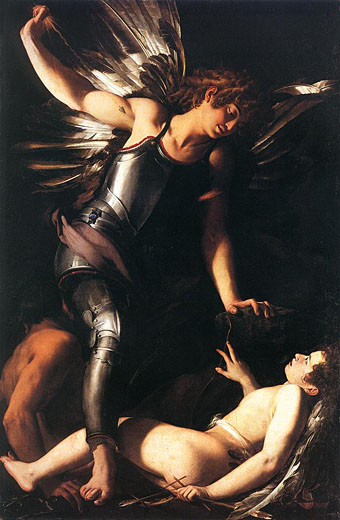
Heavenly Love and Earthly Love by Giovanni Baglione (1602–1603).
Chiaroscuro\, Chia`ro*scu”ro\, Chiaro-oscuro\, Chi*a”ro-os*cu”ro\, n. [It., clear dark.] (a) The arrangement of light and dark parts in a work of art, such as a drawing or painting, whether in monochrome or in colour. (b) The art or practice of so arranging the light and dark parts as to produce a harmonious effect.
Following from the earlier post about shadows in art, some favourite examples by masters of chiaroscuro. Another artist not represented here will be the subject of a post of his own in the next couple of days. The Dutch painter Godfried Schalcken (below) was the subject of the horror tale Schalcken the Painter by Joseph Sheridan Le Fanu, a story memorably filmed by Leslie Megahey for BBC television in 1979. Horror and the chiaroscuro effect belong together, as Fuseli’s Nightmare demonstrates, and many of Schalcken’s paintings seem even more curious and sinister after you’ve read Le Fanu’s story.
Update: John Klima points us to Hal Duncan‘s excellent story, The Chiaroscurist, which you can read at Electric Velocipede.
Smoke
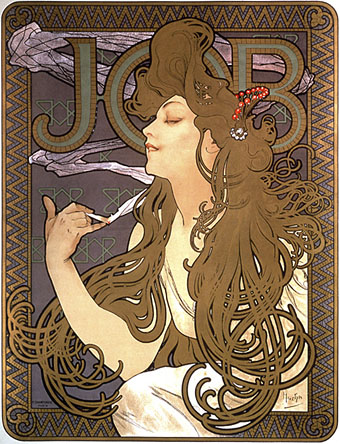
Advertising poster for Job cigarette papers by Alphonse Mucha (1898).
The law forbidding smoking in public places finally came into effect in England on Sunday, something that the nation’s smokers are still coming to terms with. I’ve never been a smoker but have always been easy-going about the activity, having had smoking parents and been around smokers for years. That said, it’ll be nice to go out now and not return home smelling like an ashtray.
To mark the passing of a nicotine-stained era, here’s a few of the many representations of smoking in the art world. Until I started looking for pictures today I hadn’t realised how many paintings there are of people (and dogs!) having smoke blown in their faces, like this one and this one.
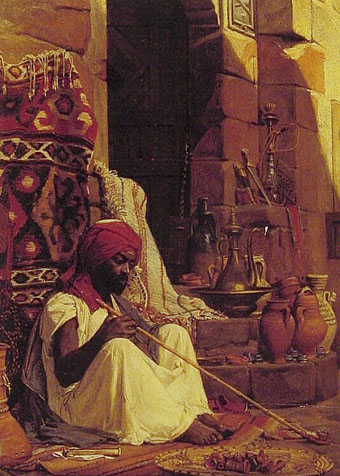
The Opium Smoker by Jean-Jules-Antoine Lecomte du Noüy.

A Voluptuous Smoke by Charles Edouard Edmond Delort.
Previously on { feuilleton }
• Perfume: the art of scent
• German opium smokers, 1900
Shadows at Compton Verney
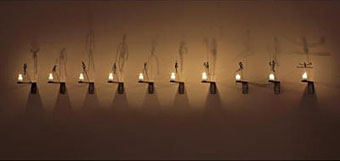
The Candles by Christian Boltanski.
The Shadow is an exhibition at Compton Verney from Saturday 30 June–Sunday 9 September, 2007. I’d been considering a post about shadows in art for a while so this has forced my hand. There’ll be some follow-ups in the coming week, work permitting. I’m busy with a big new piece of Lovecraft-related art at the moment, among other things. More about that later.
Shadows carry with them a range of associations. Whilst the shadow exists as a scientific phenomenon, its presence, from the Greek philosopher Plato through to JM Barrie’s children’s story Peter Pan, reflects the values and beliefs of society as well as an expression of psychological states.
The Shadow is the first extensive group show of its kind to look at an ancient theme that continues to emerge particularly in the work of contemporary artists. The exhibition will provide the viewer with a series of atmospheric encounters where sometimes the source is revealed but frequently the shadow exists independently, often revealing a presence outside the space represented.
The exhibition includes painting, sculpture and video by international contemporary artists such as Doug Aitken, Laurie Anderson, Christian Boltanski, Ceal Floyer, Mona Hatoum, Gary Hill, Tracey Moffatt, Anri Sala, Fiona Tan, Andy Warhol, William Wegman and Francesca Woodman.
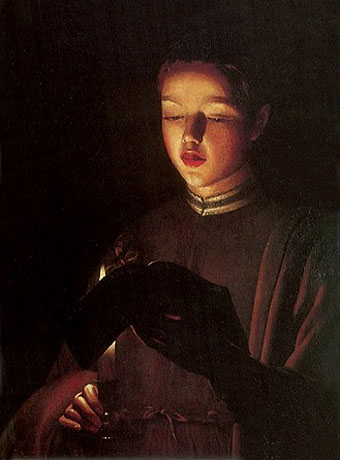
The Choirboy (A Young Singer) by Georges de La Tour (1640s).
To compliment The Shadow exhibition, Compton Verney will present a number of key candlelight works by the French artist Georges de La Tour (1593–1652).
La Tour was born in the Duchy of Lorraine and influenced by the work of Caravaggio. His works have been attributed to a number of artists and it is only since 1915 that a group of his signed paintings were linked and attributed conclusively to La Tour.
It was not until 1972 when all his surviving works were brought together in a major retrospective exhibition at The Orangerie, Paris that he came to the attention of a wider public. This exhibition will represent a rare opportunity for British audiences to view La Tour’s paintings and will focus on a number of powerful works, mainly from La Tour’s late period, which concentrate on the effect of light on the human figure.
London Pride
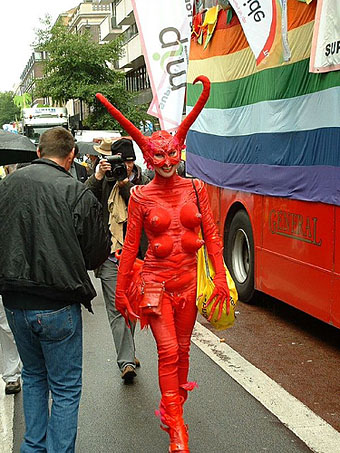
One of the exotic creatures at today’s London Pride march. More pictures at this Flickr pool. Marchers braved wet weather and renewed terrorist threats after two unexploded car bombs were found on Friday. (And where that matter is concerned, The Register has a rebuke to the inevitable hysterics.)
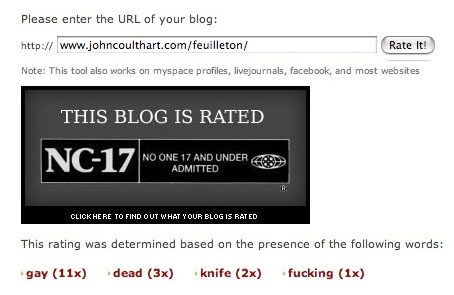
On a related note, this site has a feature that allows you to see how your blog (or page) would be rated by the MPAA. As Queerty notes, overuse of the word “gay” pushes up the supposed offensiveness quotient, something which results in this page receiving an NC-17 rating when it scans the past month of postings. Yes, it’s only a bit of web silliness but when the real Motion Picture Ass. of America has been shown to treat gay themes or stories with greater restriction than straight ones then it’s probably more accurate than its creators suspect.
Update: also in The Register, an ex-armed forces bomb-disposal operator explains why the London “terror clowns” shouldn’t be dignified with the hysteria they’ve been receiving.