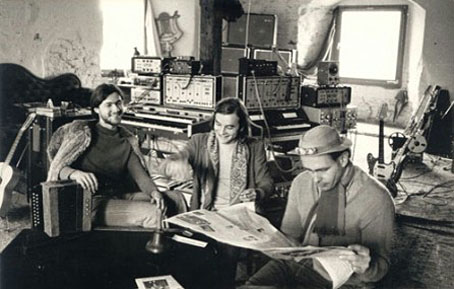
Harmonia somewhere in the 1970s: Michael Rother, Dieter Moebius, Hans-Joachim Roedelius.
Continuing the occasional { feuilleton } series exploring the byways of musical culture, this month it’s the turn of German group Cluster, prompted by their current US tour. News of their re-emergence sent me back to the albums and I’ve been listening to little else for the past week or two.
 Mark Pilkington has very conveniently saved me the trouble of summing up the wandering history of Dieter Moebius and Hans-Joachim Roedelius in their various incarnations with his introductory piece, Cosmic Outriders: the music of Cluster & Harmonia. Unlike many of their Krautrock contemporaries, Moebius and Roedelius have remained very active, Roedelius particularly has an extensive solo discography. I’ve never been very taken with their work since the early Eighties, however. I have an inordinate fondness for the analogue keyboards which contribute to their early sound; as the Eighties progressed they took to using digital keyboards and their music lost much of its earlier charm as a result.
The Cluster discography is very long and confused, encompassing Kluster (pre-Cluster line-up with Conrad Schnitzler), Cluster, Harmonia (Cluster with Michael Rother from Neu!), Cluster with Brian Eno, then Moebius and Roedelius’s numerous solo works and collaborations with other artists. As a result, a guide such as this is useful for the curious. So here we go with another blog list…
Cluster—Cluster 71 (1971)
A timeless racket. Three long noisy slabs of synth distortion that make the first two noisy Kraftwerk albums seem positively melodic. This could easily be passed off as an unreleased Throbbing Gristle or Cabaret Voltaire album.
Cluster—Cluster II (1972)
The second album continues the granular challenge but lets some light and music into the mix.
Harmonia—Deluxe (1975)
I prefer the second Harmonia album to the first, and prefer both to Cluster’s third opus, Zuckerzeit, recorded around the same time as this. Michael Rother’s involvement in Harmonia pushes the sound very close to Neu! in places, especially the more melodic strains of Neu! 75.
Harmonia—Harmonia 76: Tracks & Traces (1976)
Albums of studio outtakes are usually for die-hard listeners only but this one is surprisingly good with an outstanding long atmospheric piece, Sometimes In Autumn. Brian Eno was hanging out with Cluster by this point and he contributes a vocal on Luneberg Heath.
Cluster—Sowiesoso (1976)
The most melodic and relaxed of all the Cluster albums and the one which birthed a host of inferior copyists on the Sky label.
Cluster & Eno (1977)
Recorded at around the same time as By This River on Eno’s Before And After Science. Holger Czukay from Can is a guest on the Eno albums.
Eno, Moebius & Roedelius—After The Heat (1978)
Of the two Cluster & Eno albums this is probably the best and ends with three Eno songs which turned out to be his last vocal works until Nerve Net in 1992. Note that the CD reissue has a different (and in my view, inferior) track ordering to the vinyl original.
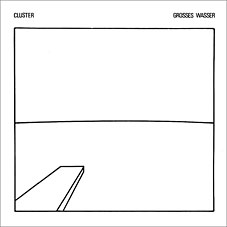
Cluster—Grosses Wasser (1979)
Produced by ex-Tangerine Dream member Peter Baumann and recorded at his studio which gave the Cluster guys the opportunity to use his superior synth equipment. As a result a couple of the tracks here are very similar to Baumann’s solo work.
Moebius & Plank—Rastakraut Pasta (1980)
This album and its follow-up should be added to the list of works which influenced Eno & Byrne’s My Life in the Bush of Ghosts. The opening track News, features sampled radio voices (as per later Eno & Byrne) mixed with a plodding rhythm that includes a recurrent synth note that’s the spit of similar sounds used on My Life.
Moebius & Plank—Material (1981)
Genius producer Conny Plank brought out the best in many of the artists he worked with and these two collaborations with Moebius are a great example of that. He had a similar effect with Roedelius on an early solo album, Durch die Wüste, moving Roedelius out of his ambient keyboards comfort zone. The tone on Material is more strident and uptempo than Rastakraut Pasta, especially on Tollkühn which is like some mad techno synth run ten years too early.
Cluster and co. on YouTube
• Cluster 71
• Harmonia—Deluxe (Immer Wieder)
• Cluster—Sowiesoso
• Cluster & Eno—Für Luise
• Brian Eno—By This River
Previously on { feuilleton }
• The Avant Garde Project
• White Noise: Electric Storms, Radiophonics and the Delian Mode
• Chrome: Perfumed Metal
• Metabolist: Goatmanauts, Drömm-heads and the Zuehl Axis
• The music of Igor Wakhévitch
• My Life in the Bush of Ghosts